Axios San Diego

January 29, 2026

Good morning! Today, we're sharing a special edition from our colleague Carly Mallenbaum on the research behind music's therapeutic effects.
- Scientists say those feel-good tunes might be working harder than we realize.
☀️ Today's weather: Coast — Sunny, high of 69; Inland — Sunny, high of 78
🎧 Sounds like: "Cecilia" by Simon & Garfunkel. Catch a concert-style theater show featuring the folk-rock duo's hits at Balboa Theatre this weekend.
🎂 Happy birthday to our Axios San Diego member Erin Otolski!
Today's newsletter is 978 words — a 3.5-minute read.
1 big thing: Music, our food for the brain
Scientists are learning how music can do more than lift our mood, from easing anxiety to helping experimental drugs reach the brain.
Why it matters: Music is a low-risk, widely accessible tool that could help more than we realize.
State of play: Music has the power to stimulate the body's reward system, similar to the way that food, and social connection do, according to Daniel Bowling, an assistant professor in Stanford School of Medicine's department of psychiatry and behavioral sciences.
- That finding is "really important for mental health," because it means music can help activate brain regions and feel-good chemicals when someone is anxious or depressed, he says.
What we're hearing: Beyond the physical reaction of hearing music, actively listening and songwriting could offer anxiety relief similar to cognitive behavioral therapy — at least that's what research music therapist Sean McNally has been seeing in an ongoing study at Memorial Sloan Kettering in New York.
- In that study, cancer survivors get one-hour music therapy Zoom sessions that often involve listening to music and discussing the emotions it evokes, and then songwriting based on how the the patient is feeling.
- Music therapy is "not about distraction," but about "giving people agency over their emotion," McNally says. "When a patient hears their own story sung back to them, there's something that shifts." It's often a powerful moment of joy and possibly tears, he says.
The latest: Spiritune is one of a few new music therapy apps leveraging AI in curating scientifically-informed playlists to help users feel more calm, focused or energetic.
- The app has developed specific "sonic recipes" (that's an internal company term) with 20 or so specific acoustic guidelines to help users feel a certain way, says Bowling, the app's scientific co-founder and a musician.
What's next: Lo-fi sounds could make help medicines reach the brain.
2. How colors of noise could help sleep
From white noise machines to pink noise playlists and brown noise TikToks, sleep sounds could be particularly useful right now as we deal with shorter days.
Why it matters: Scientists say these hums can mask environmental distractions and even sync brain activity tied to relaxation — though not all "colors" work the same way for everyone.
Here's how the sounds differ:
- White noise can sound like constant static. It's all the sound frequencies people can hear, all together.
- Pink noise can sound like a steady waterfall. It's like white noise, except with more prominent lower frequencies.
- Brown noise can sound like ocean waves crashing. It's deeper than both pink and white noise.
State of play: Research shows that white noise could improve sleep quality, particularly for hospital patients, babies and people with insomnia, says Jennifer Martin, a spokesperson for the American Academy of Sleep Medicine. It could also help with focus.
- Pink noise could reduce brain wave activity for deeper sleep. We don't have much data on brown noise.
- Yes, but: White noise could make tinnitus worse, and shouldn't be played too loudly.
TV sounds don't have the same effect.
- "The biggest misconception, by far, is that people sleep better with their TV on," Martin says. "Once you fall asleep, the variation in sound becomes problematic."
3. "Baby Beluga," and beyond
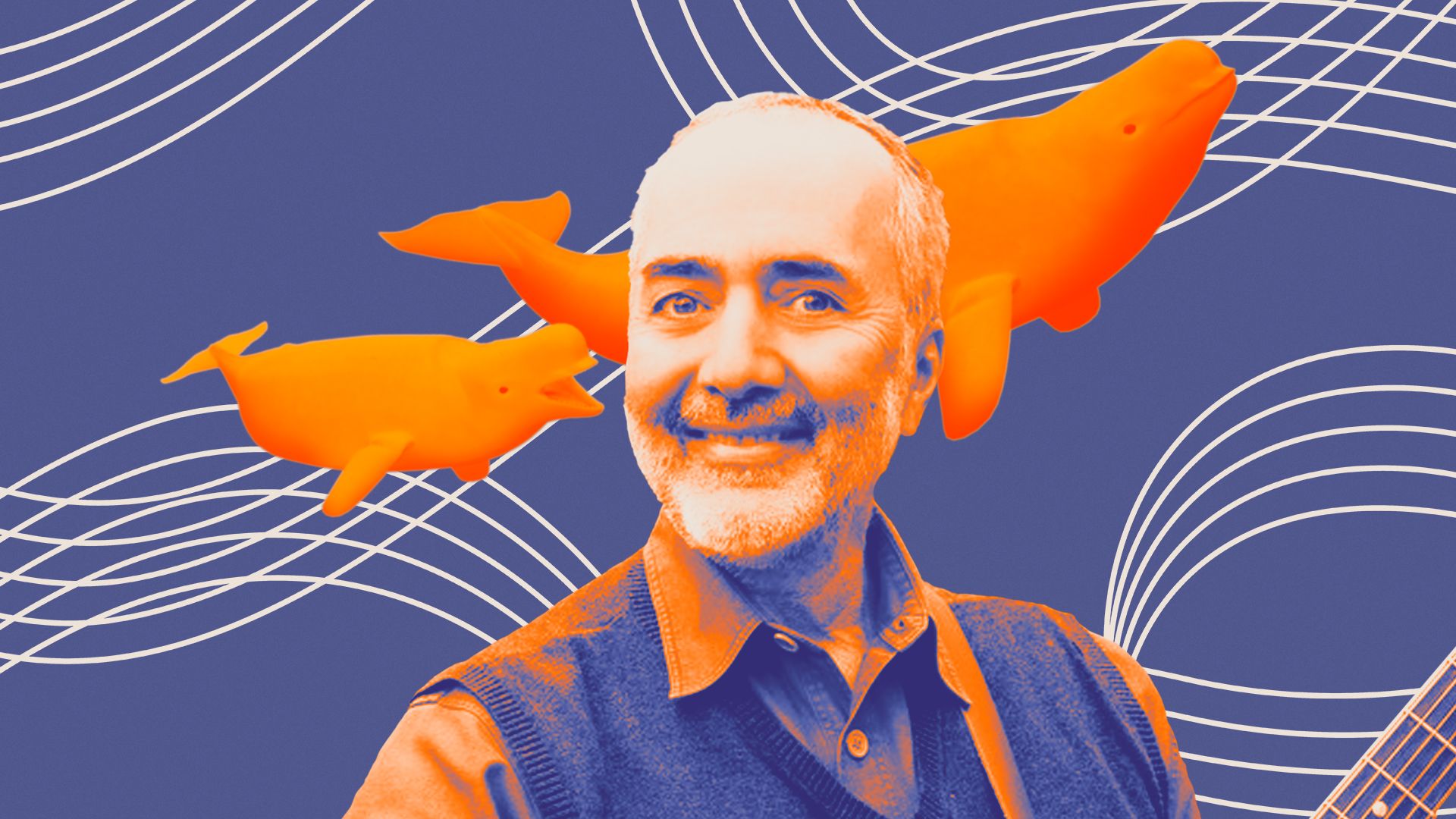
A parent's voice is one of the first soothing sounds babies hear. After that often comes Raffi, the children's folk singer who's still recording music after almost 50 years.
What he's saying: "It is the honor of my lifetime to continue to be a friend to millions of families," says Raffi Cavoukian, the Armenian-Canadian musician who's gone by just "Raffi" since he started making children's music.
- Folk singing had been a struggle for Raffi early on, he says, until he released an album for kids in 1976. "Singable Songs for the Very Young" took off, and helped him see music as core to children's social and emotional learning.
Zoom in: "Baby Beluga" remains his signature song, with more than 105 million Spotify streams.
- Even though it's not a bedtime lullaby — it features horns and whale sounds! — "parents will say at night, that's the song that will soothe my child," Raffi says.
- He has theories as to why. "There's something comforting about the line 'is the water warm/ is your mama home with you so happy,'" he tells Axios in his familiar, soulful baritone. Plus, the "almost Dixieland jazz horn thing going on" in the last verse adds some "whimsy" to the recording.
The latest: Now 77 and an activist passionate about children's well-being, environmental causes and politics, Raffi has a new single: "ABC Democracy."
4. Our kids' favorite songs
Doo-doo doo-doo doo-doo you believe that a few years after it became the first YouTube video to hit 10 billion views, "Baby Shark" remains the most popular kids' song in California? That's what Spotify data shows.
Between the lines: Spotify shared the top-streamed children's songs from Jan. 1 to Nov. 10 in 2025, using a database that tracks song types and when songs appear on a playlist with other children's tracks.
Zoom out: Not all of California's top kids' songs are sonic sugar rushes.
- Imogen Heap's "Happy Song" is a mellow tune engineered to make babies smile, and classics like "You Are My Sunshine" work well as wind-down music.
- Meanwhile, "Pretty Little Baby" sounds vintage, because it is: Recorded more than 60 years ago by Connie Francis, it went viral on TikTok this year.
🎶 Carly is playing a soothing steel tongue drum with her toddler.
Thanks to my editor Ashley May.
Sign up for Axios San Diego
