
Axios San Antonio

March 29, 2026

🛬 Sunday has landed — surprised to hear from us?
Today's weather: Partly sunny with a high in the mid-80s.
Programming note: San Antonio is rethinking how people, goods and even medical care move — from air taxis and mobile surgical units to buses.
- We're diving into the future of transportation in this special edition.
🔍 Find these stories on our Local Brief page.
Today's newsletter is 1,011 words — a 4-minute read.
1 big thing: How S.A. could shape air taxi future

Port San Antonio is positioning itself as a testing ground for emerging air taxi technology as Texas joins a federal pilot program.
Why it matters: San Antonio could play a role in a national effort to develop advanced air mobility (AAM), which includes a system of low-flying electric aircraft moving people and cargo.
Catch up quick: The Texas Department of Transportation was selected this month for one of eight projects under the Federal Aviation Administration's Advanced Air Mobility Integration Pilot Program.
- The Texas plan calls for regional routes linking Dallas, Austin and San Antonio, with Houston to follow.
- TxDOT tells Axios that the Alamo City is expected to play a key role in the network, potentially supporting medical, cargo and passenger routes, though specific operations are still being worked out with the FAA.

State of play: Work is already underway. Land is being cleared at Port San Antonio for a future vertiport — where electric aircraft can take off, land and recharge.
- The Port's focus is less on the aircraft itself and more on how to manage that airspace at scale, Port San Antonio president and CEO Jim Perschbach tells Axios.
- "It's more like navigating a parking lot than a highway," Perschbach says of low-altitude flying.
- Austin-based SkyGrid is working with the Port on tools to help operators understand conditions and avoid hazards, mapping routes that use sensors, weather data and AI.
Between the lines: Perschbach argues the bigger shift is moving away from a luxury "flying car" model toward something closer to an extension of public transportation.
Reality check: VIA Metropolitan Transit tells Axios in a statement that it remains focused on expanding bus and rapid transit service but is "encouraged by emerging technologies" that could strengthen connectivity.
What's next: Test flights could begin relatively soon, with early uses in health care and cargo, Perschbach says.
- Routine passenger service — especially for everyday commuters — faces a longer runway.
2. Q&A: Port S.A. CEO on air taxis and jobs

We spoke with Perschbach about what San Antonio's role as an air taxi testbed could mean for jobs, safety and the future of transportation.
This conversation has been edited for length and clarity.
What kinds of jobs could this create in San Antonio?
"AAM builds on industries San Antonio already excels in. As the sector grows, it will create new jobs in aircraft maintenance, electric propulsion systems, software development, AI and data analytics, cybersecurity, airspace management and advanced manufacturing."
What protections are in place if something goes wrong?
"[Pilot programs] are designed specifically to answer safety and operational questions before any passenger service begins. Early phases will focus on testing aircraft, routes and airspace integration under controlled conditions and under FAA oversight."
What's the biggest misconception people have when they hear "air taxis"?
"One of the biggest misconceptions is that air taxis will simply be a luxury service for wealthy people to get to Spurs games more quickly. And that will likely be part of the market. But these aircraft will also be used for emergency medical response, disaster support, moving goods more efficiently and connecting rural and urban areas."
3. Local company builds in-flight hospitals
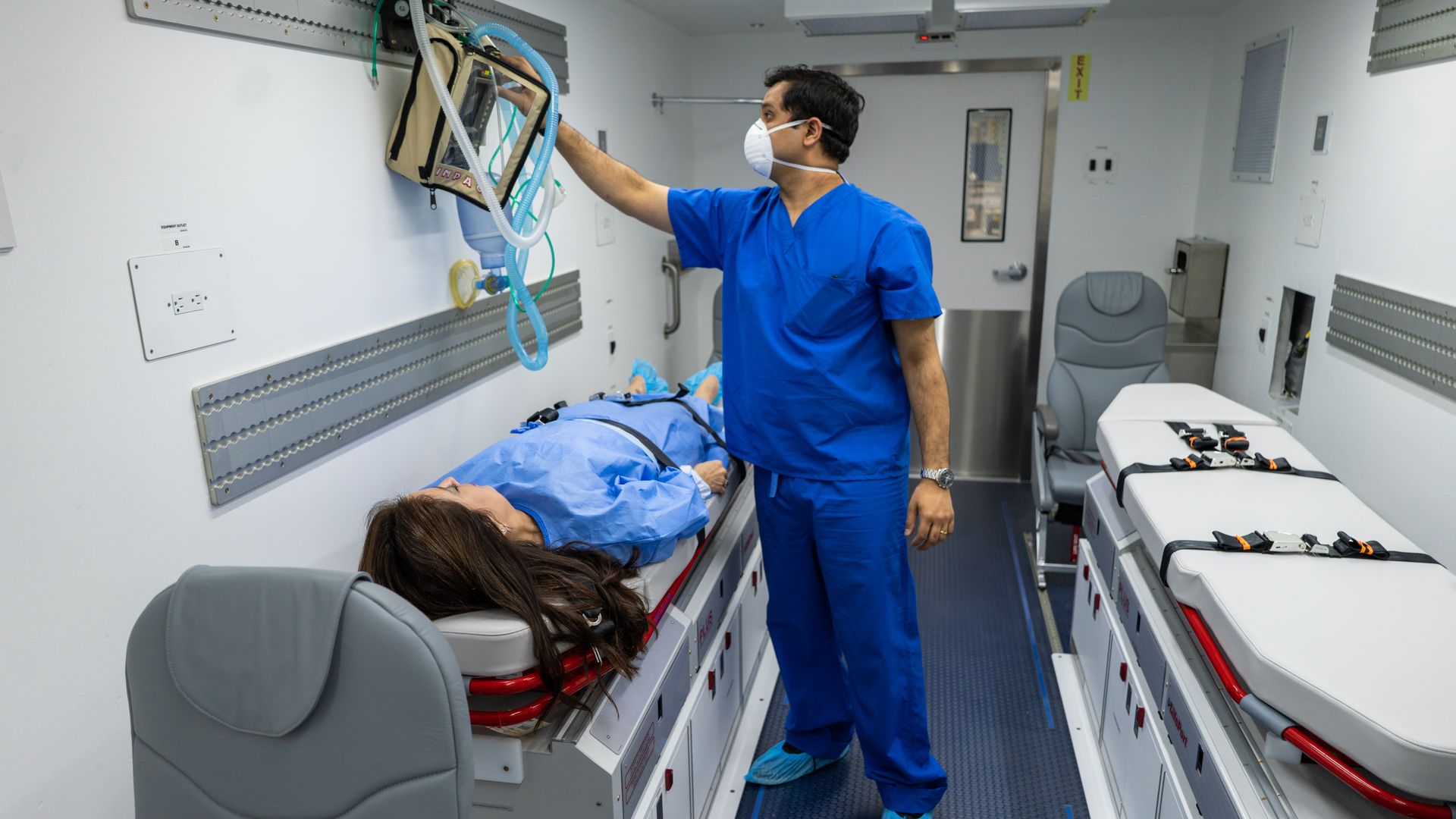
A Port San Antonio company is manufacturing medical units that can be attached to planes to treat patients in the air.
Why it matters: That's a major shift from when someone had to be stabilized on the ground before they could be transported, Knight Aerospace CEO Bianca Rhodes tells Axios.
How it works: The unit rolls onto an aircraft and locks in, allowing the rooms to be added to most cargo, military and commercial planes.
- Some units can even be used as operating rooms for surgeries.
Zoom in: The units can help with disaster recovery. If someone is injured in a hurricane and has to be moved to safety and treatment in another city, the air medical units can take them.
- Knight's customers for the units are often foreign militaries. European countries are interested because of the Russia-Ukraine war.
Flashback: Knight began designing the medical units around 2015 during the Ebola virus outbreak. It delivered the first units in 2020 during the COVID-19 pandemic.
What they're saying: "We're not just hanging medical equipment on the walls," Rhodes says. "All the connections are exactly like you would find in a hospital."
4. 🚏 What our bus stop spacing means
San Antonio's bus stops tend to be more than two football fields apart, per data compiled by the Works in Progress transit blog.
Why it matters: Bunching bus stops can make public transit slower, less reliable and more expensive to operate, per the blog.
- "This makes buses less competitive with other modes, reducing ridership," transit planner and analysis author Nithin Vejendla writes.
By the numbers: Bus stops in VIA's network are a median of 843 feet apart.
- We don't break the top 10 for the shortest spaces between bus stops — and that's a good thing.
Zoom out: Philadelphia has the country's closest-together bus stops, at a median 564 feet apart.
- Las Vegas bus stops are the most spread out among U.S. cities, with a median spacing of 1,394 feet.
Zoom in: VIA Metropolitan Transit is betting that two planned bus rapid transit routes — the Green and Silver lines — can move people more quickly and attract new riders.
- The buses will run in a dedicated lane with greater frequency.
What's next: Construction is underway on the rapid Green Line along San Pedro Avenue, which could open in 2027 or 2028.
Thanks to our editors Astrid Galván and Bob Gee.
👀 Madalyn is curious if she will be able to see AAM testing from her house, which is close to Port San Antonio.
😆 Megan is wondering if some parts of life shown in "The Jetsons" aren't that far off, and is hopeful those three-hour workdays will follow air taxis.
Sign up for Axios San Antonio