Axios Pro Rata

August 10, 2026

Top of the Morning

If at first you don't succeed, someone may force you to try again.
- That's the situation for Verisk, which on Friday was told by Delaware Chancery Court that it must proceed with a $2.35 billion merger that it had tried to terminate.
- The ruling relied on specific performance, a rarely enforced anvil that hangs over most corporate acquirers.
Catch up quick: Verisk is an insurance data analytics firm with around a $25 billion market cap. Last summer it agreed to buy AccuLynx, a privately held provider of CRM software for roofing contractors.
- In October, FTC antitrust regulators requested additional information. The delay pushed regulatory approval past the agreed-upon date, prompting Verisk in December to terminate the agreement.
- AccuLynx argued the termination was invalid, causing Verisk in January to seek court approval.
Behind the scenes: Shortly after Verisk agreed to buy AccuLynx, it ended separate negotiations for an "enhanced" integration with AccuLynx rival ServiceTitan — instead offering a standard integration.
- ServiceTitan told the FTC about the aborted agreement, which caused the FTC to develop a "market reset" theory of anti-competitive behavior.
- Per the ruling: "The FTC posited that after the merger, Verisk might develop a new, more sophisticated pricing integration for AccuLynx that it would not offer to AccuLynx's competitors, thereby foreclosing AccuLynx competitors from effectively competing in the market for roofer business management software."
- When the FTC asked Verisk if it had terminated integration agreements with AccuLynx rivals, Verisk — still unaware of ServiceTitan's message to the FTC — said it had not.
- Verisk soon would acknowledge the ServiceTitan talks and run a document search, but by then the FTC was either annoyed or mistrustful (or both) and decided it would require full compliance.
- Thus, the second information request that caused Verisk to cancel the entire merger.
Fast forward: The court basically ruled that Verisk brought this situation upon itself.
- It didn't force the merger to close, but rather said that Verisk must use "commercially reasonable efforts" to obtain regulatory approval. Plus that AccuLynx is entitled to damages for direct costs with interest.
Zoom out: It's uncommon for Delaware Chancery Court to order specific performance — in which parties are required to move forward on a deal, rather than just pay to get out of it — but it's not unprecedented.
- The most recent example seems to have come last year with 3D printing companies Nano Dimension and Desktop Metal, while the largest was likely with chemicals companies Hexion and Huntsman in 2008.
- Specific performance also is what Twitter demanded of Elon Musk, who chose to capitulate rather than wait for a ruling.
State of play: Verisk shared opened down 5.7% today. In a statement, it tells Axios: "While we appreciate the court's efforts to deliver a decision quickly, we respectfully disagree with the court's ruling and are evaluating our options."
- AccuLynx owner Rich Spanton didn't return a request for comment.
The bottom line: Some deals can come back from the dead.
The BFD
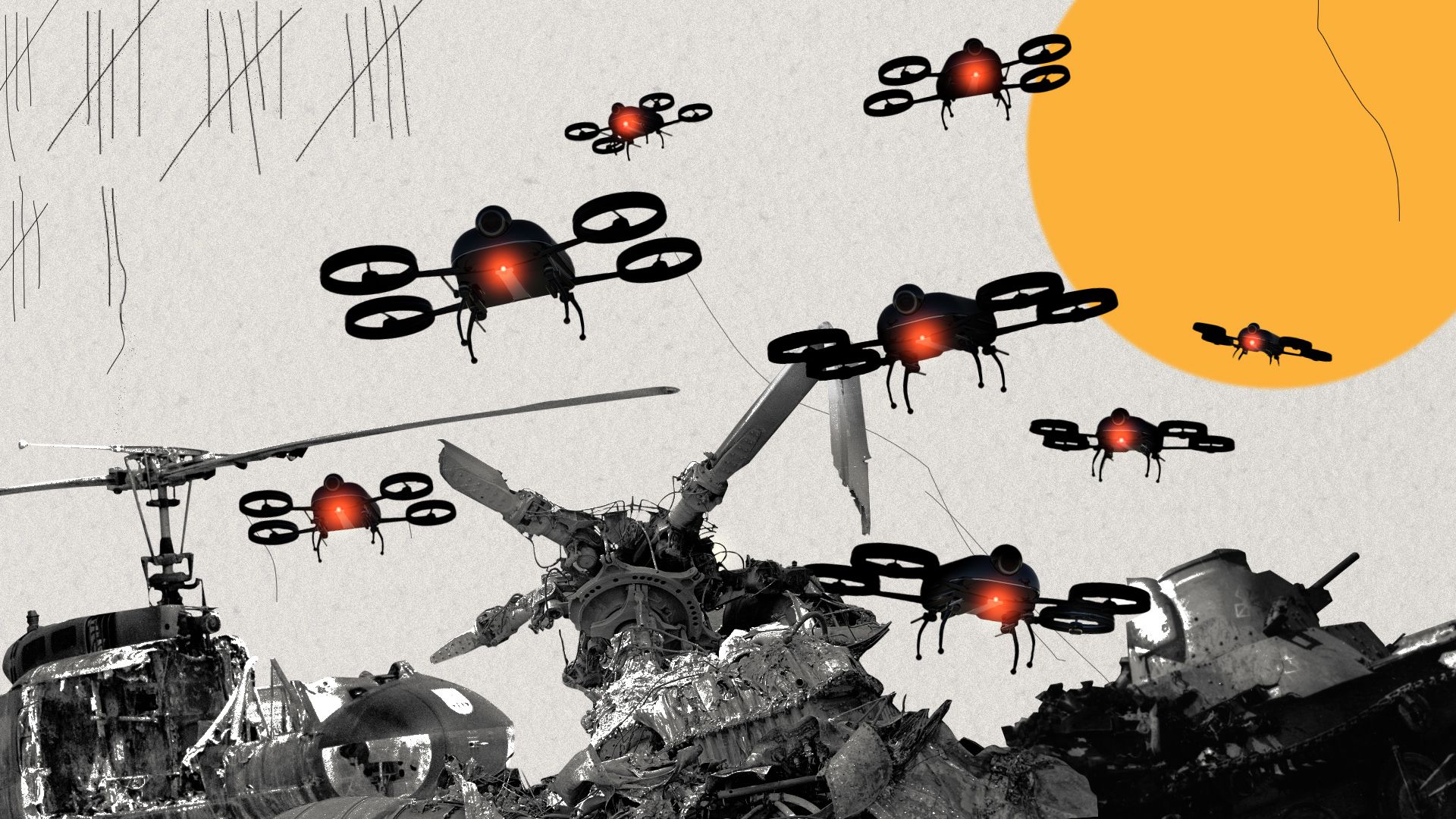
Cambridge Aerospace, a British air defense tech startup, raised $300 million in Series C funding at a $3.4 billion post-money valuation led by DFJ Growth.
Why it's the BFD: Cheap drones have redefined war, as evidenced in both Ukraine and Iran, but legacy interceptor technology remains very expensive.
- Cambridge, which already has several U.K. government contracts, is developing low-cost interceptor systems for both drones and cruise missiles. It's also building a rocket-powered interceptor system for ballistic missiles and a radar system.
Other investors in the round included Lux Capital, Accel, Lakestar, Never Lift, Ora Global, and Elad Gil.
The bottom line: The high cost of legacy interceptors is justified by their effectiveness — something the burgeoning batch of air defense startups still needs to prove.
Venture Capital Deals
• Erebor, a stablecoin banking startup co-founded by Palmer Luckey, is in talks to raise around $1.5b in new funding, per the FT. Backers would include Lux Capital, Human Capital, Valor Equity Partners, a16z, and SV Angel. axios.link/4qbFInZ
• Edgify, a London-based edge AI infrastructure startup focused on retail store loss prevention, raised $9m in Series A funding from Rank Ventures and Mangrove Capital Partners. axios.link/4z9F3HK
• Visoid, an Oslo, Norway-based AI visualization platform for architects, raised $2.5m. Skyfall Ventures led, joined by StartupLab, OBOS, Antler, Farvatn, and byFounders Angel Collective. axios.link/4xBwDHH
Private Equity Deals
• I Squared Capital agreed to acquire Australian outdoor advertising firm oOh!media (ASX: OML), beating out Bain Capital and Pacific Equity Partners. axios.link/45AZQqh
• Safe Harbor Marinas, a Blackstone portfolio company, is nearing a $1.5b deal to buy recreational boat and yacht retailer MarineMax (NYSE: HZO), per Reuters. axios.link/4xrCu1T
• VSS Capital Partners invested in Cordoba, an LA-based provider of engineering, construction and program management services. axios.link/45VAdAg
🚑 Wise Equity acquired a 60% stake in E-pharma Trento, an Italian CDMO. axios.link/4z9bki5
Public Offerings
No major IPOs are expected this week on U.S. exchanges.
• Danneskjold and Galt Acquisition, a fintech and AI SPAC led by Eric Henrickson (Solomon & Associates), filed for a $150m IPO. axios.link/4xtpGIr
• Formlabs, a Somerville, Mass.-based 3D printing company valued at $2b in a 2021 round led by SoftBank, is in early IPO talks, per Bloomberg. axios.link/45ODHEJ
• Lyntris, a defense-tech rollup backed by Trive Capital, set IPO terms to 24m shares at $19-$22. It would have a $2.4b market cap, were it to price in the middle, and plans to list on the NYSE (LYNX). axios.link/4z8e7Ip
• OceanLight Acquisition, a SPAC led by Ping Zhang (Green Leaf Air Freight), raised $100m in its IPO. axios.link/3TJL1yR
• Southport Acquisition II, a SPAC led by Jeb Spencer (TVC Capital), filed for a $200m IPO. axios.link/4ctTi06
• Switch, a Las Vegas data center operator majority-owned by DigitalBridge, filed confidentially for a U.S. IPO, per Bloomberg. axios.link/4hVzkPt
Liquidity Events
⚽ Fenway Sports Group, whose backers include RedBird Capital Partners, is expected to sell around a one-third stake in Liverpool FC to a consortium that includes Amit Bhatia, Jeff Bezos, and Eduardo Saverin, per Sky News. axios.link/4bGGFyz
• PSP Investments is weighing a sale of its India toll roads, which could fetch $1.5b, per Bloomberg. axios.link/4bD4N58
More M&A
• Archer Aviation (NYSE: ACHR) agreed to acquire Wisk Aero, SkyGrid and Insitu from Boeing (NYSE: BA). axios.link/4bEuwtY
• Ashland (NYSE: ASH), a U.S. chemicals firm with a $3.5b market cap, is exploring a sale, per Bloomberg. axios.link/45h0bhC
⚡ Eneos (Tokyo: 5020) acquired Houston-based petrochemicals firm TPC Group for $1.28b (including debt). axios.link/4g06qLI
• Frasers Group (LSE: FRAS) is the frontrunner to buy British department store chain Harvey Nichols, per Sky News. axios.link/3UlRmk6
• GameStop (NYSE: GME) "is considering withdrawing" its $56b takeover bid for eBay (Nasdaq: EBAYT), instead proposing a strategic partnership that would include a board seat, per Bloomberg. axios.link/3RVsSO3
• Harworth Group (LSE: HWG), a U.K.-based property regeneration company, rejected a £583m takeover bid from its largest shareholder, Peel Holdings. axios.link/3TQ1b9Q
• OpenAI acquired presentation startup NextSlide. axios.link/4xz5ViU
• Tabcorp (ASX: TAH) agreed to buy Australian betting tech provider BetMakers (ASX: BET) for A$267m. axios.link/4hpJrfg
Fundraising
🚑 Friale, a health tech VC firm co-led by Bryan Frist, is targeting $75m for a new fund, per Axios Pro. axios.link/4qcludW
Final Numbers


We still don't know if Big Tech's AI infrastructure bets are paying off, Axios' Matt Phillips writes:
- "Amazon, Alphabet, Microsoft and Meta don't break out sales and profits directly attributable to AI data center investment. Instead, results are embedded into parts of their respective cloud computing units.
- "Operating profit margins from those cloud businesses could offer hints about data center profitability. It's difficult to say, however, because these cloud units also contain other highly profitable, non-AI computing businesses."
📬 Thanks for reading Axios Pro Rata, and to copy editor Bryan McBournie! Please ask your friends, colleagues, and judges to sign up.
Sign up for Axios Pro Rata