Axios Portland

September 30, 2026

It's Wednesday. Hope the middle of the week isn't too mid for you.
β Today's weather: Partly cloudy. High 70, low 53.
π Sounds like: "Nicole Kidman" by AdΓ©la, who plays the Crystal Ballroom tonight.
Situational awareness: We're in Atlanta for an Axios Local retreat this week, so we're bringing you some reporting from our national colleagues.
Todayβs newsletter is 766 words β a 3-minute read.
1 big thing: π A win for transit

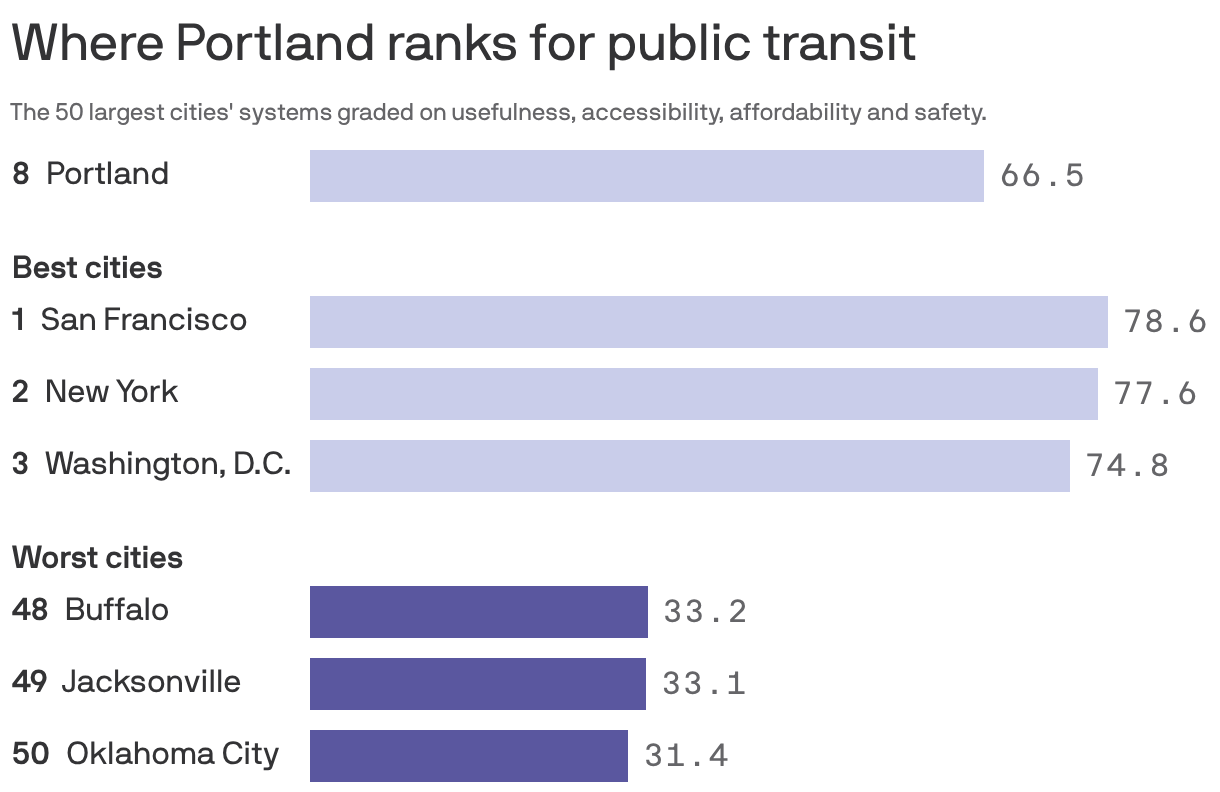
Portland's public transportation system is among the top 10 in the country, according to a new ConsumerAffairs ranking.
Why it matters: That's something to be proud of, and it could save you some cash if you jump on board.
By the numbers: Portland ranked No. 8 among the nation's 50 largest urban areas, beating much bigger metros like Miami and Houston.
- We got top marks for accessibility and usefulness, affordability, and operational safety.
Between the lines: ConsumerAffairs analyzed federal transit and census data to understand how often residents board transit, how far they travel, ADA accessibility, fares relative to riders' earnings, and rates of collisions, injuries and other safety incidents.
Yes, but: Portland's ranking comes with a big asterisk. The data was based on 2024 stats β before TriMet enacted some of its largest permanent service reduction in decades.
Catch up quick: In August, TriMet implemented major service changes to 33 bus lines, eliminated two, and shortened the MAX Green Line. Riders traveling from Clackamas County now must transfer at Gateway to continue downtown.
- The agency has also eliminated hundreds of staff positions.
Meanwhile, ridership remains at roughly 70% of pre-pandemic levels.
- Even after the cuts, TriMet is staring down an average annual budget gap of about $160 million, according to its latest adopted budget.
- The agency said its operating costs β like labor, vehicle maintenance, fuel and security β have risen 56% since 2019 and are one of the key drivers of its financial strain.
What we're watching: Portland may still be competitive nationally when it comes to our transit system, but TriMet said it needs a long-term source of revenue to avoid further reductions.

2. πΆ How much we walk
Portlanders and those visiting the Rose City walk less than half a mile per day on average, according to a new report.
The big picture: Folks here walk more than those in only 37 other large cities, according to StreetLight, a transportation data firm β about 150 miles per person per year, about the same as the U.S. average.
Editor's note: The story was corrected to show the data includes visitors (not just residents).
3. Rose City Rundown
π Portland ranked as the second-best foodie city in the U.S. for the second straight year in WalletHub's annual analysis, trailing only Miami. Our abundance of restaurants, food events, breweries and wineries gave us high marks. (The Oregonian)
π§ A California carpenters union sent a record $10 million to its Oregon political arm and already donated $500,000 to Gov. Kotek's campaign.
- Yes, but: The PAC did not say how it will spend the rest of the money ahead of the election. (Oregon Journalism Project)
The Oregon Department of Justice subpoenaed records from failed shoe startup Made in Old Town in a probe of possible violations of state nonprofit law after the startup raised $9 million in public financing. (Willamette Week)
ποΈ The city's sluggish rental market is putting market-rate apartments in direct competition with affordable housing.
- About 2,200 income-restricted units are currently sitting empty, prompting officials to spend $10.6 million shoring up struggling properties in hopes to fill them. (Wall Street Journal π)
β¬ οΈ Progressive candidates are challenging Washington County's moderate Democratic establishment in dozens of open races shaped by fights over data centers and immigration enforcement. (OPB)
4. π³ GIF du jour: Data center growth
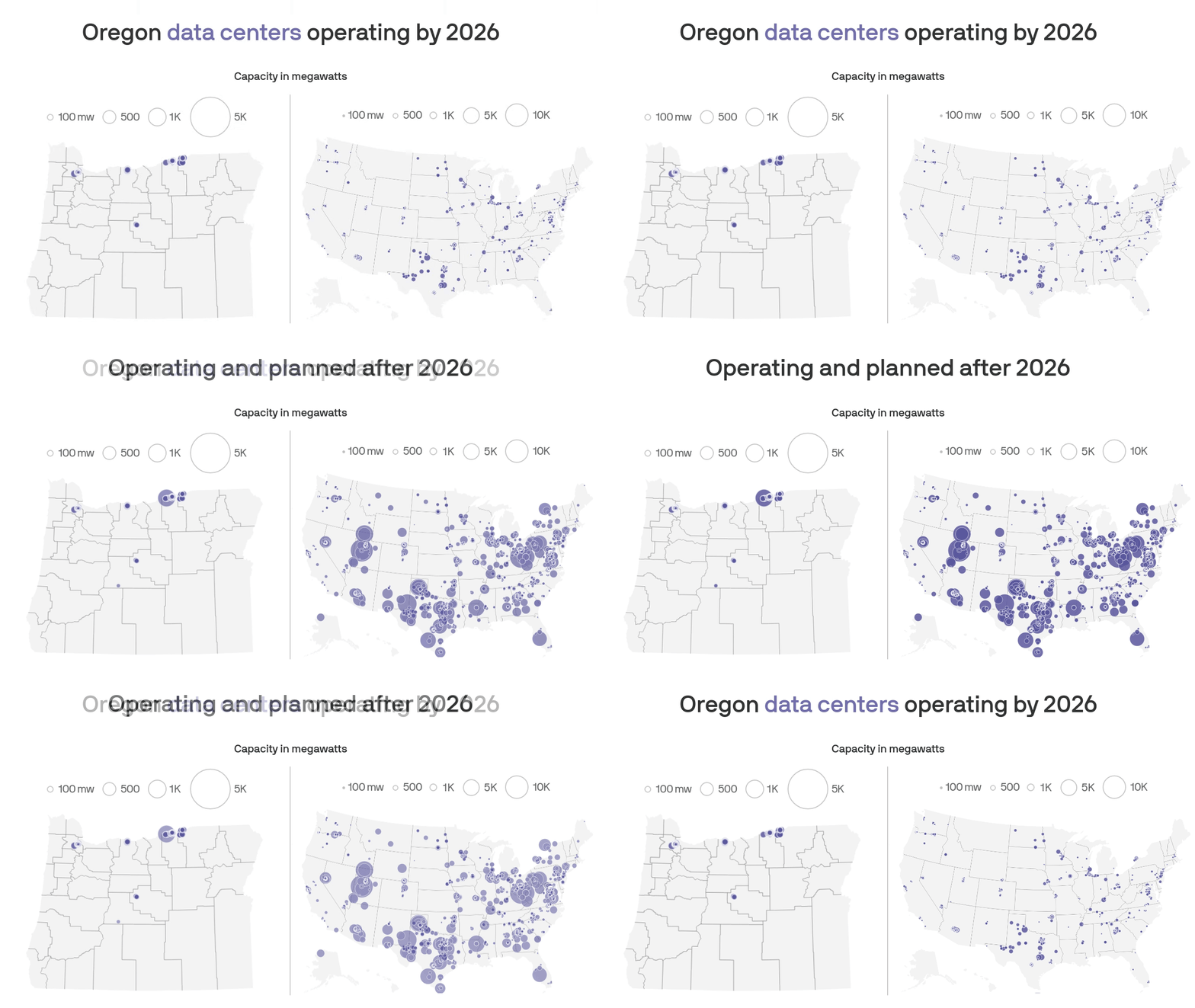
Oregon is expected to have more than 100 large data centers by the end of the year.
- The 22 in the pipeline in future years would increase today's 5,743-megawatt capacity by more than 32%, according to records analyzed by market intelligence company Cleanview.
By the numbers: Running at two-thirds capacity β typical for a data center β the average new data center uses enough energy to power 54,000 homes, according to Cleanview.
The fine print: Cleanview only counts individual buildings as data centers.
Reality check: It's unlikely that all of the more than 3,000 data centers on Cleanview's national list will come to fruition.
- Forty-five projects on Cleanview's complete list have been canceled.
- About 450 don't have a completion date.
What's next: On average, the next generation of data centers in the U.S. is on track to consume 2.5 times more power than those opening in 2026.
πΊ Meira is excited to catch up on all of her shows on the plane ride home.
π«© Kale is hoping this is his last travel day for a while.
This newsletter was edited by Geoff Ziezulewicz.
Sign up for Axios Portland