Axios Portland

October 06, 2026

It's Tuesday.
π€οΈ Today's weather: Mostly sunny. High of 75, low of 53.
π Happy birthday to our member Karm Hagedorn!
π₯³ Happy Axios Social Club day! Here's to good food, new connections and a fun night out. Enjoy!
πͺ΄ Help local journalism grow in your community. Become a member today.
Todayβs newsletter is 901 words β a 3.5-minute read.
1 big thing: π« School closure scenarios
Portland Public Schools outlined plans yesterday that could see as many as 14 schools close as the district shrinks its footprint amid falling enrollment and budget pressure.
Why it matters: After months of discussion, the list marks the first concrete details on how the state's largest school district could address changing demographic and financial realities.
- The list is not final. District officials plan listening sessions across Portland in the coming months, with a final vote slated for December.
The latest: The list of potential closures released yesterday lays out two scenarios.
- Scenario A would see Maplewood, Stephenson, Irvington, Rose City Park, Buckman, Creston, Marysville, Woodmere, Lewis, Beach, James John, Peninsula and Sabin elementary schools, as well as Sellwood Middle School, shut down and their students moved to other schools.
Scenario B would spare Stephenson, Rose City Park and Lewis from that closure list.
- Both options would require dozens of boundary changes that would affect all schools, moving a dozen or more programs and reconfiguring some K-8 schools.
- The board will also consider deferring the decision altogether, though they "would need to revisit school closures and other changes in a future year," the district said in a news release.
By the numbers: The district's headcount has fallen from around 49,000 in 2019 to roughly 43,000 last year, per KPTV, a drop of more than 12%.
- PPS has also faced sizable budget shortfalls for several years.
Between the lines: Shrinking kindergarten class sizes and Oregon's falling birth rate show the problem is more than just a blip, Ethan Sharygin, director of Portland State University's Population Research Center, told KPTV.
What they're saying: Superintendent Kimberlee Armstrong acknowledged the cuts would be painful for many families, but said in a statement they were necessary to "give every student access to strong programs, stable staffing and the opportunities and support they deserve."
What you're saying: Do you have a student at one of the schools on the list? How are these potential closures sitting with you?
- Email us your thoughts. We may use your response in a future story.
2. π€§ Sick season's early start
Winter may be months away, but flu season in Oregon doesn't seem to be waiting.
The big picture: Oregon's respiratory illness season appears to be getting an early start, with flu activity rising weeks before its typical winter peak.
Driving the news: Emergency room visits for respiratory illnesses are rising as October begins, while COVID is also showing up increasingly in wastewater and hospitals, according to state data.
- Flu typically peaks between December and February, making the early uptick noteworthy.
By the numbers: About 3.2% of influenza tests came back positive in Oregon during the week ending Sept. 26, per state reports, up from 2.6% the prior week.
- COVID hospital use has also risen from late-summer lows, CDC data shows.
Zoom out: Washington and Oregon appear to be running ahead of much of the country, with the CDC still rating overall respiratory illness as very low nationally and flu activity as low.
π Kale's thought bubble: Meira and I both caught this year's flu bug while traveling for our work retreat last week.
- It laid us both out for days and, a week later, I still have a nasty cough and almost no energy.
What to do: Health officials recommend staying up to date on flu and COVID vaccinations, staying home when you're sick and taking added precautions around people at higher risk of severe illness.
The bottom line: If it feels like sick season started early this year, the numbers suggest you're not wrong.
3. Rose City Rundown
π° Oregon Health & Science University agreed to pay its retiring general counsel nearly $1.8 million over the next two years as part of an agreement that included confidentiality and non-disparagement clauses. (Portland Business Journal)
πͺπΌ What started as an impromptu river gathering for 30 women earlier this summer has ballooned into an 850-member outdoor activity group for female and female-presenting Portlanders. (Willamette Week)
π Two Oregon-based environmental groups were among nearly 20 organizations targeted by a U.S. House Committee for allegedly using "unscrupulous tactics to profit from taxpayer dollars" by filing lawsuits that challenged timber sales. (Oregon Journalism Project)
ππ½ A record 15,000 runners took part in the Portland Marathon over the weekend, including Connor Ford, who won the men's category in his first-ever marathon. (KOIN)
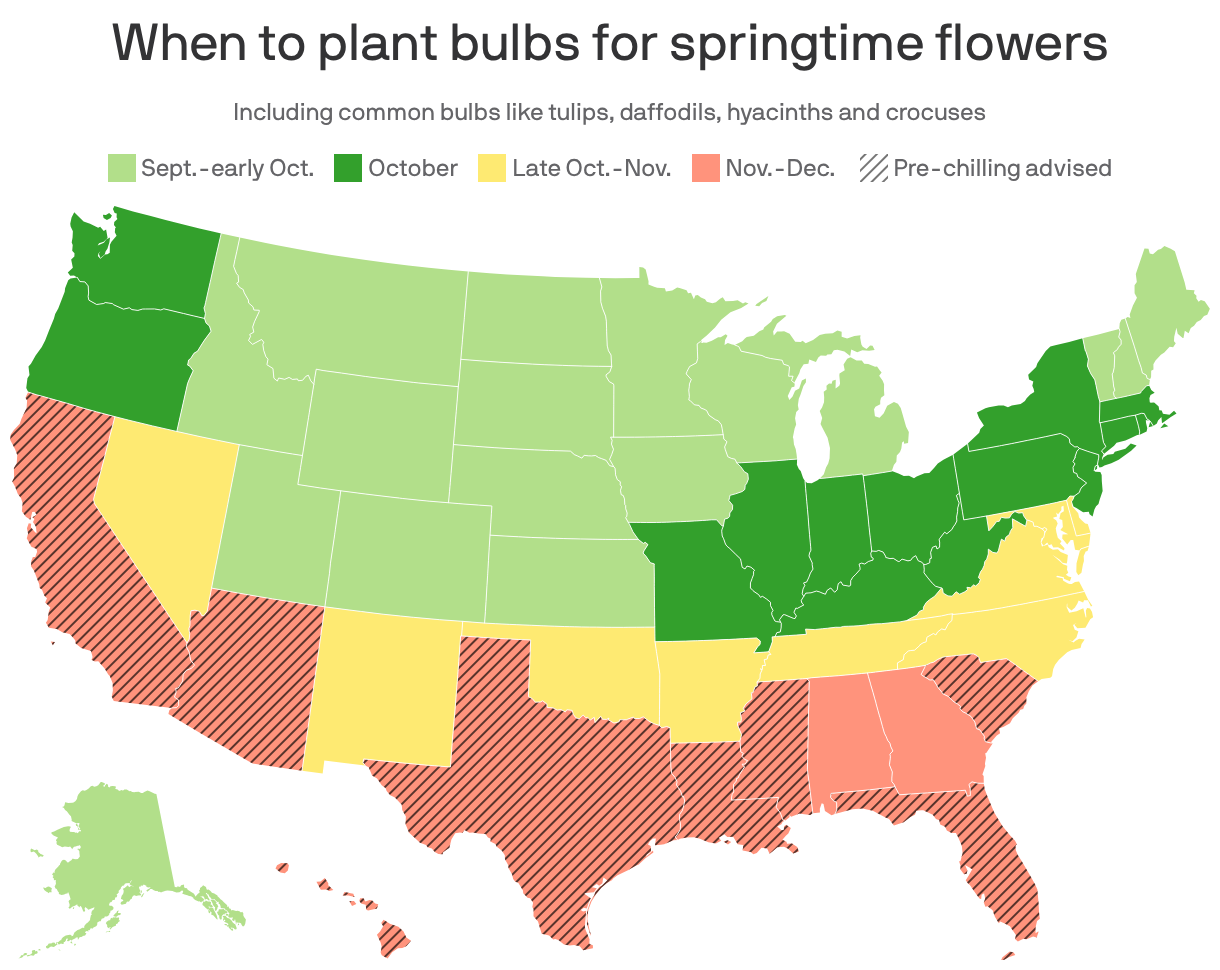
4. 1 map to go: π± Never too early

Now is the time for planting spring-flowering bulbs in Portland: the Oregon State University Extension recommends October and November planting in Western Oregon.
- Spring-flowering bulbs need cool soil but also enough time to establish roots before the ground freezes. Planting too early or too late can hurt their chances for a strong bloom.
Yes, but: Planting windows can vary widely within states that have big differences in elevation, coastal influence or winter temperatures, like Oregon.
- Bulb type matters, too: Daffodils generally tolerate warmer climates better than tulips.
π€ Meira is still laid up.
π€§ Kale is less contagious than his cough implies, hopefully.
This newsletter was edited by Geoff Ziezulewicz.
Sign up for Axios Portland