Axios Portland

April 08, 2026


It's Wednesday.
🗓️ On this day: In 1977, the Blazers' record-setting sellout streak began, fueled by a frenzied fan base and an audacious team led by Bill Walton, who brought home the franchise's only championship that year.
🌤️ Today's weather: Mostly sunny, with a high of 68 and a low of 43.
Situational awareness: Stay up to date with the latest news from the Iran war with reporting from our national colleagues here.
Today's newsletter is 1,185 words — a 4.5-minute read.
1 big thing: Court weighs tear gas

A federal appeals panel heard arguments yesterday on limits to federal agents' use of chemical munitions during protests outside an ICE facility in Portland.
Why it matters: The case could determine how broadly federal agents can use force-control tactics like tear gas during protests.
What they're saying: Putting restrictions on the government's use of chemical munitions ties the hands of agents who face unpredictable conditions at protests, Brenna Scully, a lawyer for the U.S. Department of Justice, argued.
- "Chemical irritants are a critical defensive law enforcement tool and limiting the government's ability to use them based on facts and circumstances facing officers irreparably harms the government," Scully said.
The other side: Steven Worth, an attorney representing residents of an apartment complex across the street from the ICE facility, argued that federal officers have used tear gas in situations that were not dangerous.
- Instead, he said, agents have used tear gas to create dangerous conditions, later posting footage of the confrontations on social media.
- "On numerous occasions, the government was not responding to violent protests," Worth said. "The government was creating political propaganda to post on its Instagram accounts."
Catch up quick: Federal agents have periodically used chemical munitions, sometimes on crowds that included children, to dispel protesters at the facility in South Portland since last summer.
- In two lawsuits, journalists, demonstrators and nearby residents challenged federal agents' use of tear gas, saying it represented excessive force and violated their constitutional rights, respectively.
- Two federal district court judges agreed, and in February, restricted the use of chemical munitions to situations in which officers face imminent threats.
- The Trump administration appealed both those rulings and a three-judge panel with the U.S. Court of Appeals for the Ninth Circuit ruled 2-1 to pause the restrictions ahead of Tuesday's hearing.
What's next: The panel, made up of two Trump appointees and one judge appointed by former President Biden, did not say when it expected to rule on the cases.
2. ⛴️ Frog Ferry pitches community funding

Backers of Portland's Frog Ferry project unveiled a new funding model yesterday, allowing residents to donate toward launching ferry service.
Why it matters: Project leaders are betting Rose City residents will help pay for ferry service to get a boat in the water.
What they're saying: Ferries are a low-cost transportation model that Portland is missing, Frog Ferry founder and president Susan Bladholm said in a statement.
- A ferry would "reduce roadway wear and tear, get cars off roads," and "incentivize people to be downtown," Bladholm said.
How it works: Residents can buy "shares" in the ferry — which the project makes clear are a donation, not an equity investment — starting at $300.
- $15,000 will allow donors to permanently name a seat on the ferry, $300,000 will secure naming rights for the captain's chair and anyone willing to chip in $900,000 will get to name the vessel.
Context: The idea of bringing ferry service to Portland has been around for years and has yet to gain the backing it needs to move forward.
- The project was granted permission to use docks at Cathedral Park and on the South Portland waterfront last summer.
- Service, costing an estimated $3.50 per ride, would begin between those two points, with hopes of expanding with lines from Vancouver to Oregon City, if funding allows.
What's next: The group is hoping to raise $2 million from donors to "build momentum" that would spur investment from lawmakers, corporate sponsorships, grants and philanthropic funding.
3. Rose City Rundown

🚲 Portland's e-bike rebate program rolled out this week, offering discounts to qualifying residents with the aim of making electric bikes more affordable for everyday transportation. (The Oregonian)
🏥 Oregon Health & Science University removed the chief executive officer after of its hospital just four months on the job. Tarek Salaway alleged the move was retaliation after he brought up patient safety concerns.
- OHSU officials did not comment on the cause of his removal. (Willamette Week)
🏠 Hundreds of immigrant households in Portland will see their federal housing subsidies shrink starting next month due to a U.S. Department of Housing and Urban Development policy change, raising concerns about increased rent burdens and displacement. (OPB)
✈️ The rising cost of jet fuel due to the Iran war is increasing the cost of airfare, too.
- Some plane tickets out of Portland International Airport have gone up as much as 76% in recent weeks. (The Oregonian)
4. 💪 Brain-boosting upgrades


People are finding new brain-boosting design features for their homes. And good news — they're not all big spends.
Why it matters: "The home is one of the most powerful and underutilized health interventions that we have," Melissa Batchelor, director of the Center for Aging, Health and Humanities at George Washington University, tells Axios.
- "Research now shows that things like light, nature, social connection and smart technology built into our home environments can really have a meaningful impact on our cognitive health."
Zoom in: Batchelor says home additions like a front porch can help owners meet their neighbors. And the more windows, the better.
An affordable hack: Batchelor installed smart lightbulbs and programmed them to automatically follow natural light patterns — warm in the morning to cool-bright come afternoon, and amber tones for evening.
The intrigue: Moss walls — a trendy fixture in restaurants and office buildings — are making their way into homes, Tricia Skoler, a real estate agent and neuroscience specialist, tells Axios.
- "In real estate, I'm seeing more people want access to nature," she says. In the absence of yard space, a living or moss wallscape can stimulate similar senses.
Another trend she's seeing: multifunctional furniture, especially for tight spaces, like tables or beds that double as storage, or modular blocks that can build furniture and also serve as a brain-tickling puzzle.
5. 🎸 1 good thing to go: Keep it spinnin'
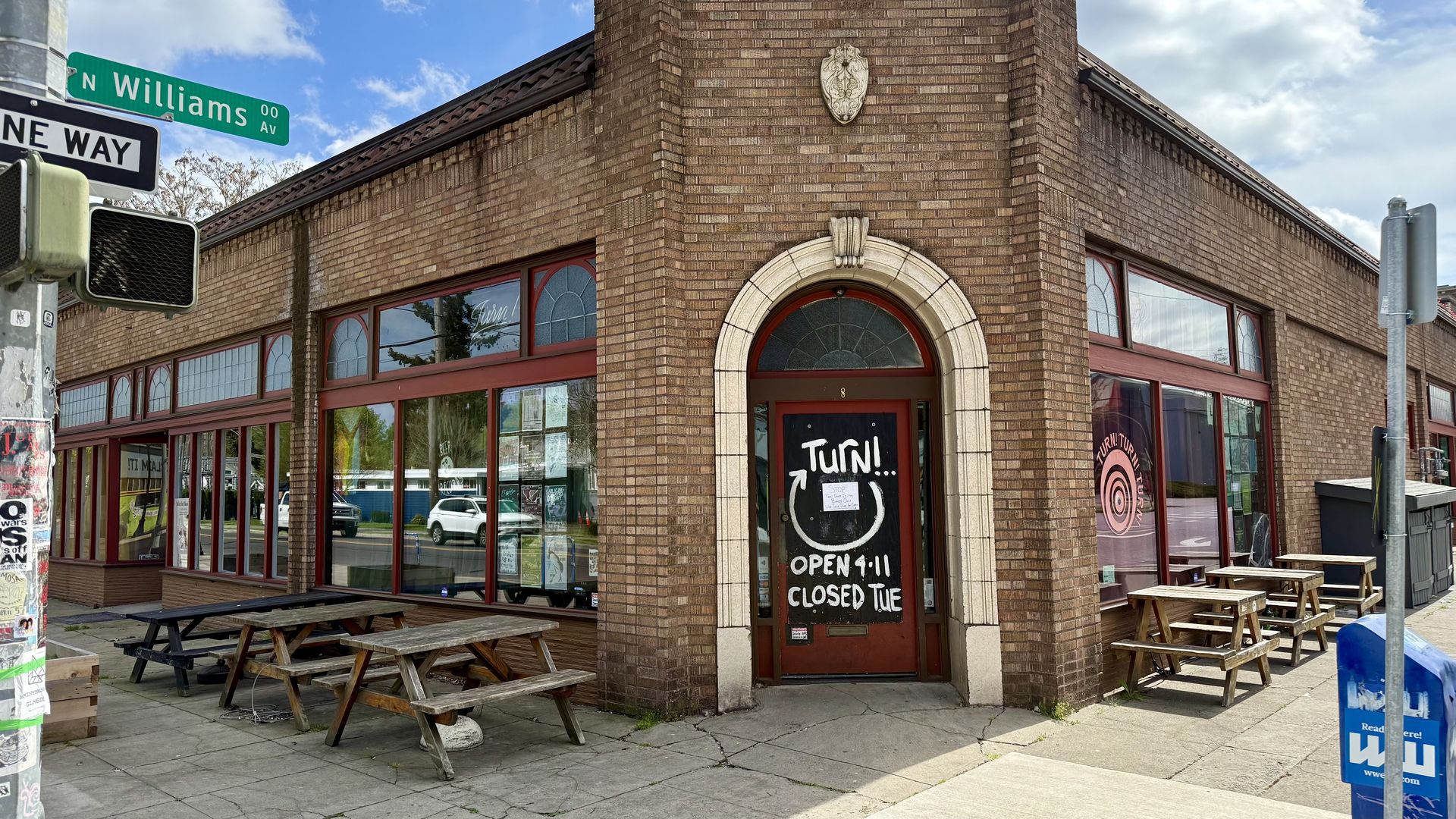
Portland's fragile indie music scene recently scored a rare win: Turn! Turn! Turn!, the intimate venue in the Alberta Arts district, has new owners dedicated to keeping the historic space open.
Local live music vets Joel Christerson and Annie Ostrowski (the booker behind Lonely God and a former marketer with Doug Fir) answered the call after the venue's previous owners announced they'd be bowing out of their duties back in December.
- It wasn't the first time Turn! Turn! Turn! faced permanent closure.
The latest: Regulars shouldn't expect much change in the handover, just a few updates to the food and drink menu, per Portland Mercury.
- Upcoming shows include post-punk band Dwelling Unit, William Surly & The Barroom Gospel Band, guitar-pop singer-songwriter Sunbathe and more, including community jam sessions and orchestra improv.
🏡 Kale is happy to be home.
🎧 Meira is late to the party but has been enjoying Robyn's new album immensely.
This newsletter was edited by Geoff Ziezulewicz.
Sign up for Axios Portland
