Axios Phoenix

August 01, 2025

It's Friday! Welcome to August.
- Today's weather: High of 111, with an extreme heat warning through tomorrow.
🎂 Happy early birthday to our Axios Phoenix member Lorraine Mutschler!
Today's newsletter is 964 words — a 4-minute read.
1 big thing: Heat streaks on the rise

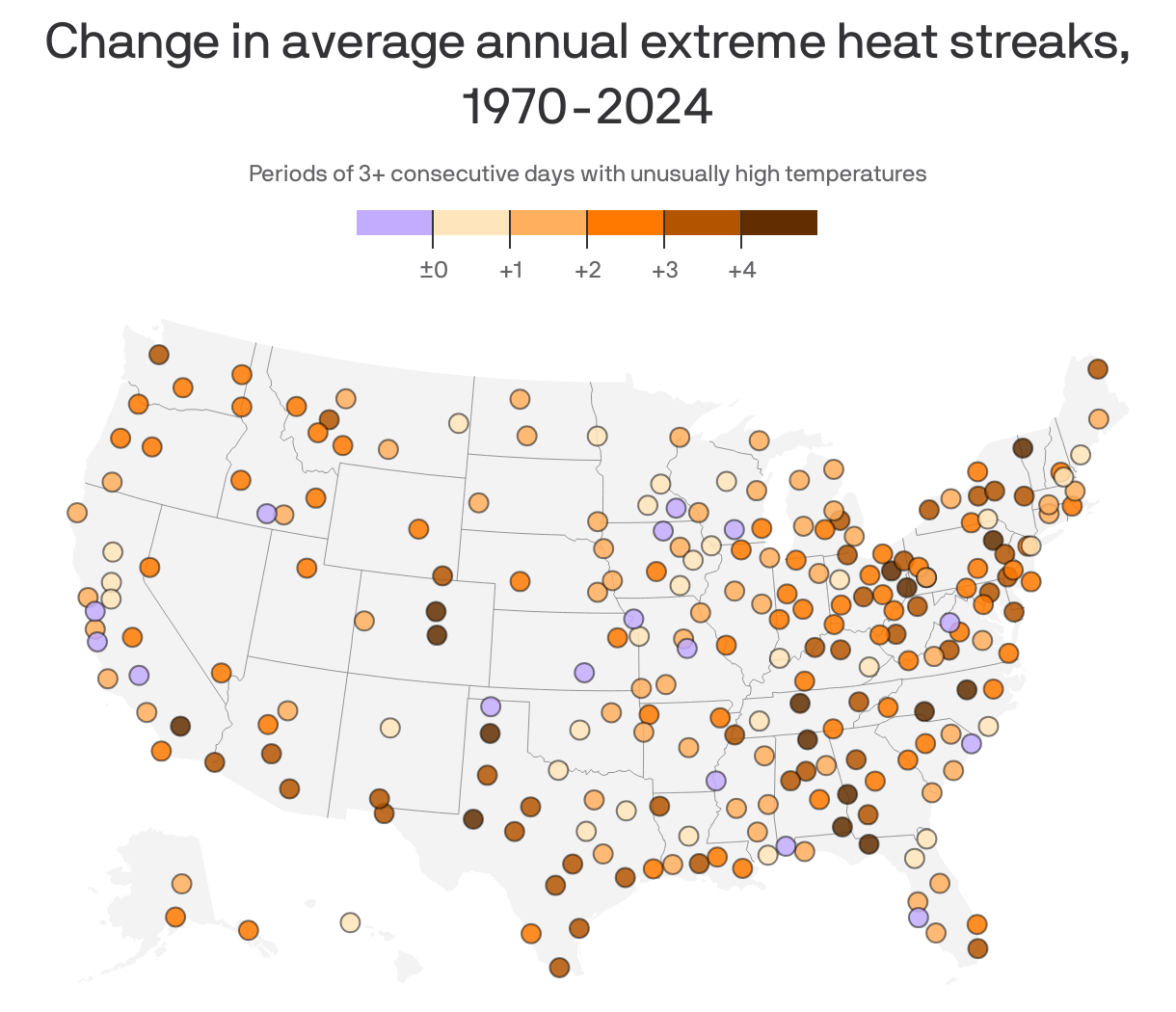
Phoenix and other Arizona cities have seen an increase in heat streaks in recent few decades.
The big picture: Many U.S. cities now have more heat streaks on average each year compared to 1970, a new analysis finds.
Why it matters: Prolonged heat — as Phoenix and much of the U.S. have experienced this summer — is particularly hazardous to human health.
- Extreme heat's effects on the body tend to be cumulative, and warm nights offer little reprieve for those without air conditioning.
- Multi-day heat streaks are also challenging for power grid operators, given all the energy-intensive A/C use.
By the numbers: The average number of annual extreme heat streaks rose between 1970-2024 in 80% of the 247 U.S. cities analyzed in a new report from climate reasearch group Climate Central.
- The nearly 200 cities with an increase now have two more annual heat streaks on average.
- Phoenix, Tucson and Yuma were on the higher end, averaging three more heat streaks year, while Prescott got an extra two annually and Flagstaff gained one.
How it works: Climate Central defines an "extreme heat streak" as three or more days in a row with maximum temperatures over the 90th percentile of a given location's daily max temperatures during the 1991-2020 period.
- "Across the 247 cities analyzed, this temperature threshold ranged from 66°F in Juneau and Anchorage, Alaska to 100°F in Yuma, Arizona," per the report, which is based on publicly available NOAA data.
Zoom in: Some areas, like Nashville and Raleigh, now have a whopping five more heat streaks on average per year.
- A few places, like Myrtle Beach, South Carolina, and Sarasota, Florida, have fewer compared to 1970.
Between the lines: Climate change is making extreme heat more intense and more frequent, studies have shown.
- Many urban neighborhoods suffer from the "urban heat island" phenomenon, where buildings, roads and other structures trap heat, making it even hotter.
2. 💩 The great dog poop debate

It's an issue that can roil society to its very core — what do you do with the dog poop you pick up while walking your four-legged friends?
State of play: Of course, you've got to pick it up. But what to do after that is a divisive question.
- Are you "doody-bound" to tote the little bag home and dispose of it there? Or is it OK to throw it in a stranger or neighbor's trash can while you're on your walk?
📧 You tell us: Respond to this newsletter, or email us [email protected] to let us know your thoughts on proper dog poop etiquette.
- We may include your response in a future edition of Axios Phoenix.
3. LDS church sexual abuse case can move forward
An Arizona appeals court has resuscitated a high-profile lawsuit against the Church of Jesus Christ of Latter-day Saints, ruling unanimously that the church may have been obligated to report a man to police after he confessed to sexually abusing his children.
Why it matters: The ruling argues there are limits to Arizona's guarantee of "clergy-penitent privilege," reversing a lower court's dismissal.
Catch up quick: The man confessed to his bishop in 2011 and was excommunicated in 2013, court records show. But the bishop later told police that church officials told him not to report the man because state law required him to keep the confession confidential.
- The abuse continued until 2017, when investigators found incriminating footage online. The man was arrested and died by suicide months later.
Friction point: A judge in 2023 ruled that the man's children couldn't sue the church because clergy are not required to report abuse they learn about in a spiritual confession.
Yes, but: On Tuesday, the three appellate judges said clergy privilege may not apply in this case, and a jury should decide whether church officials were required to report to police.
- The man later admitted the abuse to his wife during a meeting with a bishop — and a jury could reasonably decide that meeting was not a religious confession, Tuesday's ruling states.
- He also confessed in a church disciplinary hearing, which may not amount to "spiritual counsel" that's exempt from reporting requirements, the judges ruled.
The other side: The church plans to appeal, a spokesperson told Axios.
- "In this tragic case involving abuse perpetrated by the children's father, the church and its clergy acted in accordance with Arizona law," a prepared statement reads.
4. Chips & salsa: One big data center

💻 A proposed $33 billion, 3,300-acre data center development near Eloy would be the largest in the state. (AZcentral)
🔥 The Dragon Bravo Fire at the North Rim of the Grand Canyon is now the 10th largest wildfire in Arizona history after burning more than 105,000 acres as of yesterday morning. (KJZZ)
💰 Gov. Katie Hobbs is asking the Trump administration to give Arizona nearly $760 million in reimbursement for border security costs. (12 News)
⚖️ Three Glendale residents are suing the city to overturn two ordinances restricting panhandling, arguing they violate free speech rights. (ABC15)
5. Where in the Valley?
Welcome to another edition of "Where in the Valley?"
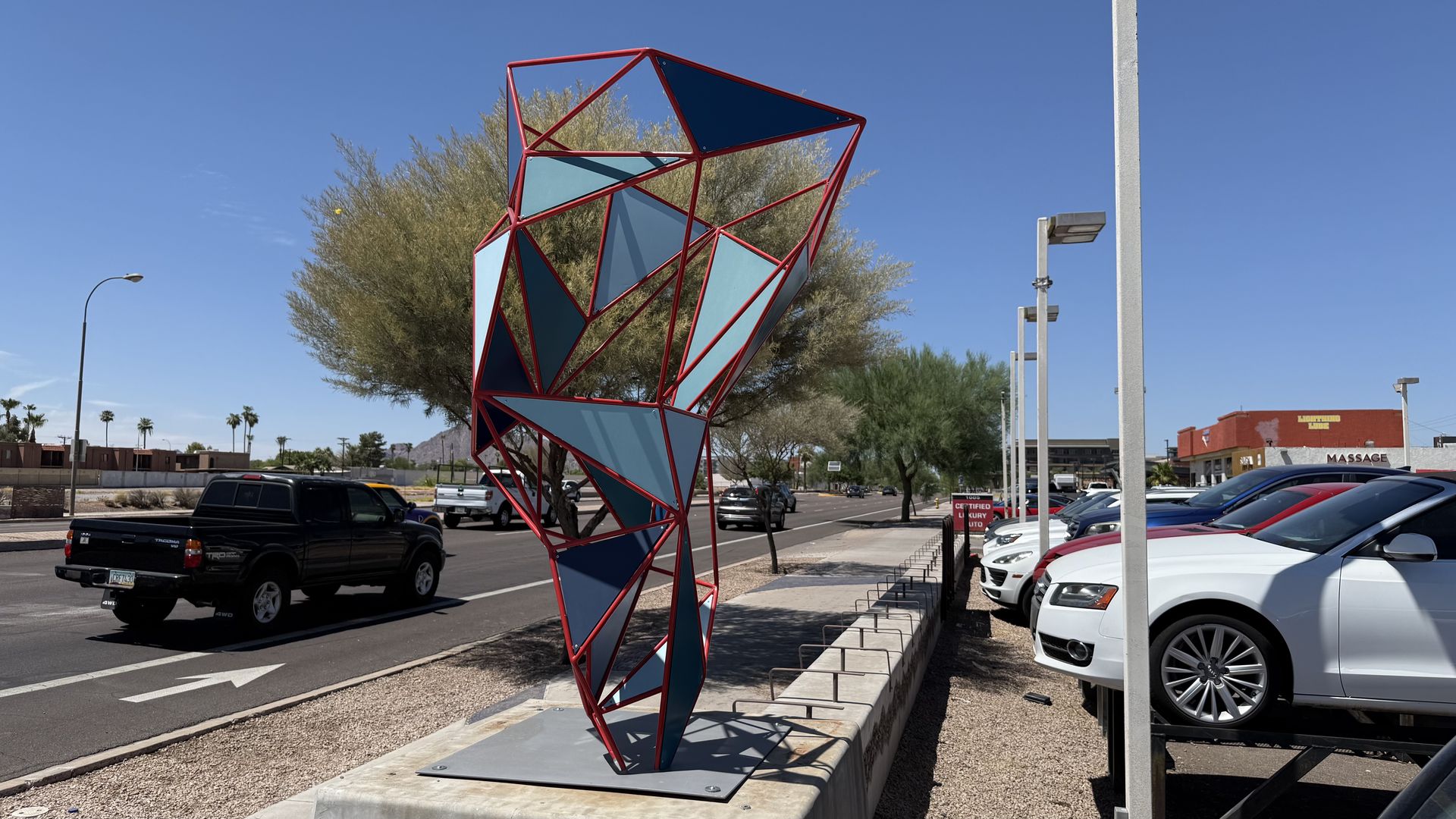
How it works: We show you something cool. You tell us where it is.
- The first reader who names the spot gets a shoutout in the newsletter.
You tell us: Where in the Valley can you find this public art?
Catch up quick: Congratulations to Nolan and Hannah Rose, the first readers to give us the location of last week's "Where in the Valley?" photo.
- The metal leaf is on 13th Street at Mill Avenue in Tempe.
🦌 Jeremy most likely won't see "Bambi: The Reckoning," but he was amused to learn that someone turned "Bambi" into a cheesy horror movie.
This newsletter was edited by Gigi Sukin.
Sign up for Axios Phoenix