Axios Phoenix

July 23, 2026


Happy Thursday! Tempe was founded on this day in 1882.
☀️ Today's weather: Sunny, high of 110.
🎂 Happy birthday to our Axios Phoenix members Michael Ryan and Christine Luna!
Situational awareness: The AP called the CD1 Democratic primary for Amish Shah last night. Read more
Today's newsletter is 906 words — a 3.5-minute read.
1 big thing: Arizona overdose deaths spike
Arizona is tragically defying a national trend on drug overdose deaths as rates here climb amid a nationwide decrease, according to a report by the New York Times.
Why it matters: Arizona's rate is now twice the national average.
The big picture: Overdose deaths hit an all-time high in Arizona last year at 43.5 per 100,000 people, the Times wrote last week.
- The U.S. as a whole has seen a marked decrease since the pandemic after several decades of rising deaths.
Threat level: Pills historically dominated Arizona's illicit opioid market, but two years ago were largely replaced by powdered fentanyl.
- Because the amount of fentanyl the powder contains can vary wildly, it creates a higher risk for overdoses, with one longtime user telling the Times, "you would overdose instantly if you weren't careful."
- Powder use spiked among people not used to using it, so many haven't had time to adapt.
- Extreme heat, homelessness and meth use fuel the problem — overdoses peak in the hottest months, and 80–90% of fentanyl users also use meth, ASU professor Raminta Daniulaityte told the Times.
Between the lines: The shift from pills to powdered fentanyl happened earlier in most of the country, with Arizona and New Mexico lagging behind other states.
- The two Southwestern states now have the highest rates of overdose deaths in the lower 48 states, and saw the biggest increases last year.
By the numbers: In Maricopa County, total drug overdoses jumped to 2,406 last year from 2,069 in 2024, per public health department data.
- More than two-thirds of the overdoses were from opioids, with fentanyl causing the overwhelming majority.
- However, 85% of overdose deaths involved more than one drug.
1 promising sign: There's a glimmer of hope — nonfatal overdoses through mid-June were lower in Maricopa County this year than the same period in 2025, and drug deaths through March lagged last year's numbers.
2. Scottsdale's election math, explained


The eight-candidate Scottsdale City Council election free-for-all hit a mathematical wall Tuesday night.
How it works: Rules dictate that whoever wins the majority wins the seat. But the process of calculating this winning threshold is complicated.
- The "majority" is determined by dividing the total number of votes cast by the number of open seats, and dividing that number by half, according to Scottsdale's charter.
State of Play: Only incumbent Solange Whitehead, a conservationist, is currently tracking to win a seat outright.
What's next: No more than two candidates can run for a council seat in the general election. If Whitehead clears the threshold, only four out of the seven remaining candidates will advance to the runoffs.
- The race for the remaining spots remains fluid.
- As of yesterday afternoon, the top four vote getters after Whitehead were: former state lawmaker Michelle Ugenti-Rita, incumbent Barry Graham, former council member Bob Littlefield and civic leader and community advocate Raoul Zubia.
The bottom line: The vote is extremely split, so another batch of results could reshuffle the entire field before the results are certified.
3. Chips & salsa: Lake's nomination moves forward
🇯🇲 The U.S. Senate Foreign Relations Committee advanced Kari Lake's nomination as ambassador to Jamaica, despite initial threats from Sen. John Cornyn (R-Texas) to block her and another nominee. Lake must still be confirmed by the full Senate. (Politico)
👀 A delay in allowing the FBI to assist in the investigation into Nancy Guthrie's disappearance may have led to crucial video evidence being erased, FBI director Kash Patel said. (Fox News)
🗳️ Navajo Nation President Buu Nygren lost his primary election, with attorney Justin Jones and Council Speaker Crystalyne Curley taking the top two spots. (KJZZ)
🏈 Arizona Cardinals offensive lineman Isaiah Adams was arrested in Canada on gun charges. His attorney said he's "completely innocent." (ABC News)
4. Indian dining at the Vine
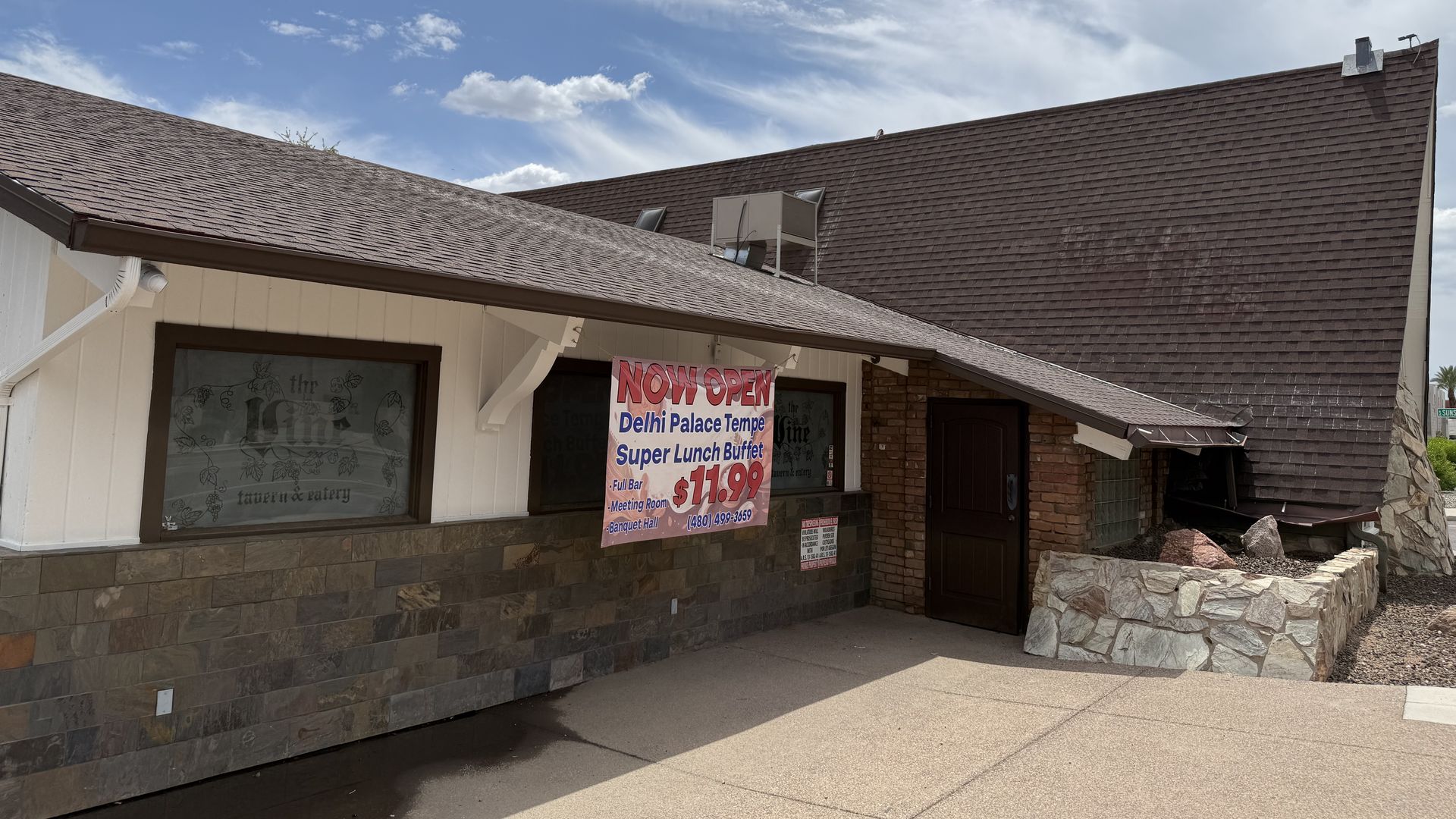
You can't get an apple pie shot at the Vine's iconic A-frame building in Tempe anymore, but if you're looking for curry or biryani, you're in luck.
State of play: Delhi Palace, an Indian restaurant previously located at Rural Road and University Drive, reopened Tuesday in the building that for 36 years was home to the Vine.
- Delhi Palace, which, like the Vine, opened in 1986, shut down two years ago after a fire.
- The old restaurant couldn't be salvaged, co-owner Parmjit Singh told Axios, but the new spot was a good fit due to its layout, ample parking and proximity to the original location.
Zoom in: The staff remains the same, as does the food, which is based on family recipes, per Singh, who co-owns the restaurant with his father, Tajinder Gill.
My thought bubble: Delhi Palace has long been my favorite go-to Indian place, so good that I'm willing to drive across town to pick up a carry-out order.
- I was devastated when it closed and worried it'd never reopen, so I'm excited to make my first trip back soon — unfortunately, I'd just eaten lunch when I popped in to talk with Singh.
📖 Jeremy is reading "The Forgotten World War," a fascinating look at global battles spawned by America's fight for independence.
😂 Jessica is thinking about the Vine's final night — a funny moment in her journalism career.
Thanks to Jessica for editing.
Sign up for Axios Phoenix
