
Axios Markets

December 17, 2025

🧑💻 All of the Magnificent 7 members caught a bid yesterday except Google parent Alphabet, which could indicate dip buying for the six that have been relative laggards. Investors otherwise appear to be rotating toward unloved corners of the market before the new year.
- Today: Robinhood makes a bet on betting markets.
- Plus: What the Venezuelan blockade means for oil.
Let's get into it. All in 970 words in 4 minutes.
1 big thing: Robinhood is betting big on betting
Robinhood is making its biggest bet yet on the convergence of artificial intelligence and prediction markets, unveiling an AI-powered investing assistant and sports trading tools.
Why it matters: Robinhood is betting on the future of investing being, well, betting.
What they're saying: "Robinhood is ushering in a new era in which AI and prediction markets will come together to change the future of finance and news," CEO Vlad Tenev said.
- Robinhood says over 1 million customers have traded 11 billion contracts since its prediction markets feature made its debut late last year. Prediction market trading is the fastest-growing revenue line in Robinhood's history.
- However, customers asked for more, which in part pushed the company to emphasize the prediction markets portion of the announcement yesterday, which was originally going to be more focused on its new AI tools.
Zoom in: The new prediction markets hub will allow dollar-based trading and thousands of new live events across economics, politics, culture and sports for users to access and bet on 24/7.
- Robinhood customers will be able to trade preset combos: If multiple outcomes occur within a single game, the user could make money.
- Today, customers can track football player performances within the app, and player contracts for more sports will roll out soon.
- In 2026, custom combos will be available.
Between the lines: Prediction market companies could see five-fold revenue growth by 2030, according to analysts at Citizens.
- Robinhood wants to ensure it cements itself as a key player within that space, especially as betting markets could continue to dominate what is currently thought of as retail investing.
Robinhood is also launching Cortex, an AI assistant on the on the platform that will let users chat about trading ideas and enact orders, once it rolls out early next year for its Gold subscribers, who pay a fee to get additional tools.
- In a demo, Cortex prompted with questions like "find five stocks that have been unfairly punished by the market" and "how to trade the 49ers game."
- Cortex has access to real-time market data, analyst reports and research, which makes it different from ChatGPT, for example.
- Cortex will also be used to power something called Digests, an automated rundown of what is driving a customer portfolio.
Zoom out: Public launched an AI-powered brokerage last month that lets users build their own ETFs to invest in.
- Oren Naim, vice president of platforms, at Robinhood tells Axios the team is not building "an advisor or anything like that. The idea is to give you kind of an objective summary…of both sides of the story. "
2. Oil prices are rattled with news on Venezuela


Brent crude oil prices surged early today after President Trump said last evening that he ordered a blockade of Venezuelan oil tankers.
Why it matters: The risk of a disruption in supply has stopped, for the moment at least, a long slide in oil prices that steepened this week on optimism about a Russia-Ukraine ceasefire.
By the numbers: In trading this morning, Brent crude, the international benchmark, was up more than 2%, to over $60 a barrel.
Reality check: After years of sanctions and the deterioration of its oil industry, Venezuela is now a fairly minor exporter.
- In November, Venezuela exported some 600,000 barrels of oil a day, per ING, with the bulk of that shipped to China.
- Saudia Arabia, in contrast, exports more than 6 million barrels per day, while the U.S. supplies several million a day.
What to watch: How the Trump administration does — or does not — act further on the president's aggressive post threatening Venezuela.
Subscribe to the Future of Energy newsletter for energy and climate news.
3. Flashiest IPOs of the year fizzle after first day

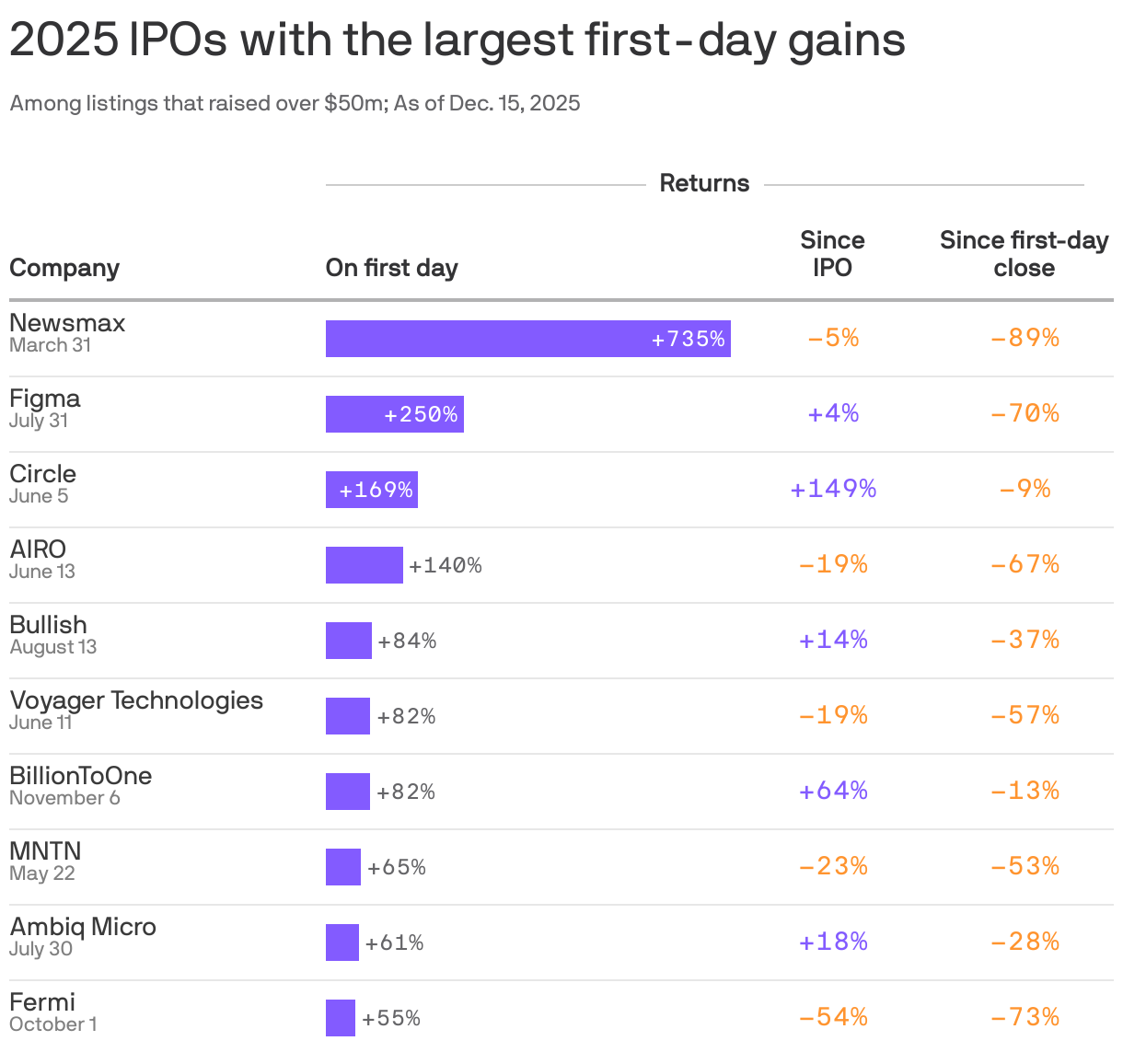
IPOs that flew out of the gates failed to live up to their debuts in 2025, according to data from Renaissance Capital.
Why it matters: None of the 10 IPOs with the largest first-day pops in 2025 are above their first-day close.
- Half are now below their IPO price, while eight are below the average return of 33.8% year to date for public debuts in 2025.
Zoom in: Conservative news channel Newsmax, which went public via Reg A+, popped 735% on its first day, the biggest jump of any major U.S. IPO this year.
- Now it trades below the $10 IPO price and $83 close on its first day.
- Figma, another one of the largest IPOs of 2025, now trades above its $33 IPO price but remains below the prices on its first day.
The other side: Pharmaceutical companies have returned the most to investors, claiming five of the top 10 IPO returns this year.
- That will likely encourage more listings from the sector that suffered a midyear IPO drought. Metsera, which was acquired by Pfizer earlier this year for some $10 billion, tops the list with a 292% return since its IPO.
What they're saying: The big IPO pops of this year are a result of pent-up demand, and "also the return of active retail traders," notes Matt Kennedy, strategist at Renaissance Capital.
- Their return is a signal of strong IPO demand going into next year.
The bottom line: First-day pops do not mean long-term returns.
If you need smart, quick intel on fintech dealmaking, get Axios Pro Deals.
Got tips? Email me at [email protected]. I would love to hear from you about anything that may be of interest for our investor audience.
Thanks to Jeffrey Cane for editing and to Anjelica Tan for copy editing. See you tomorrow!
Sign up for Axios Markets