Axios Markets

July 14, 2025

🌮 President Trump announced a 30% tariff on the European Union on Saturday. Investors waited all weekend for the market to deliver a verdict: Cue the TACO bar. Stocks barely budged, down 0.3% ahead of the Monday morning open.
🥂 Could all the market optimism be pushing prices too high?
👀 Plus: Why the Big Tech rally is a risk factor for your portfolio.
This week has it all, with big bank earnings and a buffet of inflation data. Let's get into it.
All in 931 words, a 3.5-minute read.
1 big thing: Wall Street's frothy summer looks bubbly
After nearing a bear market just three months ago, stocks are expensive again — trading above the value of their underlying assets, with analysts saying we're heading down a frothy path.
Why it matters: Markets might be rallying on vibes rather than fundamentals, while ignoring headwinds like tariffs.
- Investors don't have clarity on how tariffs will impact corporate earnings, but they're trading like they don't care.
- That could be a flashing warning sign while markets are "complacent" and money managers are on vacation.
What they're saying: "Markets can stay overbought for longer than many expect because greed tends to outlast fear," wrote Bank of America's Michael Hartnett in a recent note.
Zoom out: Investors ideally aim to price stocks in line with their earnings potential to avoid sharp corrections when reality catches up. But here's what's happening in the market now:
- The S&P 500 is trading at 22 times forward earnings, above the historic average of 18.
- The current earnings yield, 4.5%, is near its lowest level relative to long-term real yields since the tech bubble.
- Extreme greed is driving the market, according to CNN's Fear & Greed index.
- The Relative Strength Index, a measure of momentum, has hit above 70 several times this month, which is overbought territory.
Zoom in: Here are some other "toppy" signals we're watching:
- Nvidia created and entered the $4 trillion club, and Trump's posting about its share price.
- Assets under management in leveraged ETFs, which are riskier investments, hit a record high of $135 billion.
- Business travel is so back, according to Delta Air Lines.
- Meta offered a $200 million+ salary for top AI talent.
- Jeff Bezos had a $50 million wedding and sold $666 million worth of Amazon stock.
- Our own anec-data: Your Markets author is experiencing a slew of invites to international bachelorette trips, after a few blissful months of pivots to domestic travel due to economic fears.
Between the lines: If prices run away from earnings, "the market is basically saying we're gonna grow into these valuations," Morgan Stanley Investment Management's chief investment officer Jim Caron tells Axios.
Yes, but: Regarding the valuation issue, some analysts say that's not the best metric anymore.
- The index is of higher quality today than it historically has been, with record corporate buybacks to boot, making valuations defensible, according to Bank of America's Savita Subramanian.
💭 My thought bubble: A recent rewatch of "The Big Short" was a good reminder in this TACO moment that it's not always what you don't know that hurts you as an investor.
- It's what you think you're certain of.
2. Big Tech's big risk for investors


Thank Big Tech for helping power the S&P 500 to its eighth record high of the year.
- That dominance could also be the market's biggest vulnerability.
Why it matters: Nearly half of the S&P 500's earnings growth this year is coming from tech. That kind of concentration raises the stakes — and the risk — if the sector falters.
What they're saying: "The whole vibe on the current tech stonks conversation reminds me ... a lot of dot com before the crash," wrote Patrick Moorhead, founder of Moor Insights & Strategy, in a post on X.
- "Instead of [Nvidia] we were piling money into [Cisco]," Moorhead wrote.
Catch up quick: The turn-of-the-century dot-com bubble — when hype drove a surge in tech stocks, which burst when earnings didn't justify valuations — is a cautionary tale that investors would be wise to remember.
- Cisco is one of the poster children for the bubble, and often draws comparisons to Nvidia.
- At its peak valuation, Cisco traded at 200 times forward earnings. Nvidia is less than 40 right now, with the profit growth to back it up.
💭 Thought bubble, from Axios Pro Rata author Dan Primack: It's not just public companies, either. Venture capitalists mostly agree that they overspent and overvalued between 2020 and 2022, leading to a glut of stranded unicorns.
- 2025 is looking like a replay, with stratospheric startup valuations that often eclipse the ZIRP era. Median U.S. VC deal valuations are higher so far in 2025 than during the peak, save for a slight decrease for Series D+ rounds, per PitchBook.
Yes, but: Elevated prices don't necessarily mean we're in bubble territory.
- Unlike the early 2000s, today's tech giants have earnings and cash flow to back up their valuations, Sanctuary Wealth's chief investment strategist Mary Ann Bartels tells Axios.
The bottom line: The question is whether the tech rally is happening because of investors hyping up stock prices, or because of strong earnings that demand these higher multiples.
- The coming earnings season should answer the question.
3. S&P 500 valuations look stretched
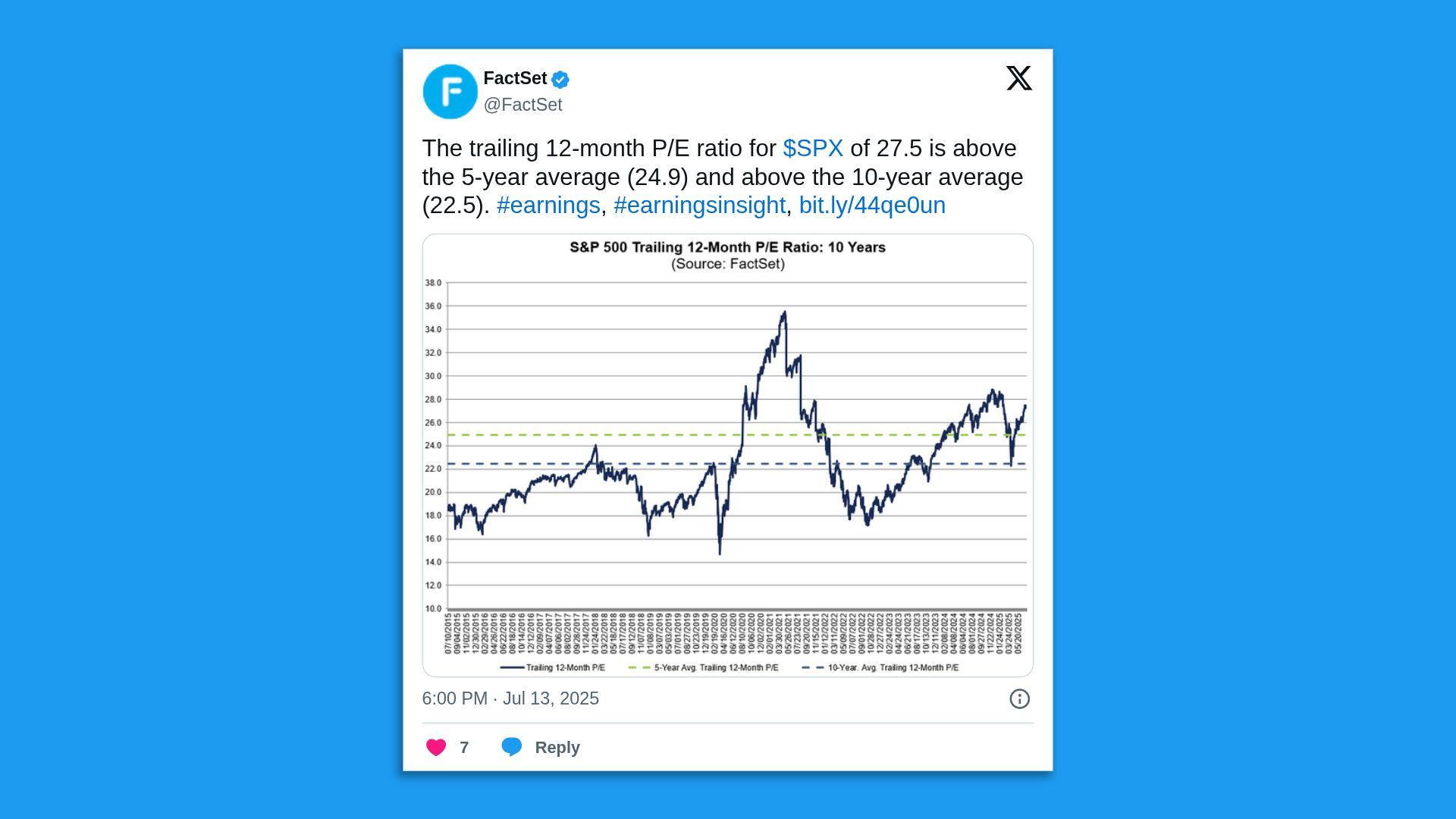
The S&P 500's price-to-earnings, or P/E ratio, is climbing again — now sitting above its five- and 10-year averages, according to a chart from FactSet.
- The P/E ratio is one of the most-watched metrics on Wall Street, measuring how much investors are willing to pay for a dollar of earnings, and the ratio has been steadily climbing since April's lows.
Why it matters: Sooner or later, prices and earnings need to align — meaning either profits rise to justify valuations, or stock prices come back down to earth.
Driving the news: Second-quarter earnings season kicks off this week.
- Analysts forecast a 4.8% profit increase for S&P 500 firms in the second quarter, per FactSet.
- That's below the 13% growth from the first quarter of the year.
- Analysts' estimates for second-quarter earnings have come down significantly off the back of tariff concerns, which could make it easier for firms to surprise to the upside.
The bottom line: The bar is high for companies to deliver profits that can justify current stock prices.
1 big date: The latest Consumer Price Index is set to publish tomorrow, which could give investors a better understanding of how tariffs are impacting prices. The options market is pricing in a 0.6% move in either direction for stocks off the back of the report.
Thanks to Ben Berkowitz for editing and Katie Lewis for copy editing.
See you tomorrow!
Sign up for Axios Markets