Axios Markets

August 11, 2025

A record number of fund managers see stocks as overvalued, but the majority remain bullish, according to the Bank of America global fund manager survey.
- Today: We share how White House tariff revisions are roiling markets.
- Plus: Concentration is king, and that could be a risk for your portfolio.
Situational awareness: Nvidia and AMD agree to pay the U.S. government 15% of their revenue from China chip sales to get the proper export licenses.
- The deal applies to chips previously barred from sale to China, a Trump administration official confirms to Axios. It is unclear how the U.S. will collect this money, but this kind of deal is unprecedented.
Let's get into it. All in 1,220 words and 5 minutes.
1 big thing: Tariff revisions leave markets roiling

Gold prices hit a record high after reports that gold bars from Switzerland would face tariffs. The White House stepped in Friday afternoon to clarify: Those gold bars would be exempt.
Why it matters: The White House continues to roll out sweeping tariff announcements with few details, which leaves investors scrambling for information. Then, often days later, clarifications or exemptions follow.
- Even countries with direct involvement in the trade deals seem caught off guard by White House statements.
What they're saying: "Washington is just randomly shooting, and they are shooting some like-minded countries from behind," Taro Kono, a member of Japan's House of Representatives, said in a briefing, per the New York Times.
- Japan thought it had received a 15% tariff rate on all goods.
- But the European Union tariff agreement made it appear that levies on certain goods from Japan would be stacked.
- Japanese officials said the White House will correct the order, though it remains unclear when that will happen.
Zoom in: Henrietta Treyz, the director of economic policy research at Veda Partners tells Axios that this "mass confusion" stands out in several specific events that have "rocked markets" in the last month alone.
- Transshipped goods — or items that pass through multiple countries — were originally tariffed at 40%, then stacked with a 20% tariff.
- Copper had its biggest one-day drop after President Trump announced exemptions on important forms of the metal from 50% tariffs.
- Non-U.S. chips were set to face a 100% tariff, but that will not apply to companies that invest in the U.S. or commit to that (enter Apple's $100 billion investment.)
How it works: This is the pattern seen in all the instances just laid out.
- The White House issues a broad announcement on tariffs, without any specifics and very rarely with details in writing.
- Investors, executives and policymakers scramble to clarify the impact on their sector. Panic ensues, and investors move money around.
- The White House clarifies the announcement. Market reactions ease.
Be smart: Two pivotal, ongoing court cases could restrict Trump's ability to use emergency powers to issue tariffs, which could make country-specific tariffs less sticky, while making sector-specific tariffs a bigger concern.
- Treyz expects a decision on these cases in the next one or two weeks, and anticipates a market selloff off the back of the result.
The bottom line: The confusion and subsequent revisions point to the fact that on tariffs "this is not one and done," Treyz says.
- Expect to be chasing clarity on tariff policy for a while longer.
2. Gold investors stay bullish amid tariff scramble
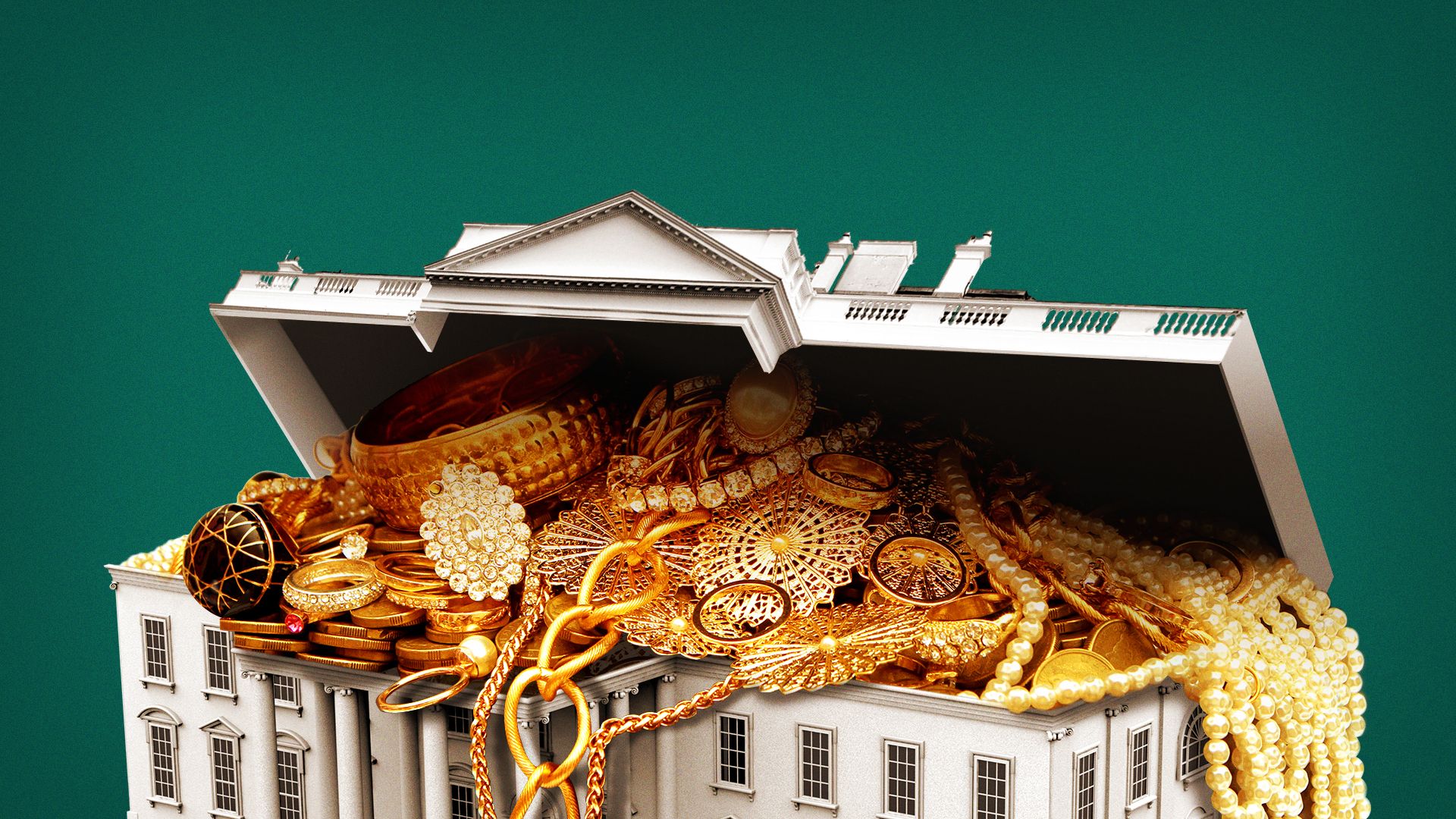
A U.S. government agency ruled that gold bars from Switzerland would be subject to tariffs. Gold prices shot up. Then the administration announced it would issue a new policy to exempt the gold bars.
Why it matters: The snip-snap approach to tariffs roiled bullion prices, but investors say they are bullish with or without the tariffs.
Catch up quick: Switzerland is one of the largest gold refiners in the world, exporting over $50 billion worth over the 12 months ending in June.
- Gold exports spiked early this year as investors sought to frontload tariffs, according to HSBC.
What they're saying: "This action further bolsters our bullish outlook for gold prices, with these tariffs set to disrupt the flow of gold globally and push both the US and global price higher," Trevor Yates, senior investment analyst with Global X, wrote in a note.
Between the lines: There are still several catalysts ahead for gold demand, according to Bob Iaccino, chief market strategist with Path Trading Partners and author of the Finance Unfiltered newsletter.
- Volatility amid tariff uncertainty would be good for gold, since it is still considered a safe haven asset. Rate cuts could be another tailwind.
- Central bank purchases of gold also continue to climb amid a de-dollarization push driven by tariff policy by the administration.
Zoom out: Investors have been riding the gold gravy train all year, according to the latest Gold Demand Trends report from the World Gold Council.
- Gold ETF inflows hit 170 metric tons in the second quarter of 2025, valued at nearly $400 billion, the strongest first half finish since 2020.
- Retail investment rose 11% year-over-year, driven by demand in China.
- Central banks added 166 metric tons in the second quarter, with 95% of reserve managers expecting central bank buying to keep exacerbating.
Yes, but: There remains uncertainty about what reciprocal tariffs on other gold-exporting countries could mean for the precious metal.
- The only two countries the U.S. gets more gold from than Switzerland are Canada and Mexico.
Be smart: According to Bloomberg, managers at gold refineries are already pausing shipments until there is more clarity on levies.
- Tariffs could also have severe implications for how gold futures are traded.
The bottom line: The back and forth on gold tariffs is indicative of how policy uncertainty on levies has roiled several asset classes this year.
3. Market concentration fears grow on Wall Street
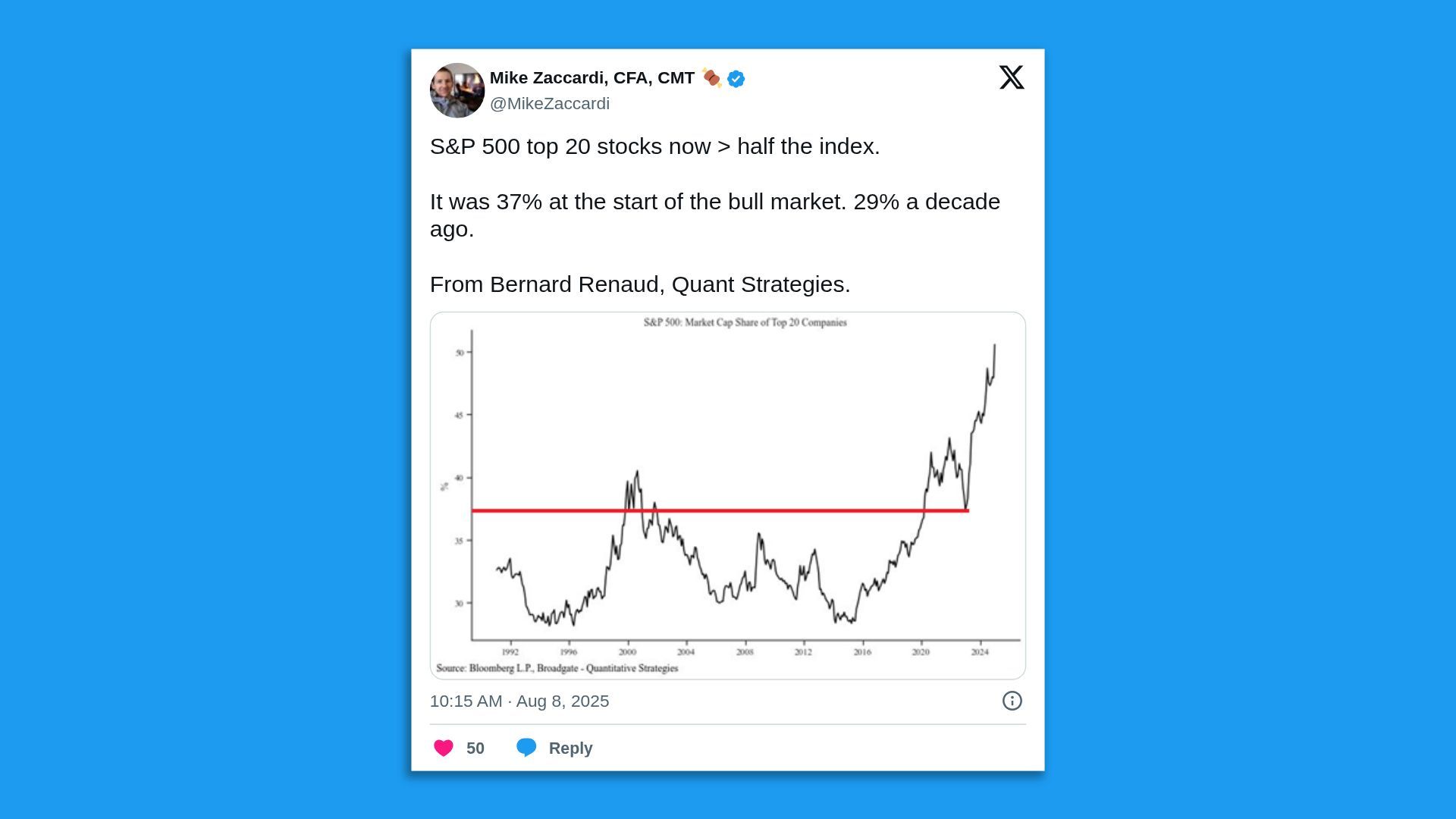
The top 20 stocks in the S&P 500 now make up half the index based on market cap, a chart from Bernard Renaud at Broadgate Advisers shows.
Why it matters: When that much of the index is weighted into a small basket of names, one slip can cause a big tumble fairly easily.
By the numbers: When the bull market kicked off following the October 2022 low, the top 20 stocks accounted for 37% of the S&P 500.
- A decade ago, that was 29%. That means concentration, when a small number of firms drive a sizable portion of the market, is increasing.
What they're saying: "While the market's 'headline act' is still tech, the rest of the cast is out of tune (for the moment)," Kenny Polcari, chief market strategist for SlateStone Wealth, wrote in a note.
- Deutsche Bank, Morgan Stanley and Evercore are calling for a near-term pullback partly due to this dynamic.
Be smart: Investors want diversification to hedge against downside risk. But concentration makes that harder. It also makes it harder for fund managers to beat the index, since it is essentially driven by the top stocks.
- You may have heard you should rebalance your retirement fund to make sure you are not overly allocated to one stock or one corner of the market.
- If your retirement fund is predominantly made up of funds that track the S&P 500, this chart would indicate you are overallocated to tech and need to make some changes as a result.
👀 Got tips? Email me at [email protected]. I would love to hear from you about anything that may be of interest for our investor audience.
Thanks to Jeffrey Cane for editing and Anjelica Tan for copy editing. See you tomorrow!
Sign up for Axios Markets