Axios Markets

August 05, 2025

2. Check out the "fartcoin" indicator (yes, really)


If you're looking for signs of the aforementioned boom deflating, look no further than…fartcoin?
Why it matters: The poster child for the "crypto is dumb" community, the joke-adjacent memecoin is still worth about $1 billion, and its recent weakness may be a sign the party is ending.
By the numbers: Fartcoin has been surging lately, rising nearly 60% from early to late July.
- Then a large holder sold, according to CoinGecko, and the coin is now off about 45% from its recent peak.
What they're saying: Unlimited Funds chief investment officer Bob Elliott, in a Substack post yesterday morning, pointed to fartcoin's pullback as one sign (among many) that the market's more extreme risk appetites may be waning.
- "Before you roll your eyes, realize that with a market cap of nearly ($1 billion) it's bigger than nearly half of the listed companies in the US by market capitalization," Elliott writes. It rhymes, he notes, with these pullbacks of late in meme stocks and other more speculative assets.
The bottom line: You could be excused for not taking this one seriously.
3. Electricity costs rise amid data center boom

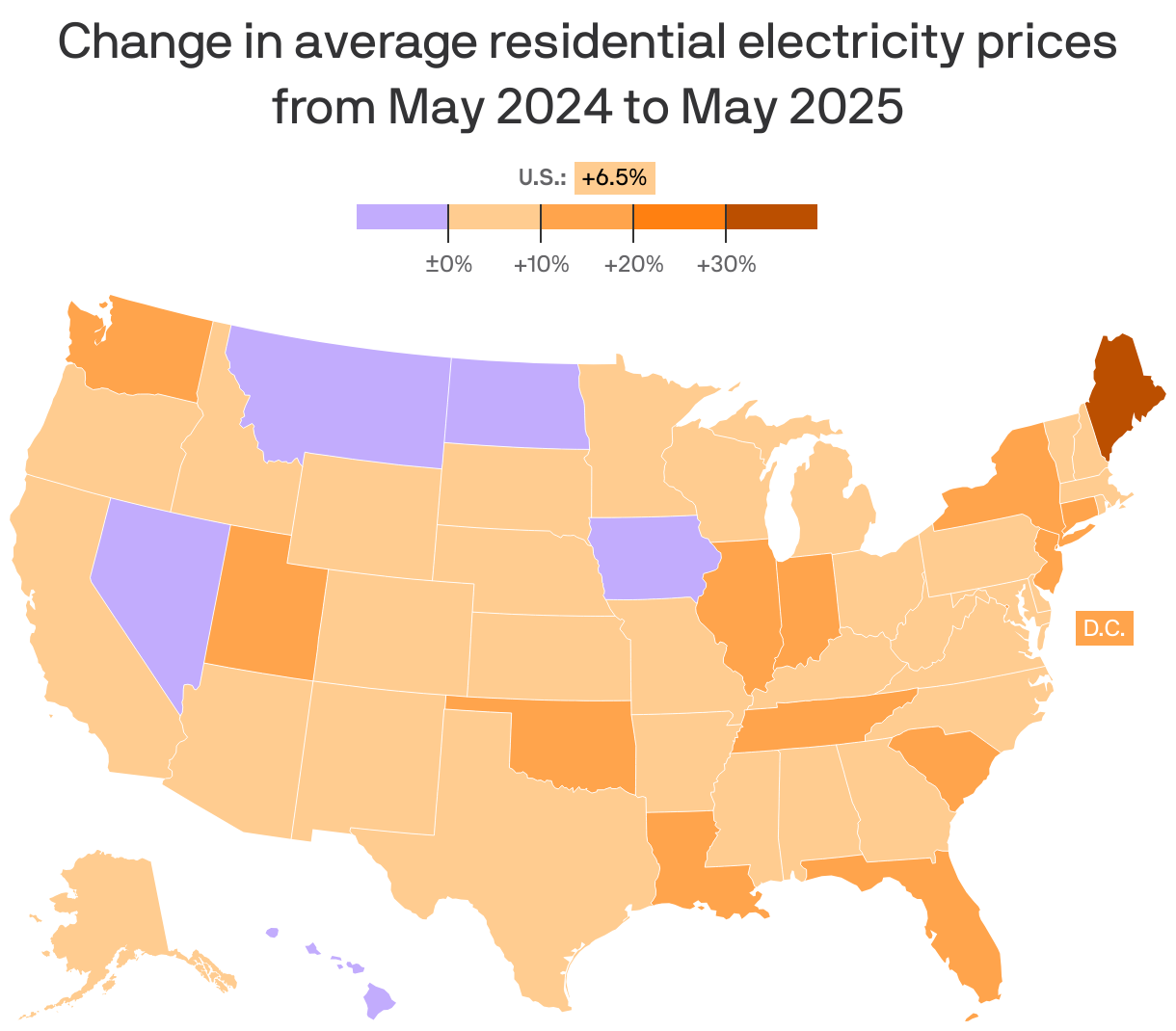
Electricity costs are rising nationwide, and they could get even higher for some amid the explosion in data centers powering AI and more.
Why it matters: Surging power bills could further stress the budgets of many Americans as pretty much everything else gets more expensive.
By the numbers: The nationwide average retail residential price for 1 kilowatt-hour of electricity increased from 16.41 cents to 17.47 cents between May 2024 and May 2025, per the latest available data from the U.S. Energy Information Administration, a gain of about 6.5%.
Zoom in: Electricity prices vary regionally and have many influences, from basic supply and demand to fuel rates and infrastructure costs.
- Yet many analysts point to power-hungry data centers as a driver of rising rates, especially in data center hotspots.
- That is partly because data centers have an immediate demand for energy, but also because grid operators are investing in new transmission lines and other gear to handle the expected proliferation, and then passing the costs along to customers.
What they're saying: "Anywhere you're seeing a massive takeoff in load growth, the most likely cause is data centers, and that is almost certainly going to have an impact on electric rates," says Cathy Kunkel, an energy consultant at the Institute for Energy Economics and Financial Analysis.
- A new analysis by the group highlights a dramatic spike in capacity market prices set at auction by PJM — an electric grid operator covering many Mid-Atlantic and Midwest states — largely tied to data centers, like those in "data center alley" in Northern Virginia.
- One estimate found that data centers accounted for more than 60% of the rise in prices in a PJM auction held last year, the report says, representing $9.3 billion that will be passed along to customers.
Friction point: Data centers' need for power may outstrip electric utilities' ability to feed them, a report from the Virginia General Assembly's Joint Legislative Audit and Review Commission finds, slowing their growth.
- Meanwhile, utilities that invest in new infrastructure to power the AI boom could find themselves in trouble should that boom turn out to be a bubble.
- What good are a bunch of new transmission lines if there is no power-thirsty customer at the other end?
The bottom line: Many of us are now paying for the AI boom, whether we use the tech or not.
Axios Markets