Axios Markets

October 28, 2025

Amazon announced sweeping layoffs of corporate workers, raising concerns about whether the low-hire, low-fire business environment has turned into a low-hire, high-fire one. Stocks hit a record yesterday as traders focused in on interest rate cuts and frameworks for a trade deal with China.
- Today: As five of the Magnificent 7 are set to report earnings this week, we look at which firms could be the next members of the Big Tech super group.
- Plus: Dealmaking is back with tens of billions of dollars in M&A in one day.
Let's get into it. All in 900 words in 4 minutes.
1 big thing: AI stocks could be part of a new Mag 7


As five of the Magnificent 7 report earnings this week, investors are looking for fresh ways to play the AI boom beyond those overbought Big Tech stocks.
Why it matters: Wall Street is shifting its attention away from the Mag 7 and throwing a spotlight on three AI companies: Oracle, Palantir, and Broadcom.
What they're saying: Those companies came up in calls with more than half a dozen strategists about potential Mag 7 candidates.
- Oracle is "emerging as a key competitor in the cloud business," says Joe Tigay, portfolio manager of the Rational Equity Armor Fund.
- Nancy Tengler, CEO and chief investment officer of Laffer Tengler Investments, is buying Palantir because of the CEO's vision.
- "The AI story is fully priced into Nvidia, but it's not priced into Broadcom," says Jay Goldberg, senior analyst at Seaport Research Partners.
- And Nvidia could face competition as Qualcomm yesterday announced new data center chips, pushing its stock up as much as 20%.
Zoom in: The broad bull case for these stocks? They could all eat the lunch of the existing Mag 7 members.
- Oracle struck a recent deal with OpenAI that puts it in direct competition with cloud giants Microsoft, Amazon and Google, Tigay notes.
- Palantir will grow into its high valuation, says Dan Ives, managing director at Wedbush Securities, adding its AI is "disrupting the software landscape like an earthquake."
- Broadcom builds custom chips for large customers. While Nvidia chips are considered the dominant industry player based on performance, Broadcom could catch up.
Zoom out: Tengler is trimming her exposure to Oracle and Broadcom because she was so early to both names that after their recent rallies to record, the two stocks made up too hefty a chunk of her ETF.
- She eyes IBM as the next Oracle, given that the company has 47% of the disclosed quantum computing deals.
Yes, but: If a major concern with the Mag 7 stocks is that they are expensive, then so are the three contenders.
- Oracle has a price-to-earnings ratio of 65, while Broadcom's P/E ratio is nearly 92. For context, Nvidia's P/E ratio is just over 54.
- Still, if the market has taught us anything this year, it's that stocks can have long rallies ahead even if they are already expensive.
The bottom line: The Mag 7 isn't dead just yet.
- "It's widening out," Tigay says. "I would say those seven companies are still magnificent…there's nothing wrong with those companies." Nonetheless, investors are looking for names where the AI growth story isn't priced in.
2. Dealmaking roars back to life under Trump 2.0
Merger Monday is back, with U.S. traded companies announcing more than $80 billion worth of deals to kick off the week.
Why it matters: While the stock market continues climbing a wall of worry about a potential AI bubble and further policy uncertainty, dealmaking looks overwhelmingly positive.
Driving the news: The total value of the deals on Monday hit $81.4 billion.
- American Water Works and Essential Utilities announced an all-stock merger worth $63 billion.
- Novartis struck an $12 billion deal to buy rare-disease biotechnology company Avidity Biosciences.
- Huntington Bancshares agreed to acquire Cadence Bank for $7.4 billion, the second-largest regional banking deal this month.
What they're saying: "You have lower regulation. That's what's happening," says Phil Pecsok, founder and CEO of Anacapa Advisors.
- He attributes the surge in dealmaking to falling interest rates, the pent-up demand in M&A, and the increasingly positive regulatory backdrop under the Trump administration.
- "You have a pro-business, business president," he says.
By the numbers: Global M&A volume jumped 43% in the third quarter from a year ago, led by large strategic transactions, according to Morgan Stanley.
- The bank expects deal activity to keep rising, by 32% this year and another 20% in 2026. It forecasts $7.8 trillion in total announced transaction volume by 2027, including buybacks and sponsor deals.
Zoom out: Dealmaking is also accelerating among private companies, although largely centered around AI, according to Crunchbase.
- AI companies captured nearly half of global venture funding in the third quarter, says Gené Teare, senior data editor at Crunchbase.
What to watch: If this wave of M&A is the opening act of a multiyear boom. Looser regulatory policy, rising corporate confidence, and wide open capital markets is a mix that Morgan Stanley says could keep dealmaking hot.
3. Robinhood Strategies hits $1 billion in assets
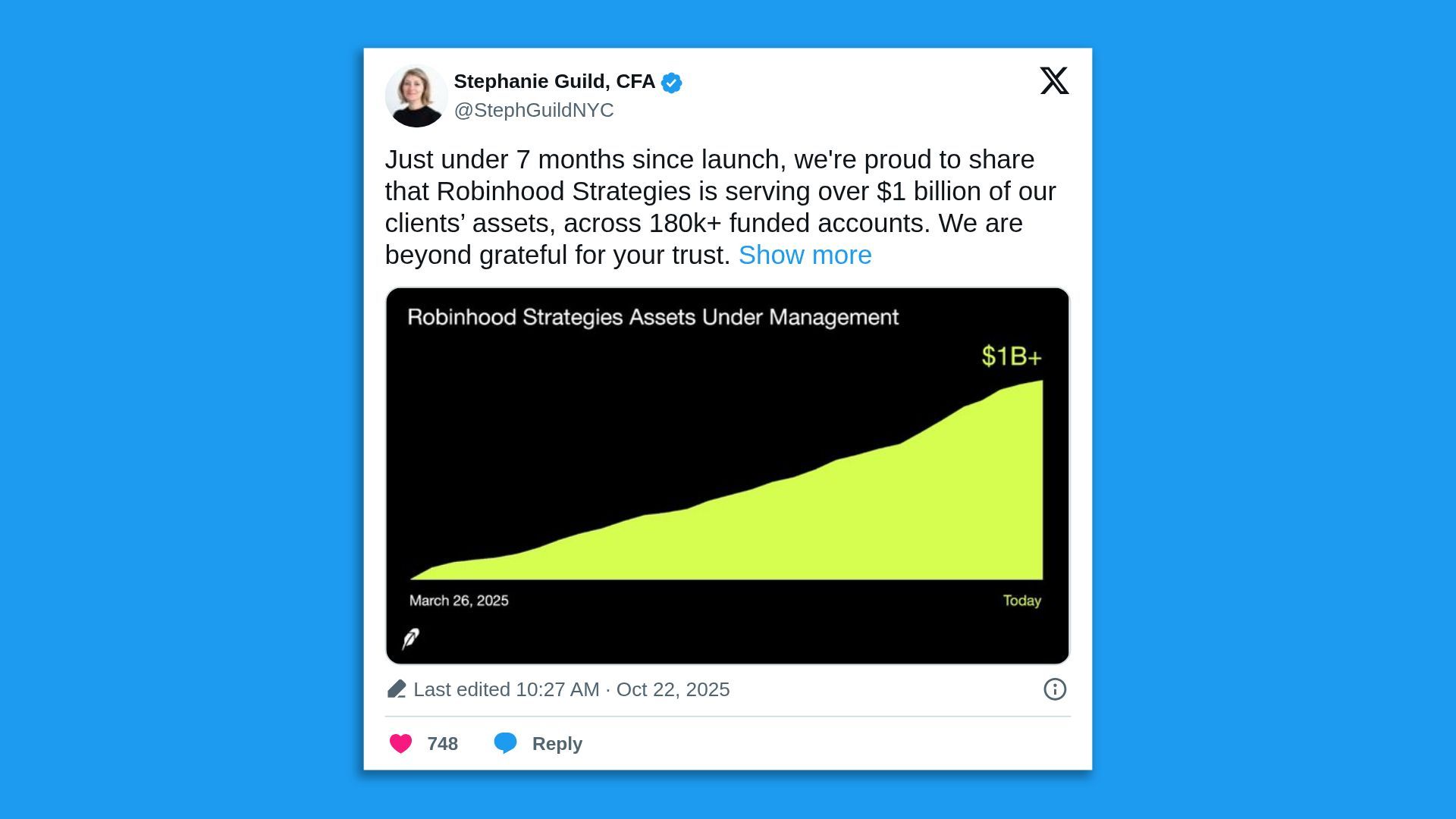
Robinhood Strategies, which is Robinhood's version of a robo advisor, now has $1 billion in assets under management, says Stephanie Guild, the chief investment officer for the firm and manager of investments for Strategies.
Why it matters: Retail investors are turning to Robinhood, instead of banks, to manage their money.
👀 Got tips? Email me at [email protected]. I would love to hear from you about anything that may be of interest for our investor audience.
Thanks to Jeffrey Cane for editing and to Anjelica Tan for copy editing. See you tomorrow!
Sign up for Axios Markets