Axios Markets

October 26, 2021
😎 Good morning! Welcome to another day with Markets.
✉️ Today's newsletter is 1,239 words, 5 minutes.
1 big thing: S&P denies allegations it sells index inclusion
Illustration: Sarah Grillo/Axios
Can companies buy their way into the S&P 500? That's the explosive allegation made by a recent NBER paper — one that's strenuously denied by S&P itself, Axios' Felix Salmon writes.
Why it matters: According to S&P's own calculations, some $13.5 trillion is indexed or benchmarked to the S&P 500. That's well over $100,000 per U.S. household. Any question as to the integrity of the index has to be taken seriously.
The intrigue: Three researchers, including former Asian Development Bank chief economist Shang-Jin Wei, now at Columbia University, spent two years examining additions to the S&P 500, and whether they could be explained using published criteria.
- They found that when a firm purchases a credit rating from S&P (but not when it purchases a credit rating from rival Moody's), its chances of being added to the S&P 500 are higher.
The other side: S&P says there's simply no mechanism whereby that could happen; that its ratings and indices arms are two separate companies that don't talk to each other.
- David Blitzer, who led S&P's index committee for much of the period covered in the paper, told the FT that he was "prohibited from speaking to anyone in S&P Ratings without legal counsel present" and that he wouldn't have even known if a company had hired S&P Ratings to rate its bonds.
The big picture: S&P Dow Jones Indices is something of a black box when it comes to decisions as to which companies belong in the S&P 500, and when they should be admitted.
- Published criteria for inclusion can feel arbitrary — Tesla was excluded from the index for years, for instance, because it wasn't consistently profitable enough. And most hot recent IPOs are also excluded from the index because of their dual-class share structures.
- The index, therefore, isn't the 500 largest companies listed in the U.S. — in fact, most of the time it isn't even 500 companies. S&P has significant discretion when it comes to which companies it includes in the index, although the researchers and S&P disagree on just how much S&P exercises that discretion.
Between the lines: The paper shows that companies step up their purchases of S&P ratings when vacancies appear in the index, or when they become large enough to qualify for inclusion. They don't act in a similar manner with respect to Moody's ratings.
- The evidence suggests that companies believe that purchasing a rating will increase their chances of getting into the index — whether or not that's actually the case.
The bottom line: The paper has not yet been peer-reviewed, but it undoubtedly raises serious questions, many of which could be fixed by S&P moving to a much more automatic and much less discretionary methodology for composing its flagship index.
2. Catch up quick
Mastercard inked a deal with cryptocurrency firm Bakkt, in a bid to allow credit and debit cardholders to pocket card rewards in the form of crypto. Bakkt’s stock has more than tripled since Friday afternoon. (Bloomberg)
The Treasury Department announced that Janis Bowdler, formerly of JPMorgan, will serve as its first counselor for racial equity, a new position created to promote economic opportunities for communities of color. (WSJ)
Modern Land became the latest Chinese real estate developer to default on its debt, failing to pay back a bond that was due Monday, and adding to a record tally of offshore bond defaults by China-based companies. (Bloomberg)
3. Tesla hits $1 trillion

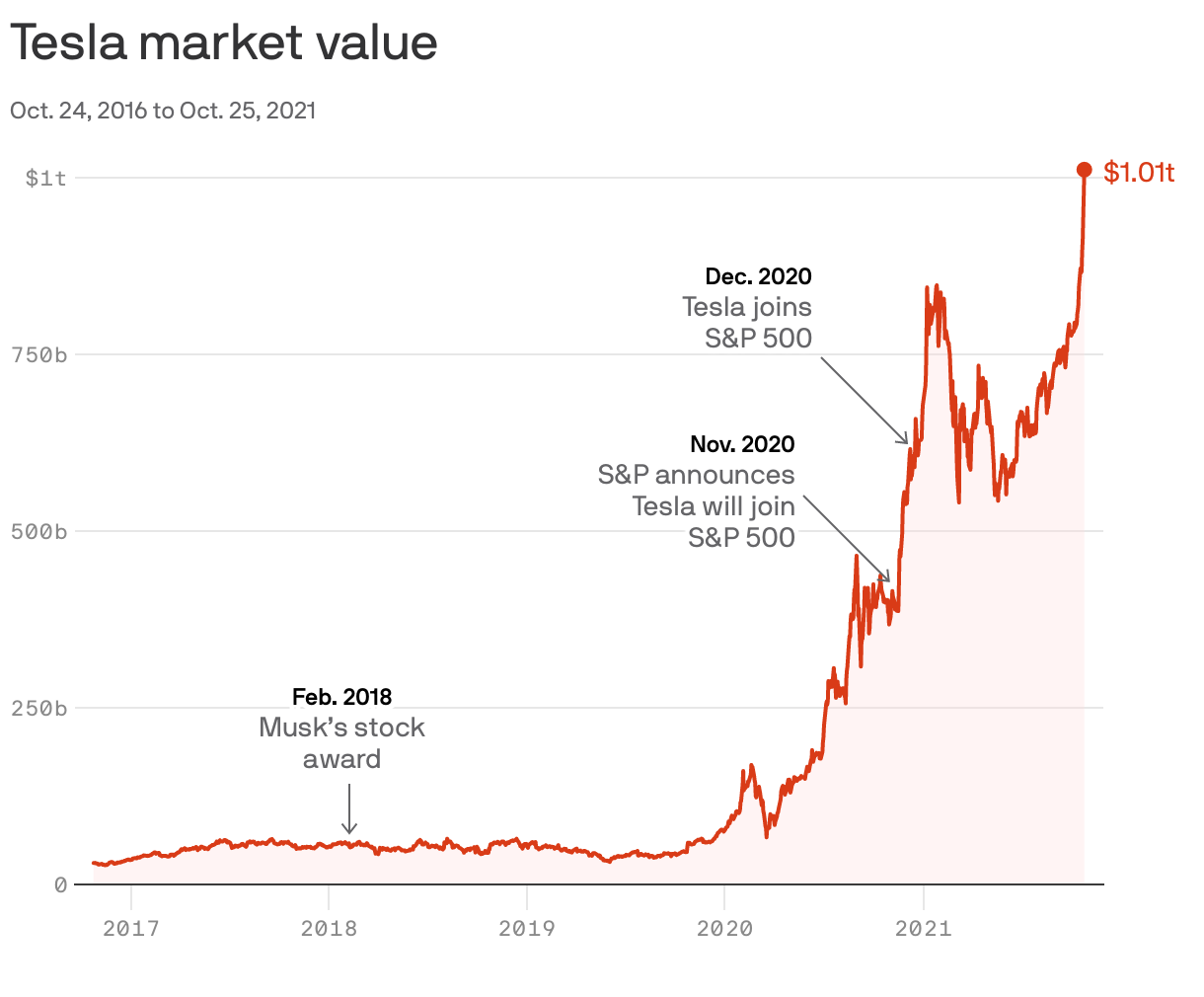
Tesla joined one of the most exclusive clubs in the world Monday when an announcement about Hertz buying its cars sent its market capitalization over the $1 trillion mark, Felix writes.
Why it matters: No matter how high it rises, Tesla stock always seems to be able to outperform expectations.
- Tesla's six-month average market cap is now $686 billion — comfortably above the $650 billion maximum target embedded in a 10-year employment agreement that CEO Elon Musk signed in 2018.
- The agreement also includes operational milestones. Musk has already met seven of them, with another three "probable," according to an SEC filing. Assuming that Tesla's market capitalization remains above $650 billion, then Musk will be fully paid out, earning 20.3 million shares of stock, way ahead of schedule.
- Those shares are worth about $21 billion as of the close of trade on Monday.
By the numbers: Tesla stock was trading at $408 per share when S&P announced in November 2020 that it would finally be joining the S&P 500. The announcement precipitated a massive rally in the shares, which were trading at $650 on Dec. 21, 2020, the date Tesla actually joined the index.
- Index fund investors don't seem to have overpaid: At $1,024.86 per share as of the close of trade on Monday, the car company has outperformed the index by more than 34 percentage points.
The bottom line: The only other companies in the world worth more than $1 trillion are Apple, Alphabet, Microsoft and Saudi Aramco. That's pretty exalted company for Tesla to be in.
4. Facebook's scandals have been great for shareholders


Facebook has been embroiled in scandal for the past five years, and while the specific allegations change over time, a central theme is constant. Given the choice between commercial and moral imperatives, Facebook always seems to choose the option that is best for the share price, Felix writes.
Why it matters: Facebook's stock chart supports that narrative. Since the 2016 scandals alleging that the social network was infiltrated by foreign actors trying to influence the outcome of democratic elections, Facebook's revenues — and its stock — have been soaring.
Between the lines: While extreme profitability hardly proves malign intent, it's entirely consistent with the narrative that Facebook is much more interested in growth than in addressing internal or external concerns about its deleterious effects on the nation and the world.
The bottom line: Facebook reported Monday that it generated over $10 per user in the most recent quarter alone, and has some 3 billion users worldwide.
- That might make the company too big to manage — but so long as the profits keep on rolling in, Wall Street, for one, seems happy.
5. Rent relief flows
Illustration: Brendan Lynch/Axios
More renters got help last month, as the Treasury Department released a record amount of emergency rental assistance, Axios’ Hope King writes.
Why it matters: After an initially slow rollout of the Treasury program, the Biden administration over the summer put pressure on states to speed up disbursements.
- September also marked the first month after the Supreme Court overturned the federal ban on evictions.
Driving the news: More than 510,000 households received support of nearly $2.8 billion in total in September, Treasury said Monday.
- That's an 11% increase in households that received aid, and a 22% jump in the amount of aid disbursed, compared to August.
- All told, the program has facilitated 2 million household payments, totaling more than $10 billion.
Context: The federal government allocated a total of $46.55 billion in emergency rental assistance as part of last year’s coronavirus relief package and Biden’s American Rescue Plan.
- Yes, but: There had been little state and local infrastructure in place for renters and landlords to apply — or for agencies to process applications and to disburse the funds quickly.
What we're watching: The Treasury Department will begin to reallocate unused state and local funds next month — and will send the money to states that are asking for more.
Sign up for Axios Markets

Stay on top of the latest market trends and economic insights