Axios Markets

August 05, 2023
Does it really matter how much effort I put into this week's newsletter? I ask that question below.
- Also: What Fitch-related headlines tell us about markets reporting, how much ESPN makes from people who aren't sports fans, and more. All in 1,373 words, a 5-minute read.
1 big thing: The American Dream has lost its hustle

Illustration: Annelise Capossela/ Axios
News organizations can't quit writing about "quiet quitting" and its close cousins — bare minimum Mondays, lazy girl jobs, loud quitting, grumpy staying, hush tripping, "act your wage," etc., etc.
Why it matters: The popularity of such stories, which largely describe behavior as old as time, reveals something important about how the American Dream has changed significantly in the wake of the pandemic.
Between the lines: Young Americans mistrusted capitalism — they were convinced that employers were exploiting their labor — even before the pandemic .
- Now, with a strong labor market at their backs, they are increasingly proud of, and being lauded for, turning the tables on their employers — the exploited have become the exploiters.
How it works: The behaviors themselves are mostly decades old. The phrase "phoning it in" dates back at least to 1938, and the novelty then was the phone, not the conduct.
- What's new is that the underlying attitude has been transformed. It used to be something to be ashamed of; now it's something millions aspire to and celebrate. The r/antiwork forum ("Unemployment for all, not just the rich!") has 2.7 million members.
- Hustle culture, even among the self-employed, is on the wane.
Flashback: The 1999 movie "Office Space" came thisclose to making slacking off heroic — but then, in the final scene, it turns out that the protagonist, Peter Gibbons, is perfectly happy to put in an honest day's work after all. It wasn't the all-American paragon of hard work he was rebelling against, just soulless corporate drudgery.
- In fact, Gibbons quits what might now be termed a lazy-girl career in order to achieve happiness. That's the exact opposite of workers today, who achieve happiness by minimizing the amount they do for their employer.
The big picture: The pandemic reminded us all that we only live once and that devoting decades of our lives to making other people rich might be a suboptimal use of our precious time on this planet.
Be smart: The Great Resignation, combined with the rise of hybrid work, helped to usher in an era where job satisfaction has reached all-time highs, partly because being interested in your job is less important to workers than it used to be.
- The key to job satisfaction turns out, at least for a substantial minority of workers, to be the ability to be happy in a job where you're not excelling, or even trying to do so.
- If workers can't have it all, then jettisoning ambition in many cases is going to be the utility-maximizing move. It also makes it much easier to carve out personal time in a world where working from home means that on some level you're always at work.
- Money buys happiness, work buys stress; so one smart post-capitalist move can be to work enough to be happy but not so much as to be stressed.
The bottom line: Hard work used to be part and parcel of the American Dream. For millions of younger workers, that's no longer the case.
2. Behind the markets headlines

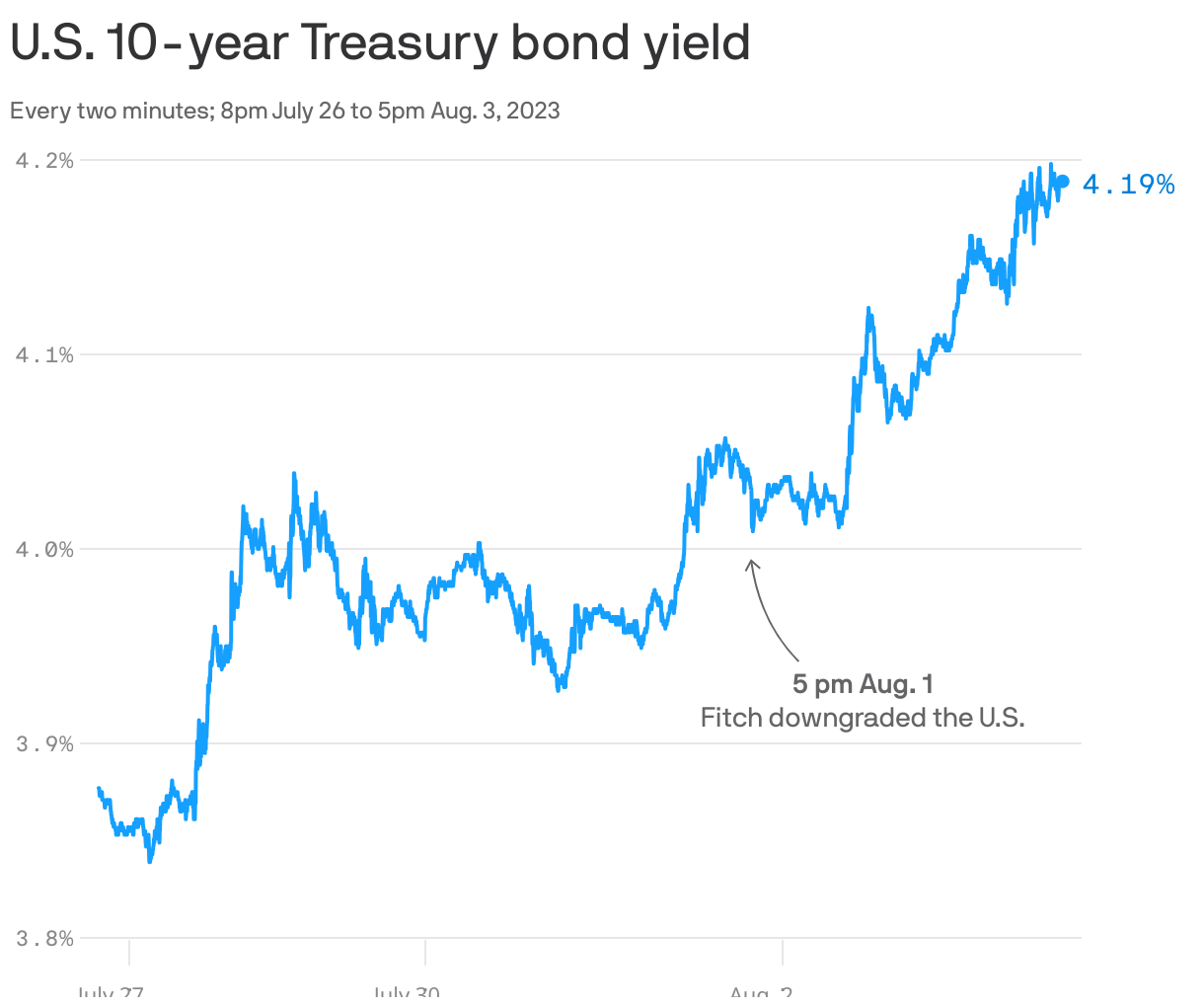
Two noteworthy things happened in the world of Treasury bonds last week: Fitch Ratings downgraded the U.S., and the benchmark 10-year bond yield rose to a level not seen since November.
Why it matters: The Fitch report hit the U.S. on multiple fronts, citing "fiscal deterioration," "erosion of governance," and more.
Between the lines: For markets reporters, the coincidence was irresistible.
- In the two days following the Fitch downgrade, almost every market report mentioned the downgrade in its headline.
- Typical headlines included: "Global markets slide after Fitch downgrades US debt" and "US Treasury yields hit 2023 highs after Fitch downgrade."
The big picture: Journalists and traders are human, and humans are storytellers.
- In order to try to understand something, we tell ourselves a story about it — and when journalists ask traders what's moving the market, they are asking to be told a simple, easy-to-understand story.
- Such stories are rarely true — that's why journalists are careful to use words like "after" instead of "because." But they scratch the itch of wanting to know why something happened, in a world where the best explanation of short-term market moves is nearly always the deeply unsatisfying one that they follow a random walk.
Be smart: While one day is certainly a period of time that coincides with news-media publishing schedules, it's a terrible period of time in which to gauge market moves.
- A one-week period, as in the chart above, can begin to show trends — in this case, yields rising ahead of hundreds of billions of dollars in new bond issuance from the U.S. government. Charts spanning months or years can begin to show what happens over an amount of time that a normal individual investor might hold a stock.
- An intraday chart can show the immediate market reaction to an unexpected piece of news — a merger announcement, say, or a CEO being fired. Often in such cases there's a sharp immediate move, and thereafter the stock trades in a relatively narrow band.
Driving the news: The Fitch report was certainly "a talker," as Axios' Mike Allen might put it. Lots of people wanted to discuss what, if anything, it meant.
- In terms of market moves, however, the effect of the report was tiny: If you squint, you can just about make out a move from a yield of 4.03% before the report came out at 5pm ET on Tuesday, to a yield of 4.01% afterward. Yes, yields went down — not up — after the downgrade became public.
The bottom line: Sensible investing is a long-term endeavor, and sensible investors generally ignore both one-day moves and ersatz explanations for them.
- Daily market reports don't tell you why the market moved; they just tell you what stories people are telling. Those stories rarely last long enough to be important or meaningful.
3. How much non-fans pay for sports

Illustration: Brendan Lynch/Axios
Sports franchises only ever seem to rise in value — as do the value of the contracts those teams give their players. Much of that money comes from fans, in one way or another. But a lot of it comes from non-fans, too.
Why it matters: If you're one of the large but dwindling band of Americans who still buys a cable bundle, then you almost certainly fall into one of two groups — people who watch sports, and people who don't.
- If you're in the latter camp, then you are paying a lot of money for sports you don't watch.
How it works: Almost everybody with a cable bundle pays about $12 per month to Disney for the ESPN family of stations. But not everybody watches those stations.
- If the stations were sold as their own separate bundle, they would have to charge somewhere between $40 and $50 per month just to keep revenue flat, per the NYT — one of the reasons why ESPN's economics are becoming fraught enough that its streaming-focused owner, Disney, is now considering selling off part of the unit.
- In other words: Sports fans probably account for a minority of the billions of dollars generated annually by ESPN. The rest comes from people who might never watch sports but who pay for them anyway as part of their cable bundle.
By the numbers: ESPN has 74 million subscribers. At $12 per subscriber per month, that works out to $10.6 billion per year, most of which ends up going to sports leagues, and thence to owners and athletes.
- If half of those revenues come from subscribers who never watch ESPN, then the sports world is receiving some $5 billion per year from non sports fans.
The bottom line: TV watchers have more choice than ever — and non sports fans can increasingly find what they need without paying for a cable bundle that includes ESPN. That's a large part of the reason why the number of cable subscribers is going to continue to decline.
4. Building of the week: The Searing House, Kansas

Kansas architect Bruce Goff built 7821 Fontana Street, in Prairie Village, Kansas, in 1967, at a cost of roughly $27,000.
- The open-concept house, currently configured as a 1,515 square-foot one-bedroom, at one point comfortably housed a family of five.
- It was listed for sale last fall "as a piece of art more than anything else" at $975,000 but failed to sell. The current asking price is $595,000.
Thanks to Kate Marino for editing this newsletter and to Jay Bennett for copy editing it.
- Special thanks, too, to Tory Lysik and Alice Feng on the dataviz team. You'd be surprised how nontrivial it was to build that bond-yield chart.
Sign up for Axios Markets

Stay on top of the latest market trends and economic insights