Axios Markets

October 06, 2025

🔥 Another record close last Friday cemented 2025 as the 20th most all-time-high-packed year on record and we just started the fourth quarter! What could derail this rally and force me to find a new way to start each newsletter...
- Today: Wall Street says the economy will only go up from here.
- Plus: Exclusive data on the hottest AI stocks for retail investors.
📺 Best-selling author and podcaster Mel Robbins explains to Axios CEO Jim VandeHei how people can keep their sanity in a world of chaos. See the clip.
- Catch the full interview out tomorrow and subscribe to our YouTube.
Let's get into it. All in 990 words in 4 minutes.
1 big thing: Wall Street thinks the best is yet to come

After a year of mixed economic signals and policy uncertainty, Wall Street strategists are growing more optimistic the economy will rev up in 2026.
Why it matters: Easier credit and less policy uncertainty will create favorable conditions for the economy next year, strategists and analysts say, even if labor market data is painting a murky picture for growth at the moment.
What they're saying: The fourth quarter "might feel a little uncomfortable," cautions Sam Zief, global macro strategist with JPMorgan. "It's probably the slowest that the economy is going to be, and things look better as you move into 2026."
- The Federal Reserve is cutting interest rates from a "risk management" perspective, not because of a recession, Zief says, which could prevent layoffs or a deeper deterioration in the jobs market.
- The long end of the yield curve isn't steepening significantly, a sign that the bond market supports the central bank's slow methodical rate-cut path.
- That drives looser financial conditions, improves lending opportunities for smaller businesses, and creates more room for growth in the economy.
- Policy uncertainty around tariffs has also fallen sharply since the spring, priming companies to take advantage of this easier financing and invest in people and operations.
Between the lines: Small businesses are the largest U.S. employer and are often the first to pull back when borrowing costs rise.
- They rely heavily on regional banks and floating-rate loans, which makes them especially sensitive to policy moves at the short end of the curve.
- As rates come down, regional banks are more willing to lend, giving small businesses better access to credit. That stabilizes hiring, easing one weak spot in the economy and reducing the risk of a broader layoff cycle.
- Even a modest pickup in small business activity can ripple through the labor market, supporting both employment and consumer demand.
Yes, but: The AI narrative driving the bull market has within it a promise of productivity gains.
- Productivity is "just a real polite way of saying something crass: robots for people," Chris Wolfe, president at Pennington Partners, a multifamily office firm, tells Axios.
- There are conflicting reports on how AI is impacting the labor market, but so far, signs of workers being replaced by AI en masse have not shown up.
- AI "has the potential to improve the fortunes of the middle classes rather than generate mass unemployment," Dario Perkins, managing director for TS Lombard, writes in a note to clients.
The bottom line: If the Federal Reserve continues to cut rates and inflation remains under control, an economic reacceleration may be in store for 2026.
2. Exclusive: Retail investors move into riskier AI bets
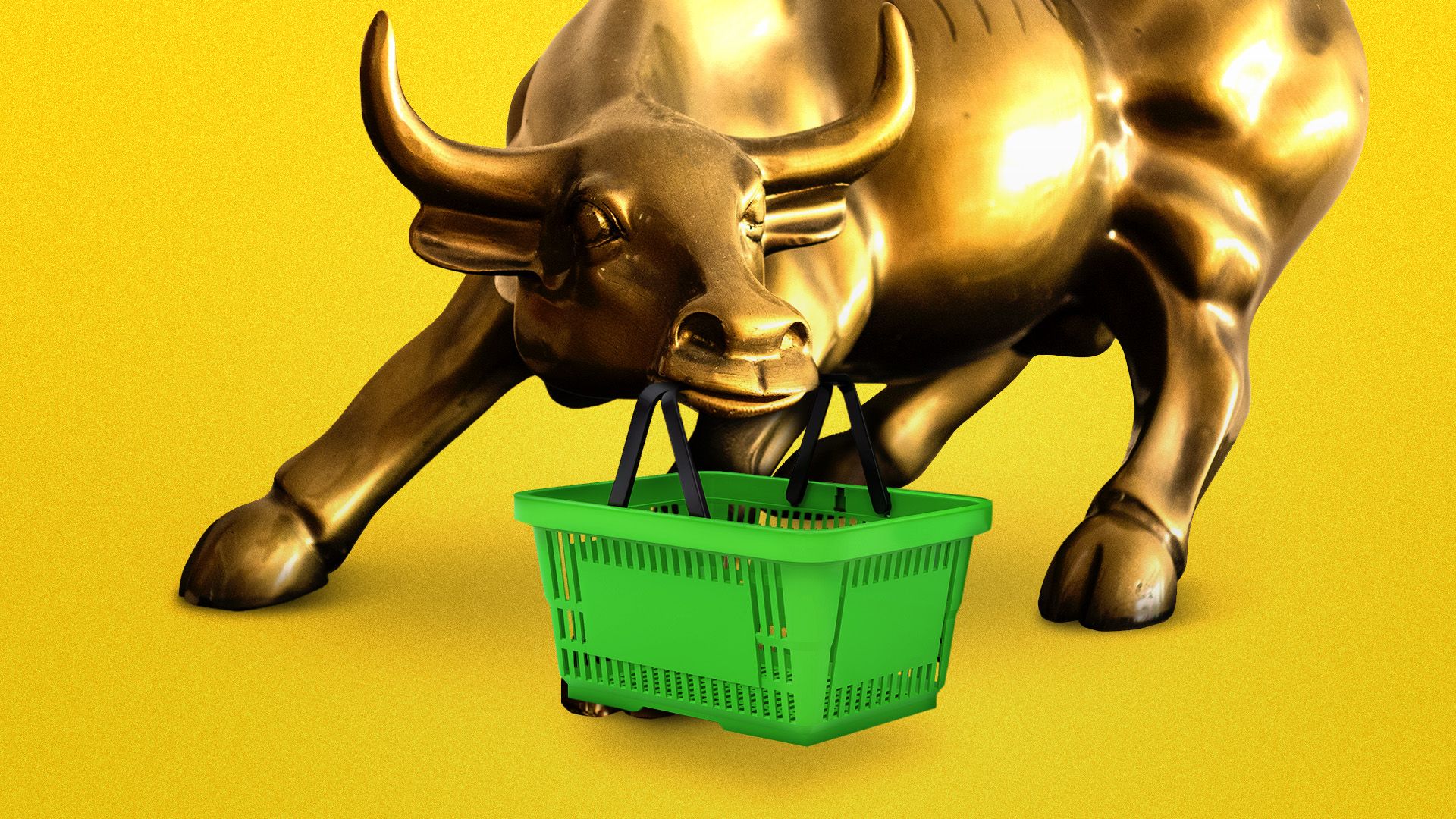
Retail investors are shifting away from the Magnificent 7 stocks in favor of riskier AI plays, according to Charles Schwab's Trading Activity Index known as the STAX, which tracks the retail trading activity of millions of customers.
Why it matters: The Mag 7 moment is nowhere near over, but that basket of seven Big Tech stocks may be losing its popularity among retail investors.
Catch up quick: Retail activity got more aggressive following last month's cut in interest rates from the Federal Reserve. The Mag 7 stocks aren't generating the biggest returns, even as the S&P 500 continues to hit record highs.
- "Nvidia is not even cracking the top 50 in terms of year-to-date performance," Joe Mazzola, head trading and derivatives strategist at Charles Schwab, tells Axios in an exclusive interview.
- Retail clients noting these trends went shopping for other opportunities in September, buying Oracle, CoreWeave and Opendoor. They also sold Tesla, Apple, Alibaba, Micron and Super Micro Computer.
Between the lines: The new entrants on the top buying list for retail clients suggest investors want to freshen up their portfolios for higher returns.
What they're saying: "These are stocks trading with a higher beta and higher volatility, and it says to me that clients are feeling more comfortable taking on that risk," Mazzola says, adding investors were more focused on AI-adjacent stocks across various sectors as well.
Zoom out: This kind of higher volatility trading, with investors getting in and out of stocks versus buying for the long term, is a shift from the more skittish retail activity in the summer. In August, Mazzola says, retail activity was not screaming "'let's jump with both feet into this pool' at this point."
- Retail investors are now actively allocating to more volatile stocks.
What we're watching: Risk level. If retail starts getting too adventuresome, that could be a concern.
- "When I do get nervous is when I see all one-way momentum trades or whatever…call options, we're not seeing that yet," according to Mazzola, "but it's not to say that can't happen."
3. Gold keeps rally alive and outpaces Mag 7 stocks
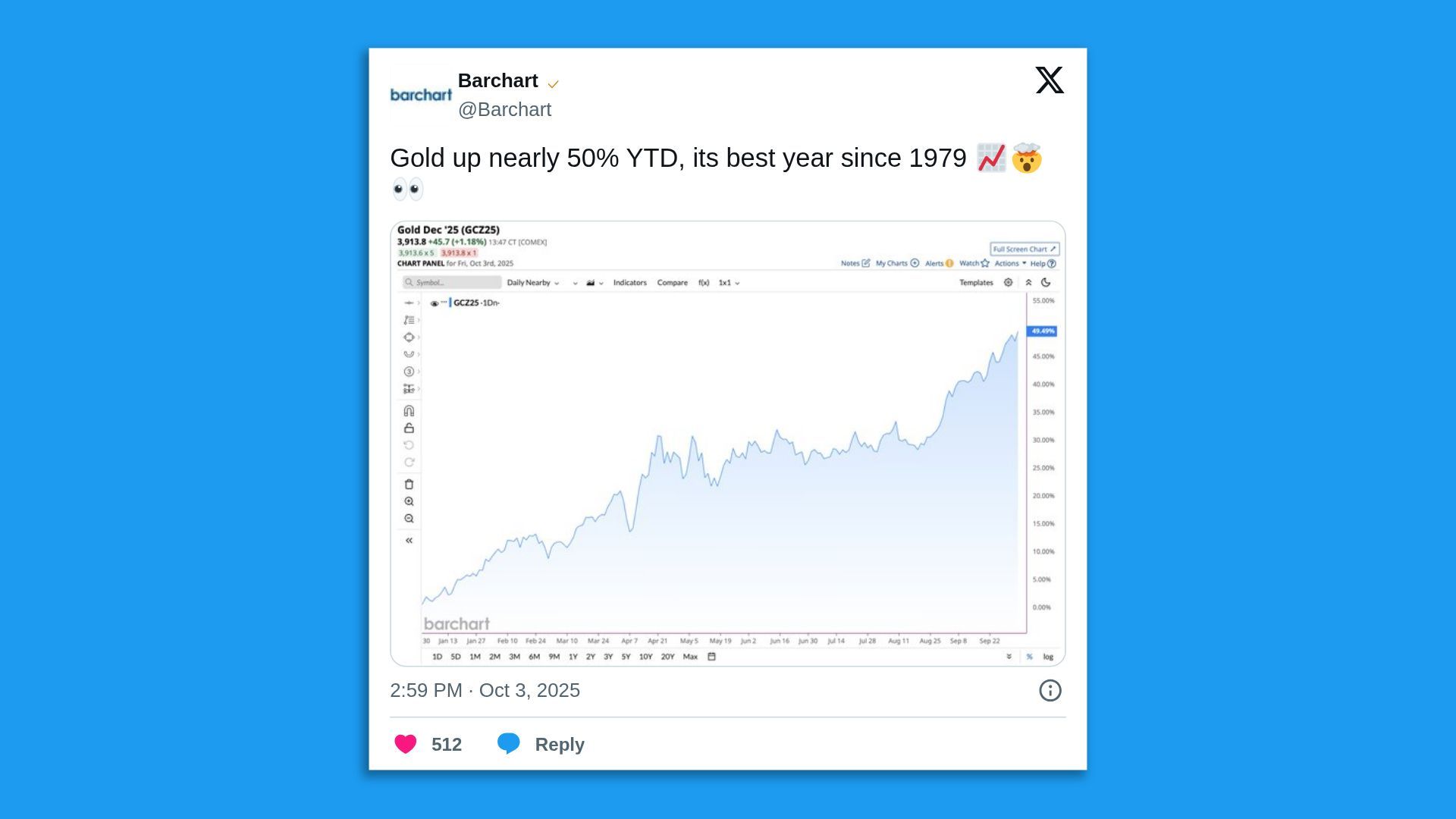
Gold is up about 50% year to date, outpacing every individual Big Tech stock within the Magnificent 7 in its best year since 1979.
What they're saying: Goldman Sachs sees more upside ahead, predicting gold will rise to $4,000 a troy ounce by mid 2026. It's now trading just above $3,900 a troy ounce.
- Central bank demand globally coupled with interest rate cuts could fuel great demand, the bank notes.
👀 Got tips? Email me at [email protected]. I would love to hear from you about anything that may be of interest for our investor audience.
Thanks to Jeffrey Cane for editing and to Anjelica Tan for copy editing. See you tomorrow!
Sign up for Axios Markets