
Axios Markets

November 17, 2025

🔤 A new filing shows Warren Buffett's Berkshire Hathaway bought over $4 billion worth of Alphabet stock in the third quarter. It means the conglomerate now holds shares in three of the Magnificent 7 firms. Talk about an antidote to news of Michael Burry shuttering his fund over market efficiency concerns!
- Today: Public is set to launch an AI-powered brokerage.
- Plus: Tech debt is not getting much love from investors.
Let's get into it. All in 830 words in 3 minutes.
1 big thing: Public launches AI-powered brokerage
Investing platform Public is launching an AI-powered brokerage designed to research, build and manage portfolios, the company shares exclusively with Axios.
Why it matters: Competition among brokerages will likely intensify as firms use AI to make investing easier and stickier for users.
Zoom in: Starting today, users on Public will be able to create their own investable indexes using artificial intelligence.
- Users can ask for a portfolio of stocks that are beneath a certain price-to-earnings ratio and that are also tariff resistant, for example. Users can also remix indexes, combining stocks from the both S&P 500 and Nasdaq.
- These self-directed ETFs of sorts will come with a fee of 49 basis points.
Public also plans to launch an AI-powered wealth and portfolio manager in early 2026. This will let users set recurring actions on their accounts like:
- Auto-investing cash holdings once their balance hits a certain threshold.
- Auto-buying of stock dips or auto-selling of rallies in specific securities.
- Advising on tax-loss harvesting opportunities within their accounts.
What they're saying: "We've always sensed there is this gap in the market for a platform that the next generation can use to take investing really seriously and build that long-term, forever portfolio," Jannick Malling, co-CEO and cofounder of Public, tells Axios.
Between the lines: The company is willing to pay up for the AI technology with the hope that these features will drive more users and more trades.
- When Public launched an AI-powered research assistant, it found that almost half of the conversations led to a transaction within 24 hours.
Threat level: AI and automation in trading could bump up against regulatory guardrails meant to prevent unlicensed investment advice.
- Public says it addresses that by ensuring investment decisions are still "self-directed" rather than an agent "going rogue trading" for you.
- The Securities and Exchange Commission moved to regulate the use of AI by broker-dealers in 2024. It is unclear whether the current administration will pursue the policy.
- Investors should ask broad and unbiased questions when interacting with large language models in order to get the most accurate answers, Andrew Lo, finance professor at MIT, tells Axios.
What to watch: Public aims to take market share from institutional players with these tools.
- While Public once drew most of its account transfers from Robinhood, it now says the majority come from Charles Schwab and Fidelity.
2. Investors sour on tech debt amid AI arms race


The $3.5 billion, 30-year bond issued by Oracle has fallen about 8% since its October peak and is now trading at just 65 cents on the dollar.
Why it matters: This is a sign of growing investor unease over the Big Tech borrowing binge to fund artificial intelligence infrastructure.
Zoom in: The credit risk for Oracle has widened faster than the overall investment-grade market has, according to a Bank of America analysis.
- Five-year credit default swaps — insurance-like contracts which protect investors against a default of company debt — have widened to 80 basis points, the highest in about two years.
- Bank of America flags this as a warning that investors are uncomfortable with how Big Tech is financing its AI buildout.
Zoom out: Financial conditions have now loosened, helped by lower interest rates and a rally in risk assets.
- Even as credit spreads have widened recently amid some AI bubble concerns, they continue to remain near historically low levels.
- Still, the bond spreads and credit default swap spreads of tech companies are widening, making it more expensive to insure their debt.
- Bank of America says that trend reflects concern that tech companies may not have enough cash to finance the "AI capex arms race."
The bottom line: Just two weeks ago, bond investors were clamoring for their piece of the AI pie, with Meta's latest debt issuance four times oversubscribed.
- A decline in demand coupled with a selloff in Big Tech stocks could be an indicator that investors are questioning how much is too much to spend on an AI buildout without a clear path for the returns on that investment.
3. Tariff mentions are dropping on earnings calls
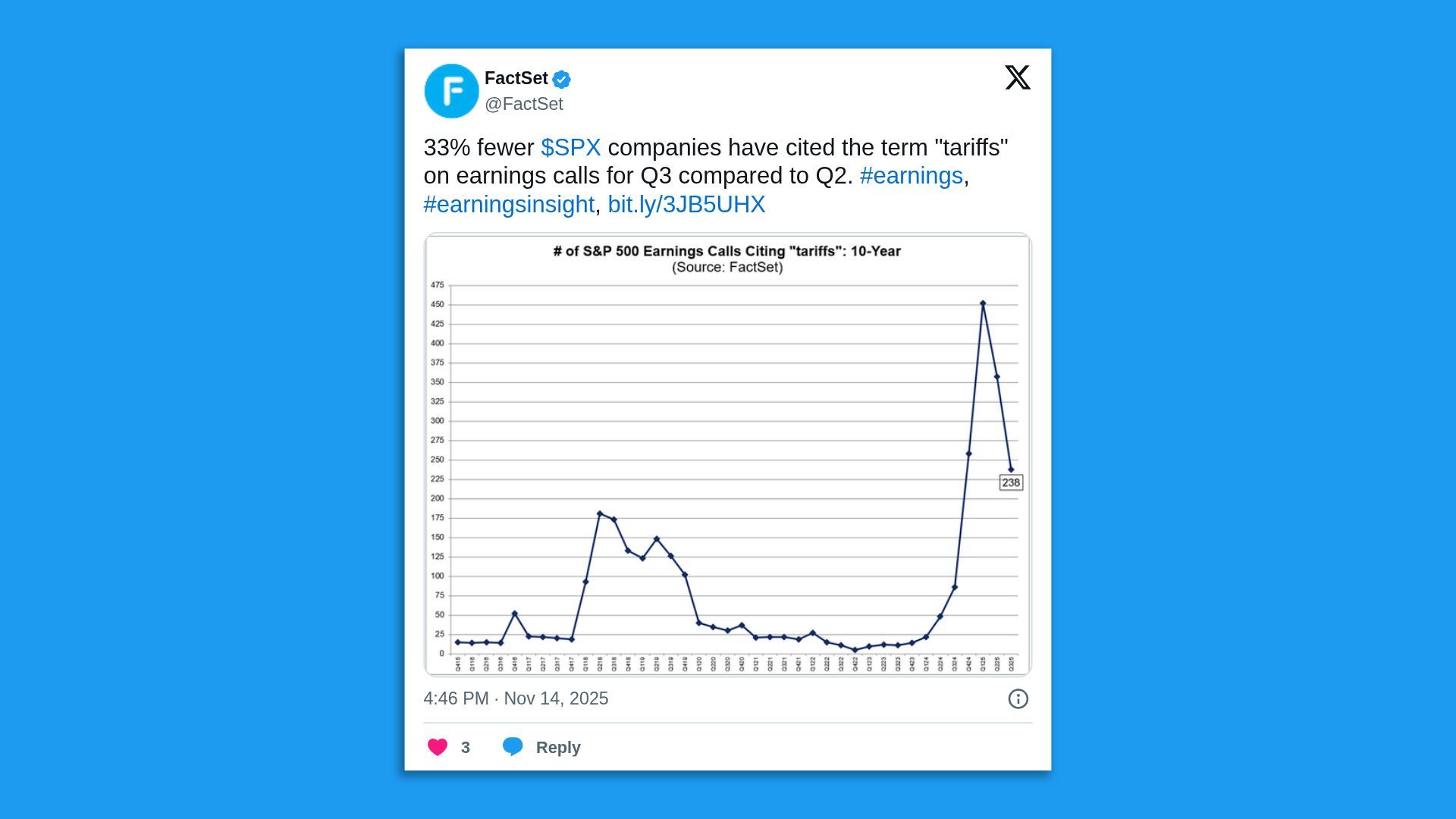
Tariff mentions on earnings calls are down, with 33% fewer companies mentioning the term in the third quarter compared with the second.
Why it matters: This is the latest signal Wall Street has moved on from the tariff concerns despite the levies causing an inflation uptick for some goods categories.
👀 Got tips? Email me at [email protected]. I would love to hear from you about anything that may be of interest for our investor audience.
Thanks to Jeffrey Cane for editing and to Anjelica Tan for copy editing. See you tomorrow!
Sign up for Axios Markets