Axios Markets

April 21, 2021
Good morning! Was this email forwarded to you? Sign up here. (Today's Smart Brevity count: 1,179 words, 4.5 minutes.)
🎙 “Here’s the truth about racial injustice: It is not just a Black America problem or a people of color problem. It is a problem for every American. It is keeping us from fulfilling the promise of liberty and justice for all, and it is holding our nation back from realizing our full potential.” - See who said it and why it matters at the bottom.
1 big thing: Inflation may not be so transitory

Illustration: Annelise Capossela/Axios
Procter & Gamble became the latest company to announce it will raise its prices in September to respond to higher commodity costs, joining consumer giants like Kimberly-Clark, Smuckers, Coca-Cola and a host of others.
Why it matters: Fed chair Jerome Powell and other top economists have all but decried that inflation is anchored and will not rise materially going forward, but a consistent drumbeat of price hikes from major companies, consumer reports and market data suggest the world may not be going along with their conclusion.
What's happening: Major brands have rolled out price hikes consistently over the course of the year, along with notable increases in the price of cars, construction, furniture and the cost of gas that are starting to show signs of staying power.
- The supply chain disruption that has pushed U.S. automakers like Ford and GM to close plants this year and pushed up prices for semiconductors and some other products already has lasted longer than expected and currently has no end in sight as producers struggle with production shortfalls.
What we're hearing: The current atmosphere of rising prices "could sustain for some time, quite frankly," Carl Chang, a regional director at the San Francisco Fed and CEO of Kairos Investment Management, tells Axios. "I don’t think it’s a 6-month or 12-month kind of thing."
- "Unless the Fed decides to take some major action I think inflation could run a little higher than certainly we’ve been accustomed to over the last decade."
Take a look around: Economists also are beginning to see upward pressure on wages, as more companies are finding workers unwilling to accept ultra-low wages and the demand for white-collar positions intensifies.
- Further, with OPEC+ holding its grip on oil supply, energy prices are expected to remain elevated and Chang says he expects supply chain disruptions to continue "over the next several years."
By the numbers: The latest reading of prices for both consumers and businesses showed sharp increases last month, with the consumer price index seeing the largest increase since August 2018 and the producer price index posting the biggest jump in almost a decade.
- The New York Fed's survey of consumers showed Americans expect inflation to rise by the most over a one- and three-year horizon since 2014 and market gauges of 5- and 10-year inflation expectations are holding near their highest levels since 2008 and 2013, respectively.
- "All of our distributors have indicated that price increases are coming," Don Katzenberger, CEO of S&K Roofing, Siding and Windows, told Bloomberg in late February.
The bottom line: None of this looks all that transitory.
2. Catch up quick
The UN is backing a group of 160 banks, asset managers, investors and insurers with over $70 trillion in assets pushing "to build a global zero emissions economy and deliver the goals of the Paris Agreement." (Axios)
Kum & Go is launching its own sneaker — adding to its list of viral marketing tactics lighting up Twitter and TikTok. (Axios)
Netflix added just under 4 million global subscribers last quarter, a far cry from the 6.2 million anticipated by Wall Street, and it expects to add just 1 million new subscribers this quarter. (Axios)
The ratio of insiders’ stock sales to buys recently rose to 143-to-1, according to data from Sentiment Trader, the highest since 2006 and nearly double the previous high. (Barron's)
Leaders from Apple and Google will face the Senate Judiciary Committee's antitrust subcommittee today, with lawmakers concerned about the way both companies run their app stores. (Bloomberg)
3. Skyrocketing housing prices drive the world's fastest unicorn
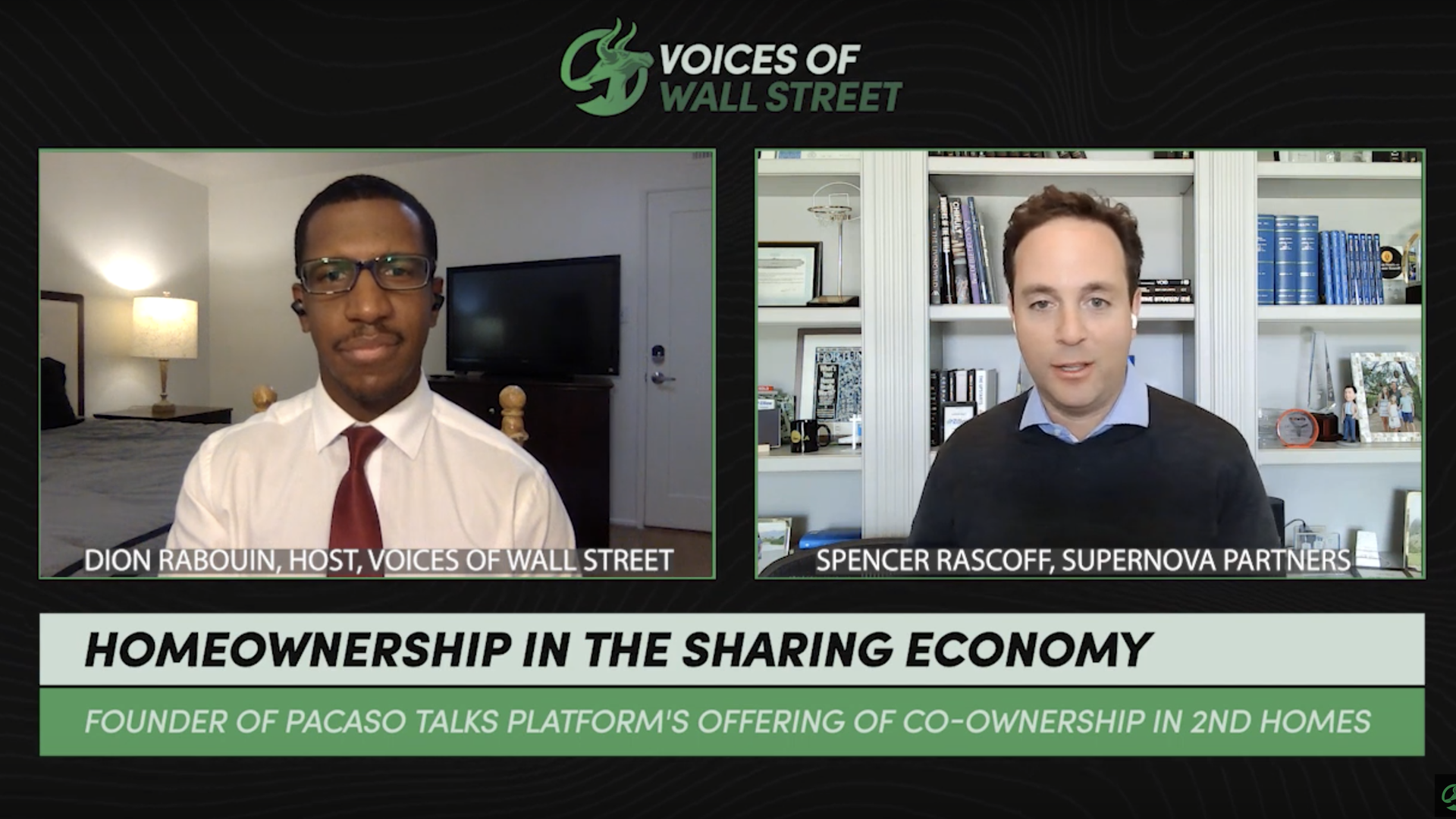
Screenshot of "Voices of Wall Street" interview with Spencer Rascoff.
With U.S. home sales scorching and home prices setting new record highs every month, Pacaso was able to demand a $1 billion valuation after less than five months in business by dividing up homeownership into fractional shares.
Why it matters: Pacaso's record-fast rise to unicorn status — "the fastest-growing company of anything I've ever seen before" co-founder Spencer Rascoff tells me on the latest episode of "Voices of Wall Street" — is a reflection of not just the market's appetite for companies offering fractional shares of things, but of just how expensive homeownership has become.
What it means: Pacaso, a startup that allows multiple people to co-own a second home, is betting that the growing lack of affordable housing is a problem that extends even to upper-income families and individuals.
- "Many, many people aspire to second home ownership but for most people, it doesn't make sense to own all of a second home, either because it's too expensive or you don't want the hassle of all of that or you won't be using it enough," Rascoff says in the interview.
- "So if you want a place in Tahoe or Scottsdale or Napa Valley or Aspen you can buy a quarter of a home through Pacaso or an eighth of a home through Pacaso and then you co-own that home with a couple other families."
How it works: Pacaso marks up home prices by 10% to 12% and owners pay a 1% fee to manage the property, which is purchased as an LLC split between the co-owners.
- "There's more interest in second home ownership than ever before and that's why the company's growing so quickly," Rascoff says.
Why you'll hear about this again: The supply of available new and existing homes is at a record low level.
- With supply costs continuing to rise, especially the all-important cost of lumber, which Rascoff notes is "up 4x versus pre-COVID because global supply chains are kind of a mess," supplies are likely to remain limited, driving prices even higher.
- That combined with rising mortgage rates is likely to push more first-time buyers out of the market.
4. Approaching the "tipping point"

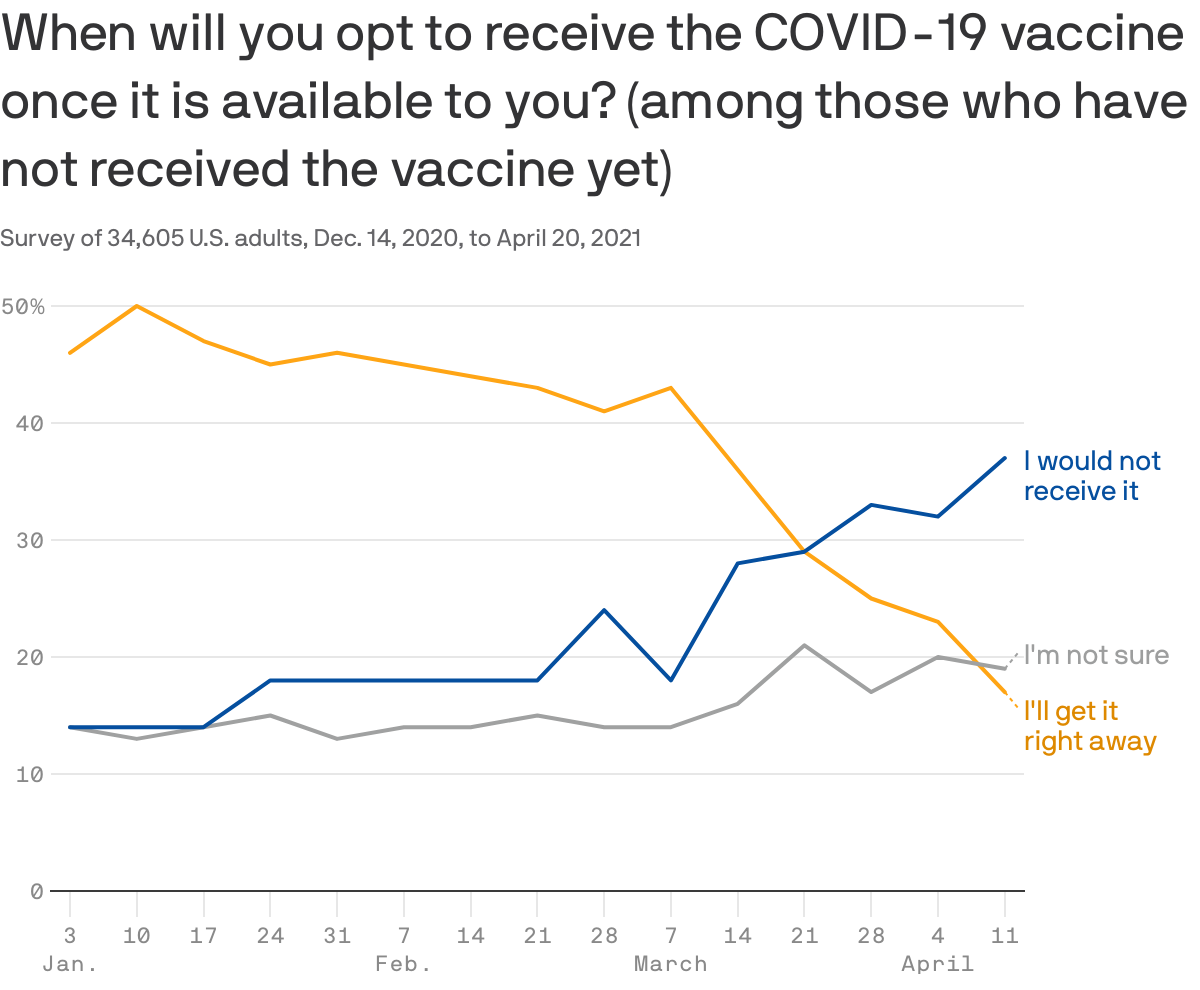
Axios' Caitlin Owens and I write: The U.S. will probably run out of adults who are enthusiastic about getting vaccinated within the next two to four weeks, according to a KFF analysis published yesterday.
- That could be bad news for Johnson & Johnson and other companies like Moderna.
Between the lines: Vaccine hesitancy is rapidly approaching as the main impediment to herd immunity.
- "It appears we are quite close to the tipping point where demand for rather than supply of vaccines is our primary challenge," the authors of the KFF study write.
- "Federal, state, and local officials, and the private sector, will face the challenge of having to figure out how to increase willingness to get vaccinated among those still on the fence, and ideally among the one-fifth of adults who have consistently said they would not get vaccinated or would do so only if required."
State of play: With more than half of the population now at least halfway inoculated — and Americans 18 and older now eligible to receive the vaccine in all U.S. states — the data continue to show an increasing portion of unvaccinated adults do not plan to get the COVID-19 vaccine at all.
Of note: J&J's stock price jumped 2.3% following its quarterly earnings release, noting it had booked $100 million in first-quarter sales of its COVID-19 vaccine.
- Its pharmaceutical business, which developed the single-shot vaccine, generated $12.19 billion in revenue, a 9.6% year-over-year increase.
- Europe’s health agency said a warning should be added to the product information of the company's vaccine that unusual blood clots are a very rare possible side effect.
Related: Republicans who say they don't want to get the vaccine are becoming only more resistant, the Washington Post reports.
- "The further we go into the vaccination process, the more passionate the hesitancy is," Frank Luntz, a longtime GOP communications expert, told WashPost. "If you’ve refused to take the vaccine this long, it’s going to be hard to switch you."
- Participants in the focus group said they were concerned by the prospect of booster shots, and most said they would want a fake vaccination card.
Thanks for reading!
Quote: “Here’s the truth about racial injustice: It is not just a Black America problem or a people of color problem. It is a problem for every American. It is keeping us from fulfilling the promise of liberty and justice for all, and it is holding our nation back from realizing our full potential.”
Why it matters: Yesterday Vice President Kamala Harris said those words in a speech following the verdict in the trial of Derek Chauvin, who was found guilty on all charges in the murder of George Floyd.
This newsletter is written in Smart Brevity®. Learn how your team can communicate in the same smart, clear style with Axios HQ.
Sign up for Axios Markets

Stay on top of the latest market trends and economic insights