Axios Markets

September 10, 2025

💰 If you haven't called your Uncle Larry Ellison lately, you might want to. Oracle shares are up 30% in premarket trading on strong guidance, which stands to make him — personally — more than $85 billion today.
🤑 Situational awareness: Overnight, Klarna shares were priced at $40, above Wall Street's estimates, as part of its IPO.
🚨 EXCLUSIVE: Commerce Secretary Howard Lutnick tells Mike Allen for "The Axios Show" that universities are the Trump administration's next target for financial deals, like with Intel and Nvidia.
- "If we fund it and they invent a patent, the United States of America taxpayer should get half the benefit." Watch the video.
- Stay tuned for the full episode, out soon.
Let's get into it. All in 1,079 words in 4 minutes.
1 big thing: Robinhood takes on Reddit and X with new social media platform
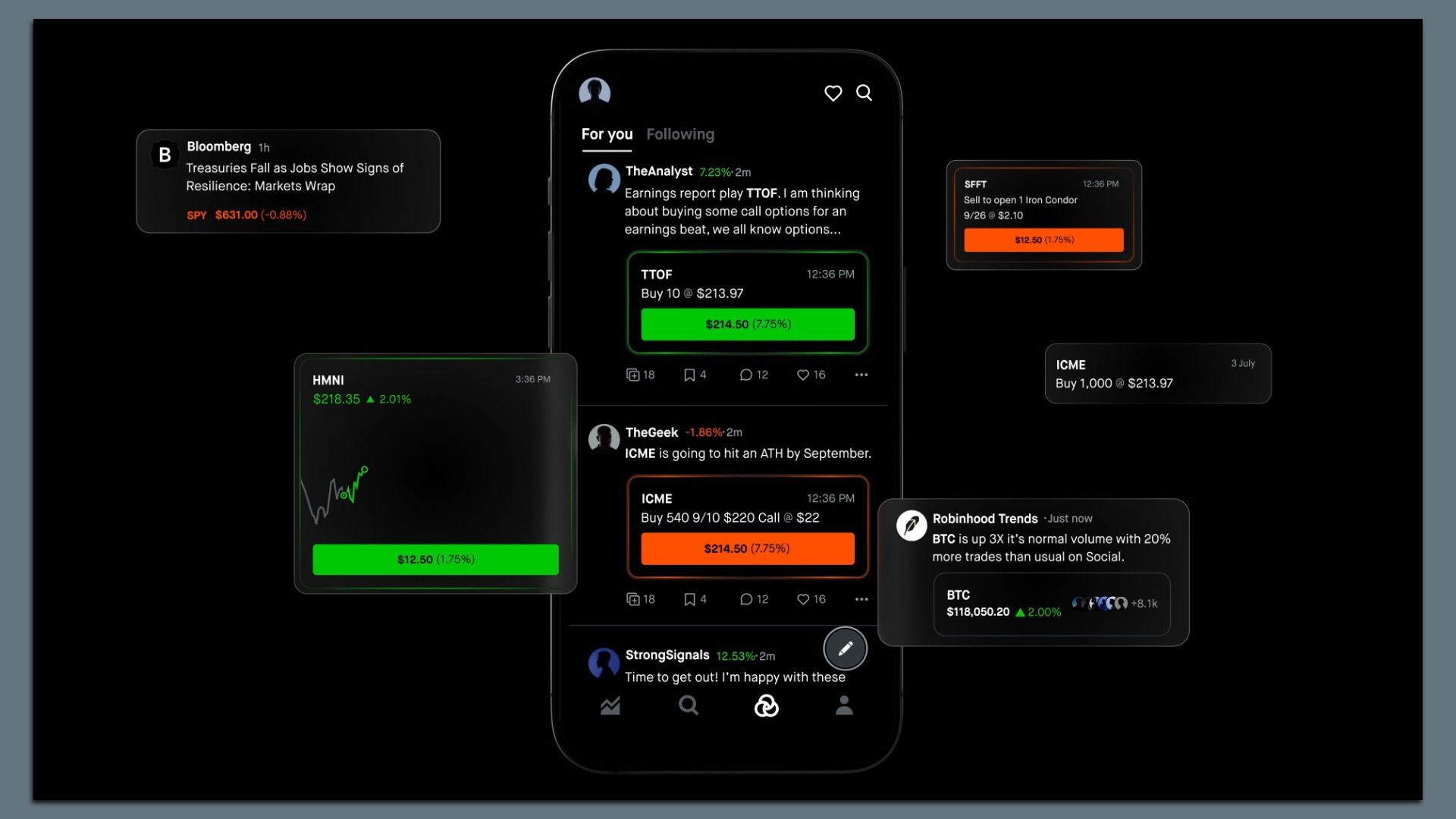
Robinhood is getting into social media with the launch of Robinhood Social, allowing users to post their trades, takes and commentary while following other users as well as avatars mirroring the trades of politicians and executives.
Why it matters: This could be serious competition for the meme stock Reddit crowd.
What they're saying: "Robinhood is no longer just where you trade - it's your financial superapp," Robinhood CEO Vlad Tenev said in a statement about the new features announced at the company's annual HOOD summit.
- The in-app social platform Robinhood Social will roll out to select customers early next year with a wider release to follow.
- Other announcements from the event include an AI-powered chart-building tool and trading for more than 40 CME futures contracts.
Zoom in: I got to preview Robinhood Social at the company's Manhattan headquarters.
- It looks like your X and Venmo feeds combined.
- For a user to have the ability to post, they have to include a trade. Then, they can share their thoughts alongside that transaction proof.
- That's by design, according to the product team.
The goal was verification. Users may post trade ideas on Reddit or talk up their own portfolios, but there's no way to know if people are telling the truth.
- With Robinhood Social, that verification is built in because you can only post your own trades.
- Each user profile includes your year-to-date return as well.
Zoom out: This could be another way for finfluencers and "thought leaders" in the world of Wall Street to grow their followings.
- The financial Twitter crowd (FinTwit) already has its own army of creators who charge for subscriptions and newsletters.
- Robinhood Social could be another revenue-building opportunity for them.
Yes, but: While the product folks I spoke with said that kind of creator monetization is possible down the line, right now they see more opportunity in using the app for investor relations.
- A future Robinhood earnings call will likely be livestreamed on the app, for example.
- Big retail investor stock darlings, like Nvidia, could also see their results streamed on the platform as part of a community-building effort.
What we're watching: How much this impacts the retail crowd's ability to rally behind different trade ideas.
- If meme stocks can take off with no verification on Reddit, this platform could supercharge that kind of activity.
Fun fact: The platform also had a slew of avatars tracking trades for everyone from tech billionaires to politicians.
- Former House Speaker Nancy Pelosi and Meta CEO Mark Zuckerberg are not users, of course, but some of their trades are public.
- The platform has avatars that post those trades, which users can follow.
2. The tooth fairy is getting more expensive
"Giftflation," or the rising cost of giving, is showing up in everything from birthdays to the tooth fairy, according to a new survey from retirement planner Empower, exclusively shared with Axios.
Why it matters: This is the latest sign that prices aren't easing the way the Fed might like.
What they're saying: "It's not just etiquette, it's economics," said Rebecca Rickert, head of communications and consumer insights at Empower.
- Consumers are adjusting their generosity to match their financial realities.
By the numbers: 75% of those surveyed said gifts are more expensive thanks to tariffs and inflation.
- Six in 10 say gifting has gotten "out of hand," and 48% reported "gift fatigue."
- A third (33%) are adopting a "no gifts" policy this year, asking others not to spend money on them at all.
- Millennials were the most likely generation to want to give the gift of time.
Zoom in: What's the going rate for giving these days?
- A birthday gift? $56 for adults, $83 for children.
- Kids receiving a weekly allowance can expect $37.
- The tooth fairy is paying $14.87. (Try getting that under a pillow!)
Zoom out: It's not just gift-giving that's been hit by the shifting economy; tipping is also changing.
- Those surveyed say they leave a median tip of 16% for takeout dining.
- That drops to 11% for food delivery, 14% for beauty services and 10% for rideshare services.
Between the lines: There's evidence of a more cost-conscious consumer behind these decisions.
- 63% say they shop for gifts based on price.
- 58% set aside a budget specifically for gifts.
The bottom line: The tooth fairy is likely not being surveyed by regional Fed presidents for a sense of tooth-flation.
- But these numbers indicate how the exchange of generosity has also been hit by the macro backdrop: one with sticky inflation and a challenged consumer.
3. Asset correlations are breaking down
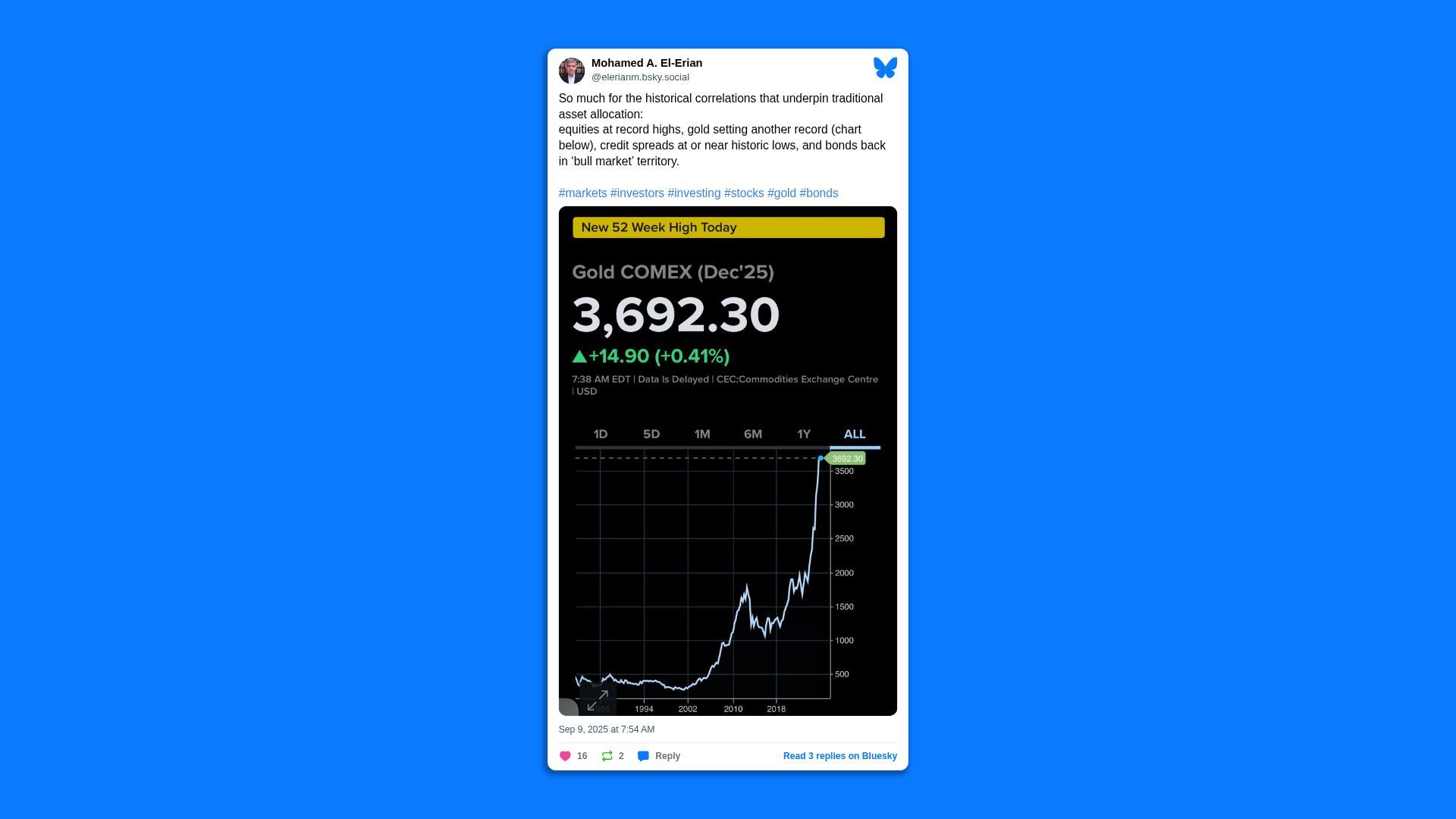
Gold is hitting record highs. Bonds and stocks are moving in the same direction: up. Credit spreads are near historic lows. Historically, none of those things typically happen at the same time, as noted by bond legend Mohamed El-Erian in a post on Bluesky.
Why it matters: Traditional asset allocations are the backbone of everything from retirement accounts to self-managed brokerages. But the correlations that helped define those investment decisions are breaking down.
Between the lines: To understand this dynamic, let's look at one example: stocks and bonds.
- Typically, bonds and stocks move in opposite directions: Stocks go up when investors are willing to take risk, and bonds go up when investors want less risk, for example.
- Right now, both stocks and bonds are in a bull market.
- That's potentially a challenge for investors because it makes diversification within portfolios more challenging.
- That diversification is even tough for S&P 500 index fund investors, with 40% of the market cap for the index in its top 10 names.
👀 Got tips? Email me at [email protected]. I would love to hear from you about anything that may be of interest for our investor audience.
Thanks to Jeffrey Cane for editing and Katie Lewis for copy editing. See you tomorrow!
Sign up for Axios Markets
