Axios Macro

November 04, 2026


After yesterday's seismic shift in the U.S. political landscape, today we look at the economic policy implications.
- The short version: It's consequential, but not the 180-degree reversal that you might expect from looking at electoral returns alone.
- Plus, we zoom in on what a Democratic Senate means for the Federal Reserve.
Just in: Neil will interview New York Fed president John C. Williams at the Axios BFD summit in New York on Nov. 17. Other featured guests include tennis legend and entrepreneur Maria Sharapova, Kalshi CEO Tarek Mansour and many more. Join the waitlist to attend here.
Today's newsletter, edited by Jeffrey Cane and Bradley Olson and copy edited by Katie Lewis, is 851 words, a 3-minute read.
1 big thing: Economic policy after Dems' big win

The stunning Democratic victory in midterm elections yesterday will have consequences for U.S. economic policy. But they are likely to be subtle, and revealed over time.
The big picture: President Trump has, for the most part, shaped economic policy through executive action rather than by passing laws. His executive powers will remain intact even after Democrats take hefty majorities in both the House and Senate in January.
- Trump will still be able to impose tariffs through executive authorities, and continue his deregulatory campaign. His signature tax policies are unlikely to be overturned.
- He holds a veto pen that will constrain the ability of a Democratic Congress to enact laws.
Yes, but: Democrats will have new power to investigate and challenge tariffs and other executive actions based on dubious legal arguments. The shifting political winds could make judges more skeptical of the administration's justifications.
- And a Democratic Senate can block Trump appointees to powerful regulatory posts — limiting his ability to fill vacancies with like-minded loyalists as the inevitable personnel churn of the second half of a presidential term occurs.
- Less knowable is whether the electoral rebuke will prompt any course correction from Trump himself, including on tariffs and the Iran war.
State of play: Gridlock looks good to markets this morning, with stocks up and bond yields down. That may reflect, in part, bets that a divided government will not be able to pursue budget-busting policies.
- "A Democratic Congress puts a stronger brake on further fiscal expansion, taking some upside risk out of long-term Treasury yields," wrote Shari Hensrud, chief investment officer of MissionSquare, in a note.
- "That reduction in fiscal risk could support longer-term Treasuries and put some downward pressure on long-term yields, while the front end remains more tied to the Fed, inflation and labor markets," added Hensrud.
- "But with a Republican White House and Democratic majorities unlikely to be large enough to override presidential authority, major changes to existing tax and spending policy would also face a high hurdle," she wrote.
Zoom out: For months now, we have marveled at how weak consumer sentiment and confidence measures have been, despite strong GDP growth and low unemployment.
- Those survey results have contained little to no information about what will happen next in the economy. Consumer spending has proven robust even as consumers' attitudes have been gloomy.
- As it turns out, there may not have been economic information in those results, but there was a whole lot of political information, as consumer misery over the cost of living was a major driver of Democratic gains.
2. Trump can't pack the Fed now
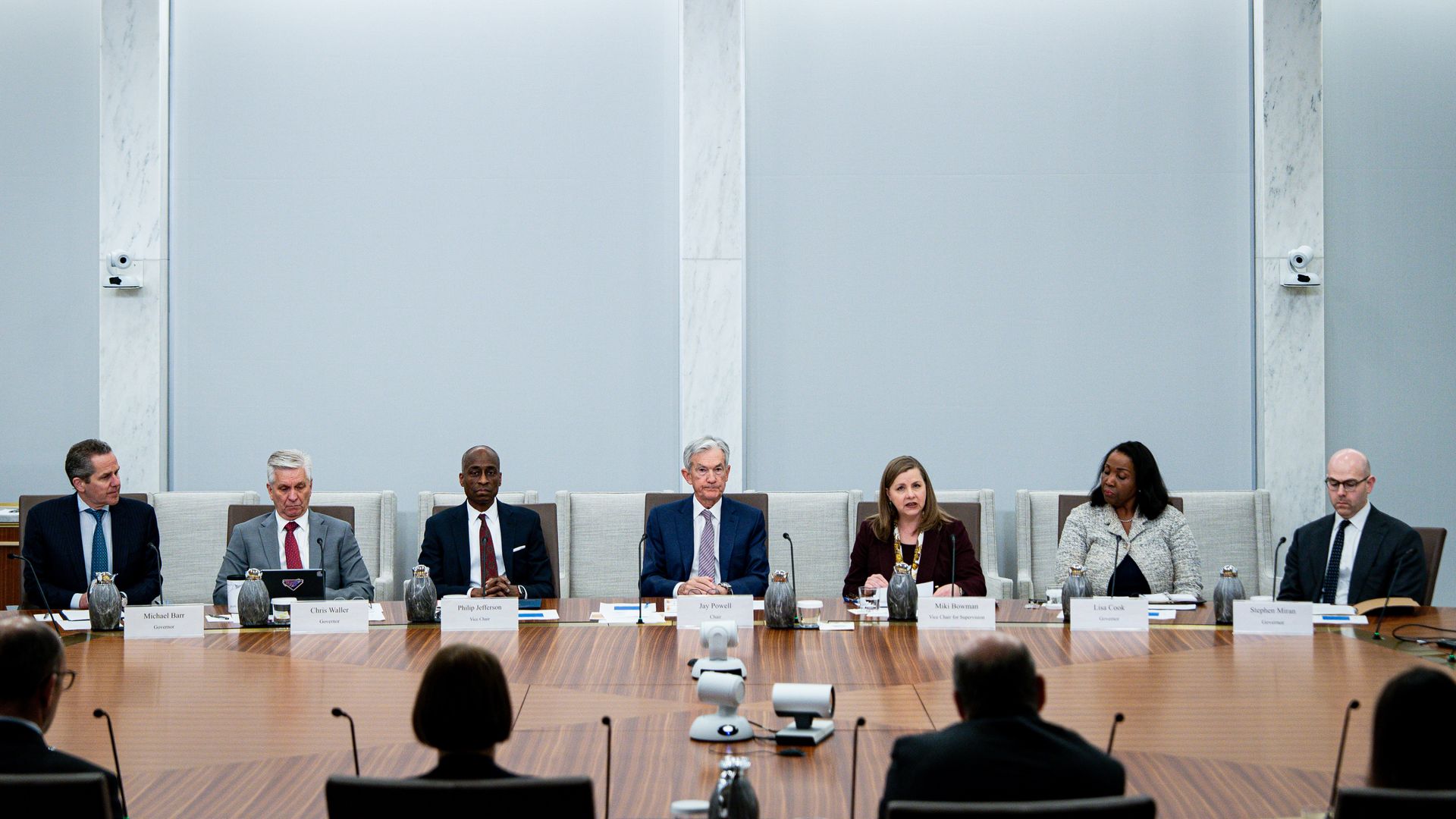
A recurring subplot of Trump's term has been a desire to replace Biden appointees to the powerful Fed Board of Governors — even ahead of their terms ending — with allies. That effort now looks dead in the water.
Why it matters: Even if Trump succeeds in his efforts to fire governor Lisa Cook, or to oust any of the other three Biden-era holdovers on the seven-member board, a Democratic Senate will likely block any replacements it views as insufficiently independent from the administration.
State of play: The president seeks to fire Cook — whose term runs through 2038 — for alleged mortgage fraud, an effort that has been blocked so far by the courts. The White House plans a hearing over the allegations next month.
- Former chair Jerome Powell has remained on the board as a governor, a term that ends in January 2028.
- Michael Barr, whom Biden appointed as top financial regulator, has remained in place as a governor in a term that extends to 2032.
- Philip Jefferson's term as vice chair ends this coming September, though his term as a governor extends to 2036.
Between the lines: It would break with current precedent for those officials to stick around to the end of their terms. In recent decades, Fed governor spots have turned over much more regularly, particularly after their time as chair or vice chair ends.
- Powell, Barr and Jefferson may feel greater comfort relinquishing their roles as governors before the end of their terms if they are confident the Senate will block any replacements who don't respect the tradition of central bank independence.
Of note: Sen. Elizabeth Warren is set to chair the Senate Banking Committee that must advance Fed governor nominees, and she has assailed chairman Kevin Warsh for being a "sock puppet" of the administration.
- Only one Senate Democrat, John Fetterman, voted to confirm Warsh.
Sign up for Axios Macro

Stay ahead of the curve on the most important economic developments with reporting and analysis on how business, policy, and markets collide.