Axios Macro

May 09, 2024

What happens if global investors start to take the risk from dysfunctional U.S. political institutions seriously? Nothing good, a former Biden administration official argues. More below.
- Plus, the Bank of England inches closer to interest rate cuts. 🇬🇧
Situational awareness: Initial jobless claims spiked last week by 22,000, to 231,000—the highest since late August, though unemployment filings still remain low by historical standards.
Today's newsletter, edited by Kate Marino and copy edited by Katie Lewis, is 784 words, a 3-minute read.
1 big thing: The hidden cost of U.S. political risk
Illustration: Sarah Grillo/Axios
Despite it all — disputed elections and a Capitol insurrection, debt ceiling showdowns and massive fiscal deficits — global investors have shown unwavering confidence in the U.S. government.
- But if that were to change, even just a little bit, it would be awfully expensive, warns a new paper from a former Biden White House economist.
Why it matters: The U.S. enjoys a "safe harbor premium." It is viewed globally as among the most sound and stable places on Earth in which to invest. That results in lower borrowing costs for U.S. citizens, companies and government entities, and more abundant foreign investment.
- But if global investors start to view the U.S. political environment as creating economic risks, that could change abruptly, writes Ernie Tedeschi with the Yale Budget Lab.
- Tedeschi, formerly chief economist at the White House Council of Economic Advisers, sought to quantify the potential cost of global investors' loss of confidence in U.S. political and economic institutions.
The big picture: Investors in emerging markets are inherently making bets about the stability of countries where they consider buying bonds or building a factory.
- Will courts enforce contracts fairly? Will my funds be expropriated by a political leader? Will the central bank allow hyperinflation?
- But even in stable, affluent countries, the same dynamics can apply, if less dramatically.
State of play: The U.S. currently enjoys zero risk premium, according to data Tedeschi cites from NYU Stern economist Aswath Damodaran, meaning investors do not demand any extra compensation for deploying capital here.
- It's one of only a handful of countries of which that can be said, a list that includes Canada, Australia and Switzerland.
By the numbers: Other wealthy, advanced economies have a significant premium. It's 0.72 percentage points for France and over 3 percentage points for Italy and Greece.
- Britain's number was 0.48 percentage points in the immediate aftermath of its Brexit vote, and has risen to 0.88 points amid a revolving door of prime ministers (five of them since 2016!).
- By Tedeschi's calculations, if the U.S. risk premium rose merely to the level of Britain, over 10 years it would reduce Americans' wealth by $50,000 per household and reduce GDP by 1 percent.
- In a more dire scenario in which a crisis causes U.S. political risk to surge toward Italian or Greek levels, it would cause a 3.5 percent hit to GDP and earnings per worker falling by $5,900 over a decade.
What they're saying: "If you're talking about a contested election or political chaos, the question is 'what does that mean for me as an investor?'," Tedeschi tells Axios.
- "Even advanced economies have gone through this, and not collapsed but had a little bit more risk and been a little bit less favorable destinations for investment," he says.
- Global investors' views of U.S. soundness "may end up being much more fragile than we thought," Tedeschi says.
2. The Brits move closer to a rate cut
Commuters near the Bank of England in London. Photo: Hollie Adams/Bloomberg via Getty Images
It increasingly looks like the Fed will soon stand alone among major central banks in postponing interest rate cuts.
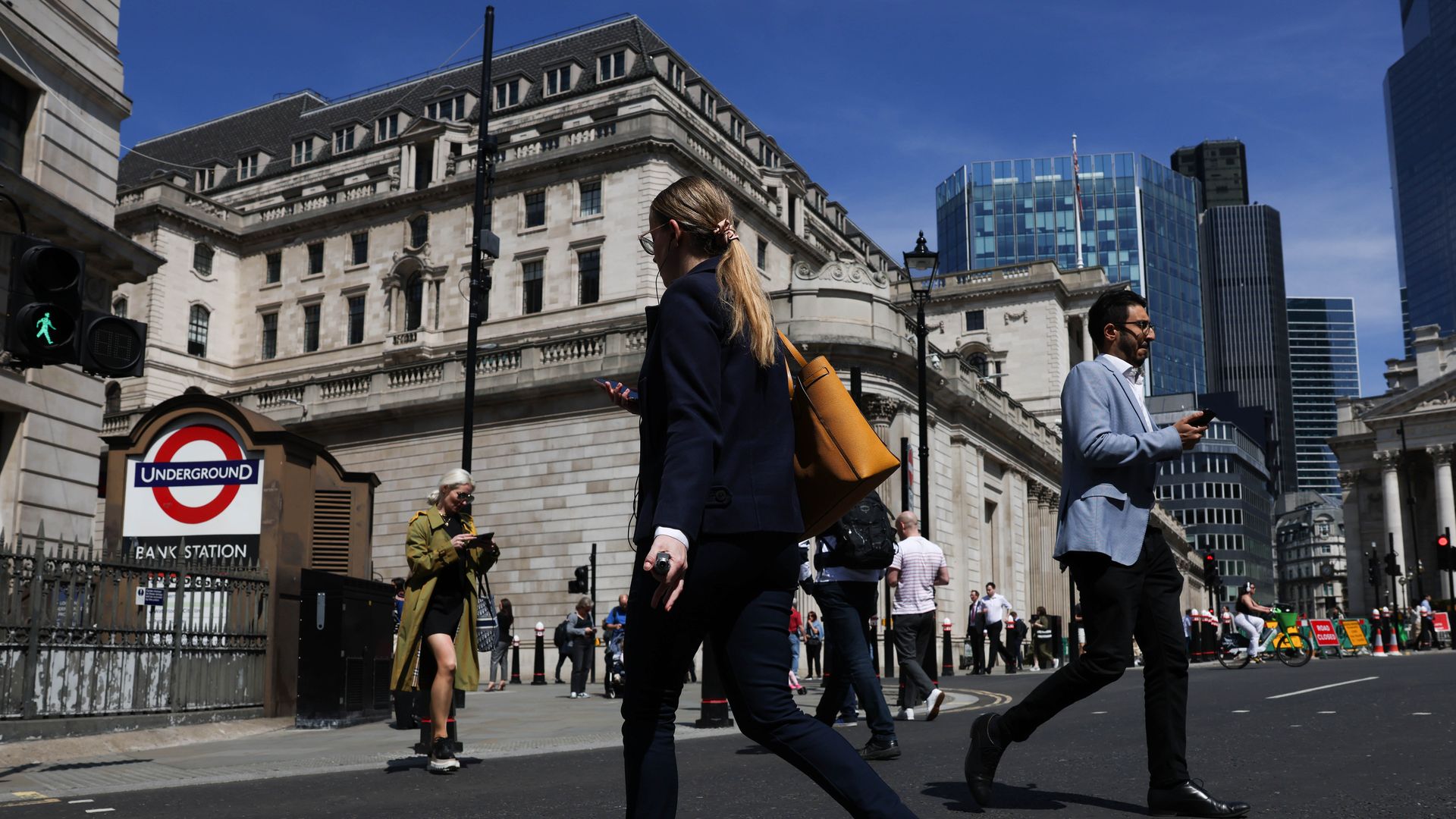
Driving the news: The Bank of England today held its interest rate target steady for the sixth straight meeting, but gave new hints that it will likely loosen monetary policy soon.
What they're saying: "Inflation has now fallen to just about 3% and we expect it to be close to the target in the coming months. That's encouraging," Bank of England governor Andrew Bailey said at a press conference.
- "We need to see more evidence that inflation will stay low before we can cut interest rates," Bailey added. "I'm optimistic that things are moving in the right direction."
Why it matters: The inflation shock was much worse across the Atlantic, but it dissipated more quickly than in the U.S. — setting up a situation in which central banks there are better positioned to slash rates.
- In the 12 months through April, U.K. inflation was 3.2% — well below the peak of 11% reached in 2022 after fallout from Russia's invasion of Ukraine.
State of play: In recent weeks, European Central Bank leaders suggested that an interest rate cut was coming this summer, perhaps as soon as next month. (Other central banks in smaller European economies — like Switzerland, Hungary and, yesterday, Sweden — have already lowered rates).
- Bailey told reporters that a rate cut in June is "neither ruled out nor fait accompli."
The intrigue: Decisions to hold rates steady have been unanimous among Federal Reserve policymakers. That has not been the case for its counterparts in Europe, who have pushed for rate cuts sooner.
- Two Bank of England officials said they wanted to cut rates. And ECB president Christine Lagarde said at a press conference last month that some policymakers wanted to cut rates at the time.
Sign up for Axios Macro

Stay ahead of the curve on the most important economic developments with reporting and analysis on how business, policy, and markets collide.