Axios Macro
July 28, 2026


Some of the most important questions of this moment involve how AI advances will play out through the $30 trillion U.S. economy.
- Today, we look at the latest evidence on two key questions: how much the hardware buildout is contributing to overall growth, and how much of the recent surge in economy-wide productivity is a result of AI advances.
Situational awareness: Consumer confidence fell 1.4 points in July as Americans' views about current conditions and the labor market softened, the Conference Board said. 📉
- Respondents' mentions of war and geopolitics eased during the survey period, but the business research group cautioned that could shift since the conflict intensified.
Today's newsletter, edited by Jeffrey Cane and copy edited by Katie Lewis, is 1,071 words, a 4-minute read.
1 big thing: AI's hidden boost
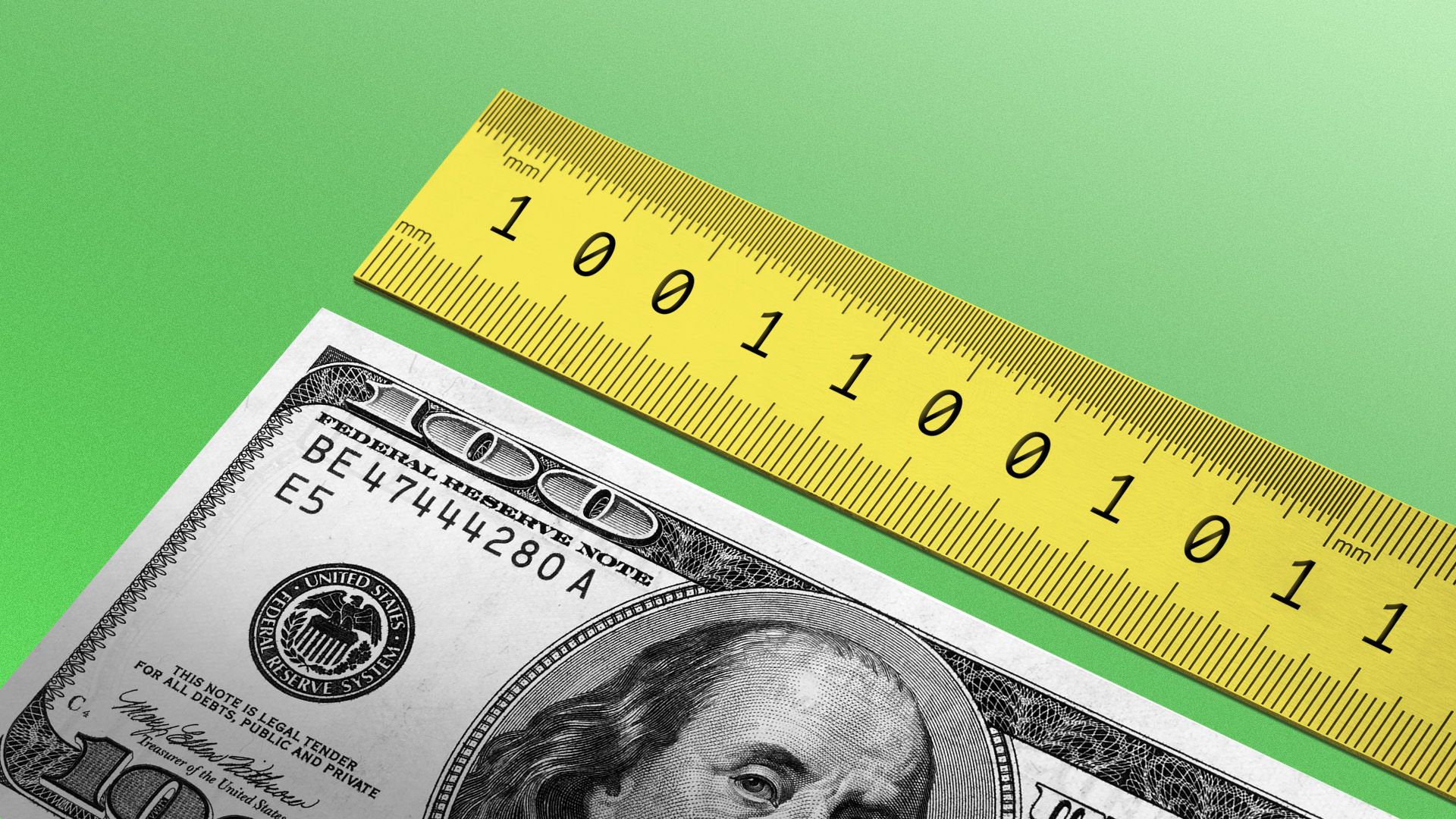
America's AI investment boom may be playing a bigger role in the U.S. economy than headline economic statistics suggest.
Why it matters: The AI boom depends on enormous imports of hardware that the U.S. doesn't make. That creates an unusual disconnect between the scale of the investment and how it appears in the government's economic statistics, particularly GDP.
The big picture: Not all investment counts equally toward GDP. The AI buildout relies heavily on imported chips, servers and networking equipment, meaning that part of the investment boom is offset in the government's growth calculations.
What they're saying: AI doesn't have its own catch-all category in the government's economic data, forcing economists to infer its contribution from underlying investment and trade categories.
- "Measuring precisely how much recent GDP growth has been boosted by AI-related investment poses a greater challenge given the lack of a dedicated line item in the national accounts and the high import-content of the equipment underlying the buildout," Federal Reserve Board economists Paul Soto, Mason Thieu and Jeffrey Allen wrote in a paper this month.
By the numbers: The economy grew at an annualized 2.1% rate in the first quarter. The Fed economists estimate that spending on AI — investment in software, data centers, power infrastructure and computing equipment — added about 0.73 percentage point to GDP growth.
- But without the drag from imported AI-related parts, the estimated contribution from AI-related investment would have been larger.
- Net imports of computers, peripherals and parts alone subtracted 0.45 percentage point from growth.
Zoom in: AI-related products accounted for 23% of all U.S. imports in 2025, up from 15% in 2023, according to research from Minneapolis Fed economist Michael Waugh — with computer hardware accounting for roughly half of AI-related imports.
- The rest includes products like electrical equipment, networking gear and cooling systems that are necessary to build and operate AI data centers.
- The Trump administration has largely shielded many of those AI-related inputs from broad-based tariffs.
Zoom out: The AI investment and trade dynamic was even more striking in late 2025. Companies poured money into AI hardware in the final three months of the year, but the boost to GDP largely disappeared once imports were factored in.
- The Fed economists note that the net effect of AI investment "varies considerably across quarters, as the drag from net exports of computer, peripherals and parts offsets much of the gross investment in quarters where imports rose sharply."
- They estimate the AI buildout contributed just 0.14 percentage points to GDP — even though spending across relevant categories contributed about 0.75 percentage points before accounting for imports.
- Net imports of AI equipment shaved 0.61 percentage points off growth.
What to watch: Economists anticipate that the economy grew at a 1.8% annualized pace in the April-June period. The report is out on Thursday.
- Goldman Sachs anticipates a rebound in consumer spending, alongside strong business investment that stems from equipment spending related to AI.
The bottom line: The AI boom is forcing economists to rethink how they measure the economy. As more growth comes from technologies that rely on imported hardware and intangible software, the traditional gauges of economic activity may become harder to interpret.
2. About that AI productivity surge ...

AI appears to improve workers' efficiency in a number of sectors. The U.S. has experienced a surge in economy-wide productivity in the last couple of years. But the former isn't necessarily driving the latter.
The big picture: Companies are achieving more output per person-hour of labor because they are making better use of existing capital, a provocative new analysis finds — not, at the moment at least, by making major use of AI.
- AI advances may be generating substantial micro-level gains in some sectors, but so far are not the driver of one of the most important macro trends of the last couple of years, finds Ernie Tedeschi, chief economist at Stripe.
State of play: A surge in labor productivity — after a couple of decades of subpar improvement — has been one of the best pieces of news about the U.S. economy in the last few years.
- Over the last year, output per hour worked is up 2.5%, compared with 1.6% annually over the last 20 years, Tedeschi wrote.
- That may sound like a small gap, but if sustained over just a few years, that higher productivity would compound, making incomes and output per worker much higher.
Yes, but: Tedeschi noted that while labor productivity is up, total factor productivity — not just output per hour of work but output per hour of work and unit of capital — is little changed.
- Looking across industries, he finds that while sectors with high AI adoption do have higher productivity growth, that trend predates the pandemic — before high-quality large language models were widely used.
- Rather, he finds, the higher output is coming from higher usage of existing capital.
Zoom in: "Think longer runs of factories already built, more utilization of server racks and GPU clusters already paid for, and more occupancy of existing hotel rooms," Tedeschi wrote.
- "Economists call this 'capital intensity' or 'utilization.' Higher capital utilization represents real economic gains, but it's not the same as microproductivity."
Of note: None of that precludes the possibility that AI advances will generate major productivity gains in the not-too-distant future, as companies work through the workflow and choke points that have restrained their potential.
The bottom line: "It looks likelier and likelier that the U.S. is in a period of high productivity growth, and that AI is part of the story," Tedeschi tells Axios.
- "But we need to be sober about how it's playing a role, because that will help us discern whether AI is just a temporary blip on the growth path or something more persistent and transformational."
Sign up for Axios Macro