
Axios Macro

August 07, 2023
A fascinating new essay that has the econ world buzzing argues that some bad stuff is happening beneath the surface of the Chinese economy. We unpack it below. 🇨🇳 📉
- Plus, what to watch in this week's key inflation data.
Today's newsletter, edited by Kate Marino and copy edited by Katie Lewis, is 708 words, a 2½-minute read.
1 big thing: China's weakened economy
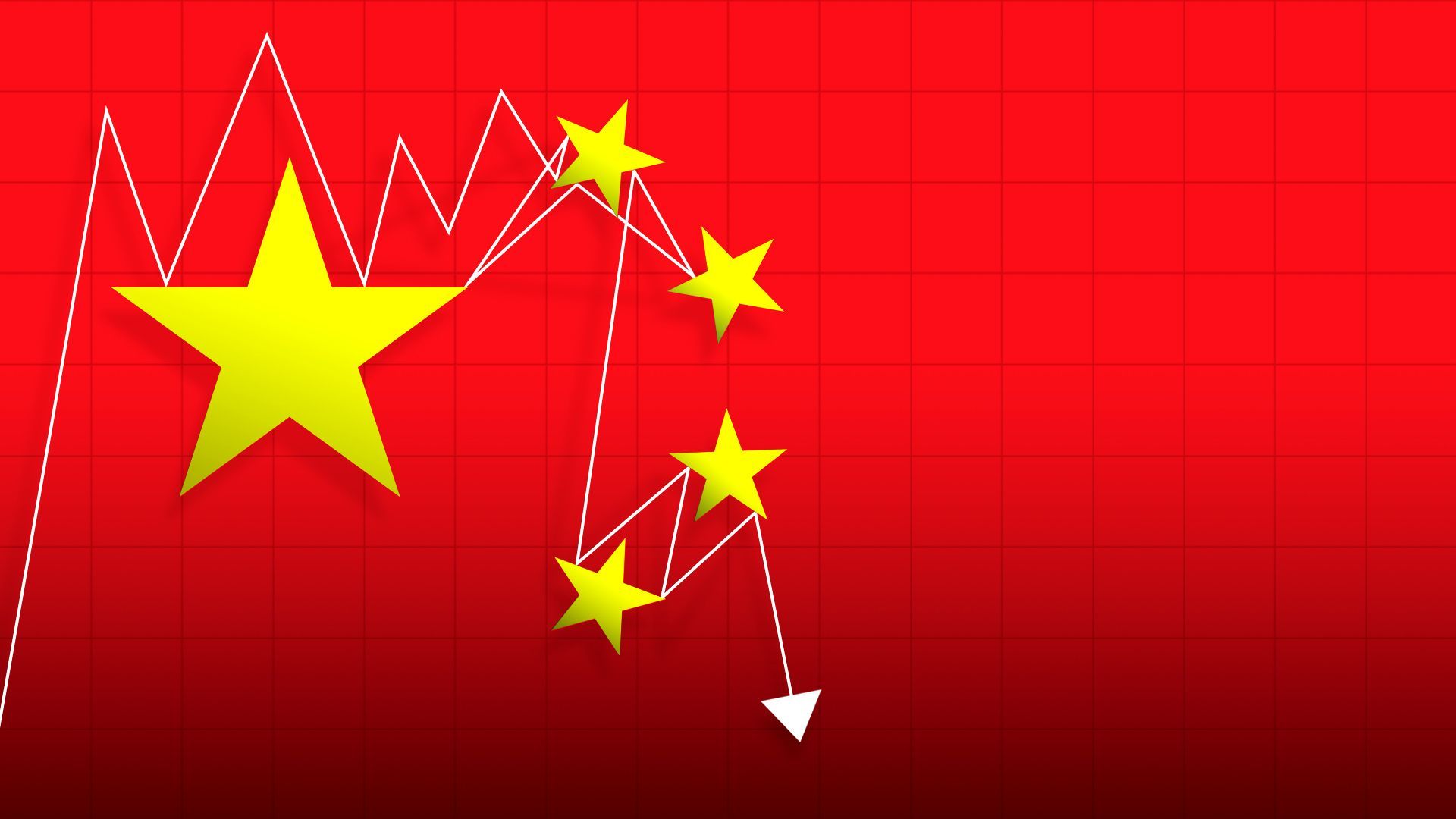
Illustration: Annelise Capossela/Axios
The Chinese economy is in worse long-term shape than is widely understood, a prominent American economist is arguing, in ways that cannot be easily fixed.
- It is "economic long COVID," featuring a persistent dearth of investment and consumer demand, writes Adam S. Posen in Foreign Affairs.
Why it matters: Belief in a Chinese economic juggernaut has been a core assumption in the mainstream understanding of the global economy and diplomatic landscape for a generation. If it's no longer true, China's position on the world stage is weaker than is commonly understood.
The argument: Dating to roughly 2015, and especially since the onset of the pandemic in 2020, the Chinese government has acted increasingly capricious and arbitrary in restricting economic activity, writes Posen, who is president of the Peterson Institute for International Economics.
- This is causing Chinese citizens and businesses alike to hoard cash rather than spend or invest, he argues.
- Deposits in Chinese banks have soared since 2015, Posen calculates, while private-sector consumption of durable goods is down by around a third and private investment is down by two-thirds.
What they're saying: "China's body economic has not regained its vitality and remains sluggish even now that the acute phase—three years of exceedingly strict and costly zero-COVID lockdown measures—has ended," he writes.
- "The condition is systemic, and the only reliable cure—credibly assuring ordinary Chinese people and companies that there are limits on the government's intrusion into economic life—cannot be delivered," Posen writes.
- That, he argues, will limit the government's ability to stimulate the economy, because consumers will be inclined to save any financial boost they receive from the government, and businesses will be reluctant to invest even when bank lending is more freely available.
This is a common feature of autocratic regimes, he argues — that they can achieve strong growth while letting the private sector largely act freely, but eventually tighten the screws of government control in counterproductive ways.
Yes, but: It's increasingly hard to know exactly what is happening in the inner workings of the world's second-largest economy because the government is clamping down on consultants and statistics-providers whose conclusions might be politically inconvenient.
- The Financial Times reported this weekend that Chinese economists are under intense pressure to withhold negative analysis of conditions.
- "The regulator doesn't want to hear negative comments about the economy in public," an unnamed adviser to China's central bank told the FT. "They wanted us to interpret bad news from a positive light."
That sort of thing, Posen tells Axios, is "part and parcel of reversion to the authoritarian mean on economic policy."
- "This is likely to further undermine the impact of any stimulus measures undertaken," he says.
2. Key inflation data on deck


This week brings another round of key inflation data: The Consumer Price Index, out Thursday, will confirm if price pressures continued to ease in July.
Why it matters: Whether the Fed raises rates at its September policy meeting rests on a slate of incoming indicators released between now and then.
- Evidence of disinflation could push officials in favor of holding off on another rate increase.
What they're saying: "The recent lower inflation reading was positive, but I will be looking for consistent evidence that inflation is on a meaningful path down toward our 2 percent goal as I consider further rate increases and how long the federal funds rate will need to remain at a restrictive level," Fed governor Michelle Bowman said in a speech Saturday.
What to watch: Economists expect that overall CPI rose 0.2% in July.
- In the 12 months through July, CPI is expected to be 3.3%. That's because the base effects that helped push it down to 3% in June have eased.
- Core inflation, which excludes food and energy costs, is estimated to have risen 0.2% — matching the prior month's cool pace. In the 12 months through July, core CPI is estimated to be 4.7%, down a tick from the 4.8% in June.
The intrigue: "The July CPI data should be another set of welcome news for [Fed officials], and if the CPI comes in close to our expectations, will bolster the case for some participants that additional rate hikes are unnecessary, at least for the time being," write UBS economists, who expect core CPI to be 0.1% in July.
Sign up for Axios Macro

Stay ahead of the curve on the most important economic developments with reporting and analysis on how business, policy, and markets collide.