Axios Macro

June 24, 2025

A new consumer confidence reading is hot off the presses. We unpack it below.
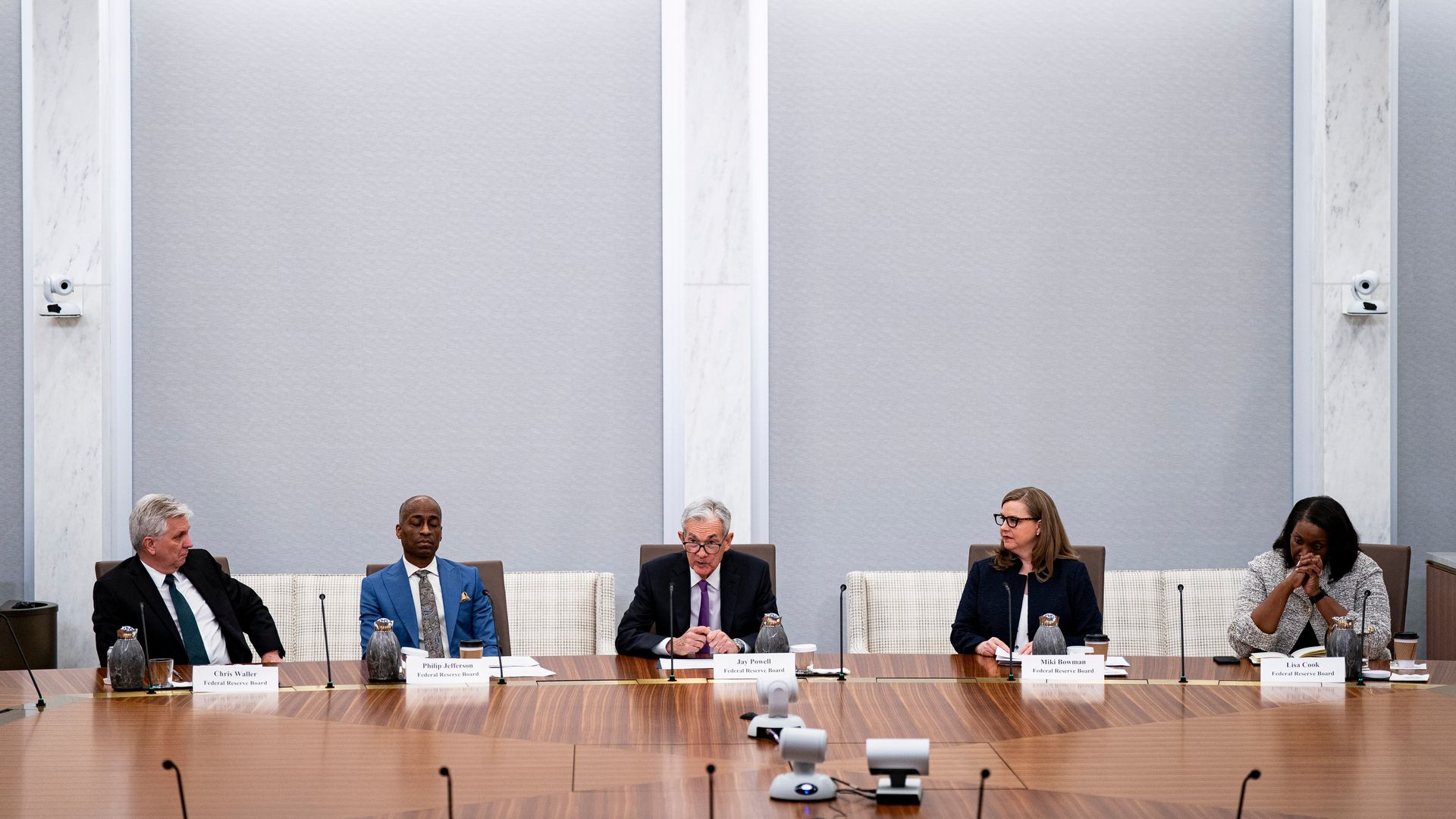
- But first, as we hit send, Federal Reserve chair Jerome Powell is testifying before the House Financial Services Committee — amid a striking divide among Fed policymakers on the path ahead.
Today's newsletter, edited by Ben Berkowitz and copy edited by Katie Lewis, is 675 words, a 2½-minute read.
1 big thing: Split at the Fed
Two Trump-appointed Fed officials favor interest rate cuts as soon as next month. Seven of their colleagues don't envision cutting rates this year at all.
Why it matters: It amounts to the biggest divide over the proper course for policy in years, one with delicate political optics as the Trump administration and some Republican lawmakers beat the drum for lower rates.
- The tension boils down to whether the Fed should hold back from adjusting policy, despite falling inflation in backward-looking data, because of the inflation risks ahead due to tariffs.
State of play: Powell, in his news conference last week and in this morning's congressional testimony, stuck to the wait-and-see message. He argued that the uncertainty around how prices will evolve calls for patience.
- It comes after governors Christopher Waller and Michelle Bowman said in recent days that rate cuts could make sense at the Fed's July policy meeting. They emphasized that any tariff-driven inflation would be a one-time adjustment, not a driver of ongoing inflation.
Yes, but: They appear to be outliers on the committee. In projections last week, seven of 19 top Fed leaders envisioned leaving interest rates steady through the end of the year. Ten officials envisioned one or two rate cuts this year.
- Two officials envisioned three rate cuts this year. The projections do not have names attached, but it is reasonable to guess that those were Waller and Bowman.
Between the lines: It's rare for two governors to openly adopt a policy view that diverges from the Fed leadership's party line.
- In contrast to reserve bank presidents, governors work in Washington alongside the chair, and in their publicly stated views, they rarely stray too far from the consensus.
- Governors tend to play an inside game rather than an outside game, which makes the open disagreement in the last few days all the more surprising — and evidence of wider-than-usual divides within the central bank.
What they're saying: Asked why the Fed has not cut interest rates as aggressively as many other global central banks, Powell said, "[Y]ou're right that if you just look in the rearview mirror and look at the existing data that we've seen, you can make a good argument that would call for us to be at a neutral level, which would be a couple of cuts, maybe more."
- "The reason we're not [cutting rates] is forecasts ... that do expect meaningful inflation over the course of the next year."
- Asked about Bowman's and Waller's arguments for a potential July rate cut, Powell said that "if it turns out that inflation pressures do remain contained, we will get to a place where we cut rates sooner rather than later."
- "I wouldn't want to point to a particular meeting. I don't think we need to be in any rush, because the economy is still strong," Powell added.
2. Consumer confidence backtracks


Consumers felt giddy about the economy in May as Trump rolled back tariffs on Chinese goods. Those good vibes, however, did not last.
Driving the news: The Conference Board's Consumer Confidence Index declined by 5.4 points in June, erasing almost half of the previous month's gains.
- Consumers were more pessimistic about their present economic situation and what they anticipate in the months ahead, including less job availability and worse income prospects.
Why it matters: Consumers of all age groups and almost all income groups reported lower confidence, suggesting unanimity of weakening economic prospects.
- The same was true of all political affiliations, with Republicans reporting the largest decline.
What they're saying: "Tariffs remained on top of consumers' minds and were frequently associated with concerns about their negative impacts on the economy and prices," Stephanie Guichard, a senior economist at The Conference Board, wrote in a release.
- Guichard added that "inflation and high prices" were also an oft-cited concern, though there were a few more mentions of "easing inflation" relative to May.
What to watch: Consumers' inflation expectations continue to recede, though they remain elevated.
- Average 12-month inflation expectations fell 0.4 percentage point to 6%, continuing to fall from the 7% hit in April.
Sign up for Axios Macro