Axios Macro
October 18, 2022

The American consumer won't stop spending, for better and worse. That's the lesson from recent bank earnings. Today we unpack why — and look at the risk that could change abruptly.
- Plus, a worrying new recession model. 🥺
Today's Macro, edited by Kate Marino and copy edited by Katie Lewis, is 531 words, a 2-minute read.
1 big thing: The "Wile E. Coyote" risk for consumers
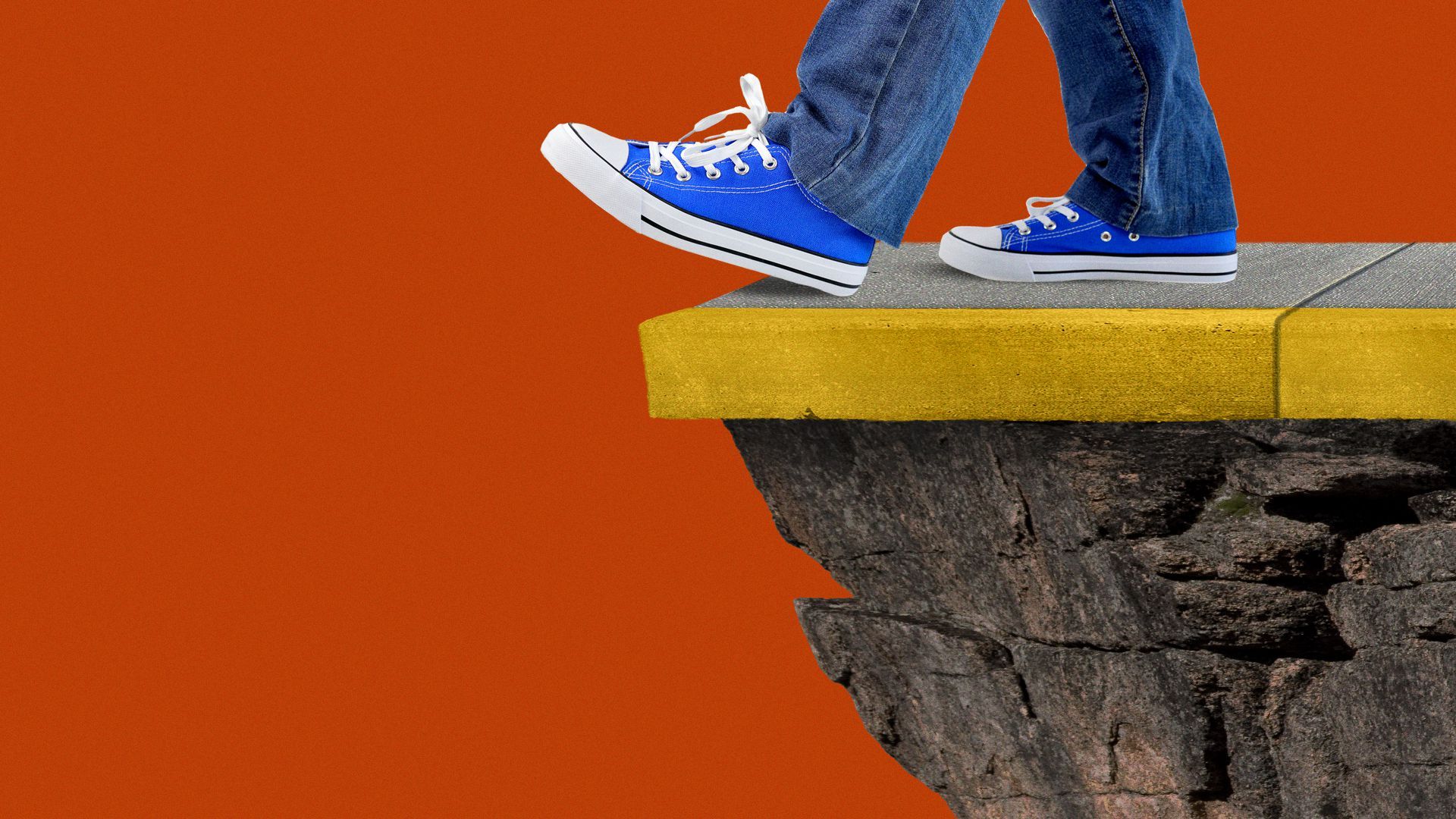
Illustration: Maura Losch/Axios
For all the headlines focused on recession risk (including the one below), the evidence from major banks reporting results in the last few days points to Americans' personal finances holding up extremely well. For now, at least.
Driving the news: Bank of America said this week that spending by customers using its credit and debit cards and other forms of payment is up 10% compared to a year ago, and that delinquencies remain below pre-pandemic levels. JPMorgan Chase also reported low credit losses.
Why it matters: The Federal Reserve is looking to chill demand, and could be forced to act more aggressively in its rate-raising campaign if consumer spending keeps rising as it has.
Where it stands: There are two key forces helping keep consumers afloat.
- Businesses are still hiring at a historically rapid pace to fill payroll gaps left by the pandemic. On average, the economy has added roughly 420,000 jobs each month this year. Wages have risen quickly — though, in many industries, not as quickly as inflation is rising.
- Households are still collectively sitting on a relatively large pile of excess savings, buffered by the fiscal transfers during the first two years of the pandemic — a story that, of course, isn't universal across income groups.
Yes, but: The risk is for a "Wile E. Coyote moment." If consumers' spend-down of pandemic savings runs its course and the labor market weakens simultaneously, Americans could find themselves having run off a cliff with nothing beneath them — causing an abrupt reduction in spending.
- Revised data shows that the savings stockpile is smaller than previously thought and is being drawn down rapidly, "which may imply a more subdued pace of consumer spending going forward than had been projected," Fed vice chair Lael Brainard said last week.
- “Businesses are still seeing rather robust demand when they look in the rearview mirror. But as economists and forecasters, we look at the road ahead, and it appears much bumpier than the road behind us,” says Greg Daco, chief economist at EY-Parthenon.
The bottom line: "Household strain will appear pretty suddenly," says Vincent Reinhart, chief economist at Dreyfus and Mellon.
- "The fact that households have been doing well doesn't mean they will do well over the next six months."
2. Recession model puts odds at 100%
Illustration: Sarah Grillo/Axios
Gulp. For all the will-there-or-won't-there-be-a-recession discourse this year, most of the formal forecasts have pointed to elevated odds that one will take place.
What's new: One such model out this week estimates a virtual certainty of a sustained downturn that is ultimately classified as a recession.
Driving the news: Economists at Bloomberg maintain a quantitative model to predict recession odds that incorporates 13 macroeconomic and financial factors. The latest run of the model put those odds at 100% in the next 12 months.
- In the previous release from economists Anna Wong and Eliza Winger, the model assigned a mere 65% odds to a U.S. recession in the next 12 months.
- The new run also assigned 73% odds, up from 30%, to a recession within 11 months.
Other Wall Street forecasters have also increased their projected odds of a recession in recent months, though few would describe it as the certainty implied by the Bloomberg model.
Sign up for Axios Macro
Stay ahead of the curve on the most important economic developments with reporting and analysis on how business, policy, and markets collide.