Axios Macro

June 12, 2024
Fed day is here! Look for the Federal Open Market Committee policy statement at 2pm ET and accompanying economic projections that may show consensus for two rate cuts later this year. Chair Jerome Powell's press conference is at 2:30; Neil will be in the room.
- Ahead of that, we dig into the May Consumer Price Index. Plus, an exclusive look at how top CEOs feel about the economy. 💼
Today's newsletter, edited by George Moriarty and copy edited by Katie Lewis, is 684 words, a 2½-minute read.
1 big thing: Inflation is cooling (again)
Illustration: Shoshana Gordon/Axios
It's starting to feel a little bit like late 2023: For the second straight month, the CPI was cooler than expected — a sign that inflation might be back on a downward path.
Why it matters: The first few months of the year stoked fears that price pressures were reaccelerating. So far, the second quarter appears much different — with a soft landing path for the economy looking like a reality.
- That could shift the tenor of today's FOMC meeting and make officials more comfortable penciling in two rate cuts this year in their projections. The first rate cut could be in September, if that scenario comes true.
- Stocks and bonds were both rallying this morning upon the news.
What they're saying: "Inflation's return to the Fed's target took two steps forward in May after one step back in the opening months of 2024," Comerica's Bill Adams wrote in a report.
By the numbers: The CPI was unchanged for the month of May after rising 0.3% in April. The core measure, which excludes food and energy prices, rose 0.2% — the slowest monthly pace since August 2021.
- Year-over-year inflation edged down as well, to 3.4% from 3.5%.
- Core CPI is up an annualized 3.3% over the past three months, the lowest since October.
The intrigue: Some categories where price increases were feared to be sticky showed the opposite in May.
- Car insurance, for instance, fell slightly by 0.1% after two consecutive months of rapid gains. (The category is still up more than 20% from a year ago.)
But the long-awaited decline in rental prices (already observed in private data) still hasn't shown up in the CPI report.
- Owner's equivalent rent, which the government uses to account for inflation in homes that people own, rose 0.4% for the third month.
The big picture: The report won't alter the Fed's likely decision to keep interest rates unchanged this afternoon. But it might provide some of the evidence they want to see of normalizing inflation.
- That is, at least, the obvious sentiment in financial markets today. The yield on the two-year Treasury note plunged 0.13 percentage point after the report was released — reflecting expectations of lower rates.
- The CME's FedWatch tool, based on futures prices, puts 61% odds on a rate cut by September — versus about 47% yesterday.
The bottom line: Inflation looks to be cooling again — an encouraging development for consumers and Fed policymakers.
2. Exclusive: Economy's midyear holding pattern
From the C-suites of big companies to the halls of the Federal Reserve, economic decision-makers are waiting to see whether the next shift is toward recession, reacceleration or something in between.
Why it matters: The economy has hit a midyear holding pattern in which policy is static, growth and inflation have leveled out and CEOs aren't making major adjustments to hiring plans as they await the results of the U.S. presidential election and a Fed policy pivot.
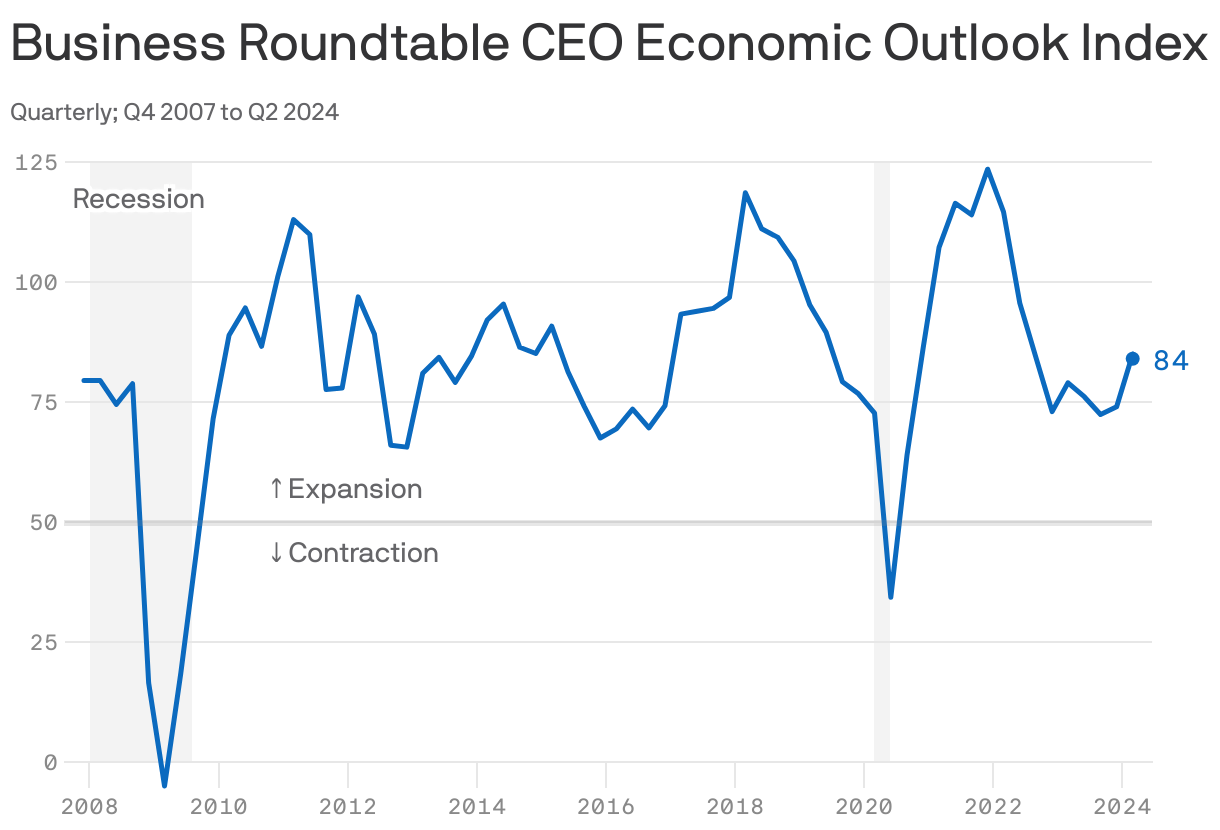
Driving the news: The Business Roundtable's quarterly survey of major company CEOs shows steady confidence in the economy.
- The BRT's economic outlook index, at 84, was a tick below the 85 reported in March and near the long-term average of 83.
What they're saying: "The overarching message from our member CEOs is that the economy is steady and stable, but they remain cautious," said Cisco CEO Chuck Robbins, who chairs the BRT, in a statement.
By the numbers: CEOs reported growing sales — with BRT's index of sales activity rising to 123 from 118. They reported lower plans for capital spending, however, with that index falling to 70 from 78.
- Plans for hiring were unchanged compared to March, with that sub-index steady at 60.
- CEOs expect GDP to grow 2.3% over the coming year, up from 2.1% in March.
- "The survey results imply stable CEO plans and expectations, broadly in line with the historical average — certainly not signaling either overheating or recession," BRT chief executive Josh Bolten tells Axios.
The bottom line: After a tumultuous four years of pandemic, supply chain breakdowns, labor shortages, inflation, war and then a cooldown, this summer is looking like a period of stability and reassessment.
Sign up for Axios Macro

Stay ahead of the curve on the most important economic developments with reporting and analysis on how business, policy, and markets collide.