Axios Macro
August 31, 2026


In Neil's many years attending the annual assemblage of central bankers in Jackson Hole, he has never heard the term "fiscal dominance" on so many lips.
- Today, we look at the emerging clash between the world's central banks and elected governments, which will define the path of inflation, interest rates and economic governance far into the future. 💸
- Plus, Courtenay reports from the G20 summit in Asheville, North Carolina, including a hot-off-the-press exclusive on Treasury Secretary Scott Bessent's planned remarks on financial regulations. ⛰️
Today's newsletter, edited by Jeffrey Cane and copy edited by Katie Lewis, is 1,105 words, a 4-minute read.
1 big thing: Two words that worry global central bankers the most

Around the world, what were once solid lines dividing the responsibilities of those in charge of fiscal policy and monetary policy are being challenged or redrawn.
The big picture: If elected governments succeed in undermining their central banks' independence — pressuring them to suppress interest rates or monetize debt to bail out yawning public debt problems — it foretells a world of higher inflation and economic volatility.
- It was a challenge very much on the minds of the central bankers who assembled over the weekend in Jackson Hole, Wyoming, for the Kansas City Fed's annual symposium — and underscored by recent news.
Zoom out: Central bankers' great fear is that we're entering a new era of "fiscal dominance," in which the money supply is being managed not to achieve low and stable inflation, but to help elected politicians avoid hard choices around taxes and spending.
- It comes as inflation has already been elevated in much of the world for years and as longer-term interest rates are climbing.
- At the same time, elected governments are under intense political pressure not to enact the tax increases or public benefit cuts that would improve their debt outlooks.
Driving the news: The Bank of Japan has been under intense pressure from Prime Minister Sanae Takaichi's government to not raise interest rates despite accelerating inflation, while the Japanese finance ministry has worked with the U.S. Treasury on unusual interventions in currency markets to bolster the yen.
- Leftist French presidential candidate Jean-Luc Mélenchon has proposed canceling debt held by the European Central Bank, essentially seeking to ease the nation's fiscal challenges by offloading the burden on the continent's monetary authority.
- And in the United States, President Trump has undertaken a renewed attempt to fire Fed governor Lisa Cook, which, if successful, could also presage attempts to remove governors Michael Barr and Jerome Powell.
- In addition to Trump's longstanding attacks on the Fed, demanding lower interest rates, the Treasury has undertaken efforts to suppress long-term borrowing costs with a bond market intervention.
What they're saying: "In the context of escalating fiscal pressures, central banks around the world may face pressures about risks of fiscal dominance," IMF managing director Kristalina Georgieva said on a panel in Jackson Hole Friday.
- "Standing here in this legendary monetary policy setting—in this great state of rodeos where every license plate shows a cowboy on a bucking bronco—let me frame the answer in the following way," she said.
- "Central banks' most critical role is to ensure inflation remains low and stable. ... And that means no monetary policy cowboys riding to the fiscal rescue."
Reality check: The efforts to undermine central bank independence have had only modest success so far. Most of the institutions have significant legal safeguards insulating them from political pressure.
- Friday morning, Fed chairman Kevin Warsh strongly suggested that interest rates are in play if the Fed does not gain confidence that inflation is coming down, contrary to the oft-stated desires of the president who nominated him just months ago.
Yes, but: The underlying debt situation in the U.S. — annual deficits of 6% to 7% of GDP even amid full employment — means that any further rise in interest rates will only complicate the politics facing the Fed.
- And while the numbers and institutional details differ around the world, the basic story is the same across most major advanced economies.
The bottom line: "If legislatures end up viewing central banks as a money pot, the risk is you end up compromising on monetary policy for the sake of fiscal authorities," Adam Posen, president of the Peterson Institute for International Economics and a former Bank of England official, tells Axios.
- "If it's World War II or the Great Depression, that's fine," he adds. "But doing that in a more normal economic backdrop is dangerous."
2. On the ground in Asheville
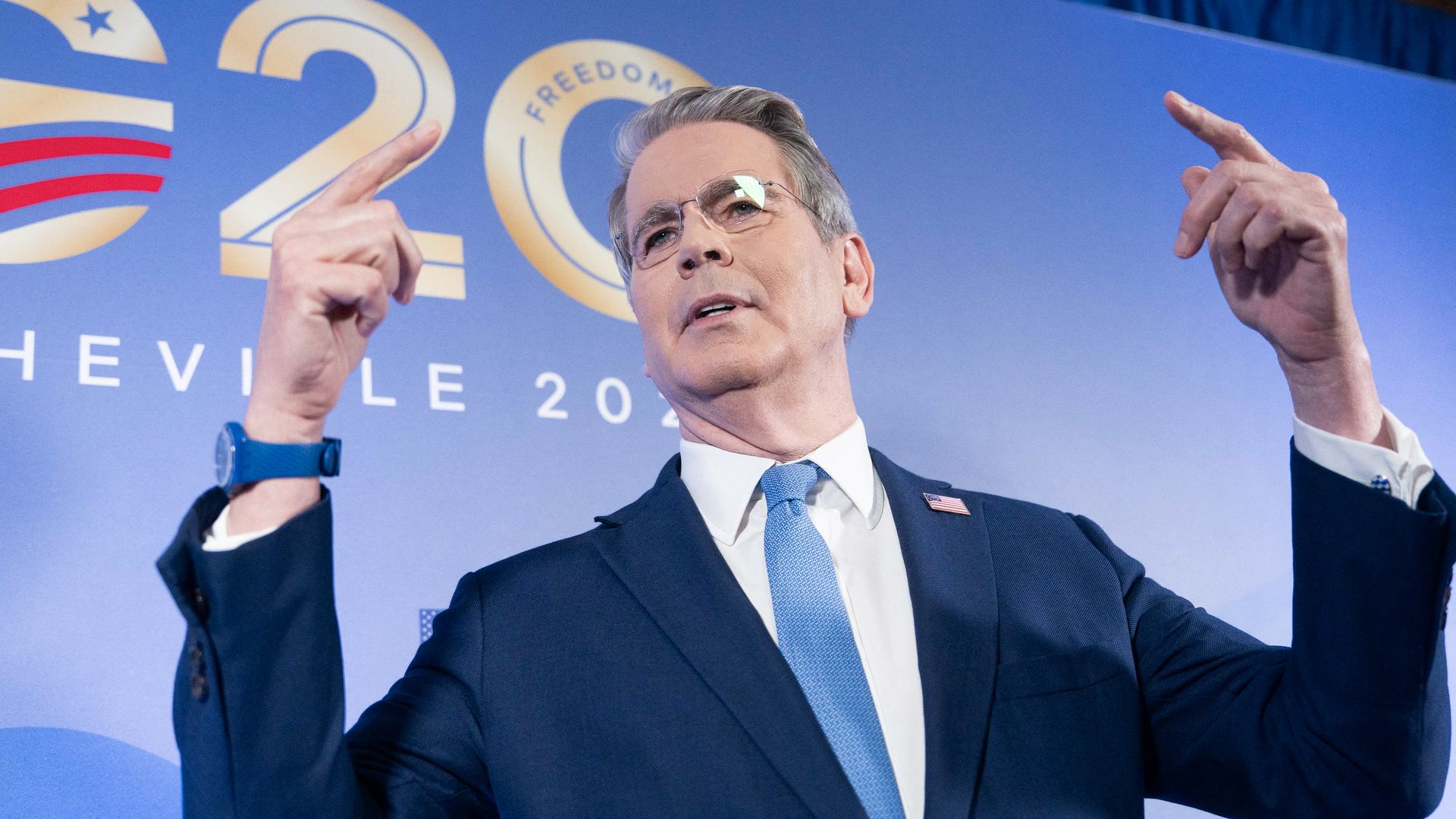
The globe's top economic policymakers gather in the mountains at a shaky period for the global economy, with the Iran conflict driving up energy prices, trade tensions running high and governments facing huge debt loads.
- Bessent's message to the world: The way through is stronger growth.
What they're saying: Bessent pointed to the U.S. economy as a model, arguing that deregulation and policies aimed at boosting private-sector growth should be more broadly embraced by G20 nations.
- "The only way for us to get out of this is to grow our way out of it," Bessent told reporters today. "I'm confident that a lot of the leaders are very receptive to this."
Between the lines: Bessent put growth at the center of the U.S. G20 agenda, calling for reducing regulation, addressing global trade imbalances and improving debt restructuring for struggling countries.
Zoom out: Warsh, returning to the G20 as a Fed official for the first time since the financial crisis, said the economic debate has changed.
- "Secular stagnation" and a "global savings glut" — two themes that dominated during his last stint at the Fed — no longer describe the world economy, he said.
- "I've said previously that inflation is a choice. What I'll add to the discussions today ... is growth is a choice, too."
What to watch: The tensions shaping the global economy were on full display, as the U.S. wages a trade war with some of its closest partners while pressing them to help economically isolate Iran.
- Bessent cheered support for the additional economic pressure on Iran signaled by the EU.
- As Bessent spoke to reporters, Canadian Finance Minister François-Philippe Champagne was nearby after telling international reporters that Canada's economy was doing fine amid an escalating trade fight with the U.S.
What we're hearing: In remarks seen first by Axios, Bessent brought that growth agenda directly to a room of top U.S. executives, calling for lighter financial regulation and a bigger private-sector role in shaping policy.
The bottom line: "The world economy is a little bit like the weather in Asheville — it's unpredictable, it's foggy and we hope it will clear up by the end of the day, " French Finance Minister Roland Lescure told reporters this morning. (By early afternoon, the sun had come out.)
Sign up for Axios Macro