Axios Macro

August 06, 2024

Markets are rebounding after their Monday rout, with the S&P 500 up 1.3% as we send today's newsletter. Exhale, everybody. 😮💨
- In today's Macro, we look at some historical analogues for the Federal Reserve shift to rate cuts now underway, plus yet more data pointing to rising delinquencies on consumer loans.
Today's newsletter, edited by Kate Marino and copy edited by Katie Lewis, is 781 words, a 3-minute read.
1 big thing: What the Fed's past pivots tell us about today
Financial markets gyrating. The economy showing cracks. Wall Street talking heads accusing the Federal Reserve of being cluelessly behind the curve.
The big picture: These are hallmarks of moments when the Fed has undertaken a pivot toward rate cuts, and are very much in the air right now. Examining those past episodes sheds light on what could go right — or very, very wrong — as rate cuts loom.
- Three past dovish pivots from this century stand out for what followed — one good (2019), one bad (2001) and one ugly (2007).
Flashback: The dream scenario is what played out in 2019. In December 2018, the Fed signaled more interest rate increases were on the way in the ensuing year, and markets went haywire.
- In the final days of 2018 and the start of 2019, stocks and bond yields fell as markets started to see recession risk due to the Fed's over-tightening policy.
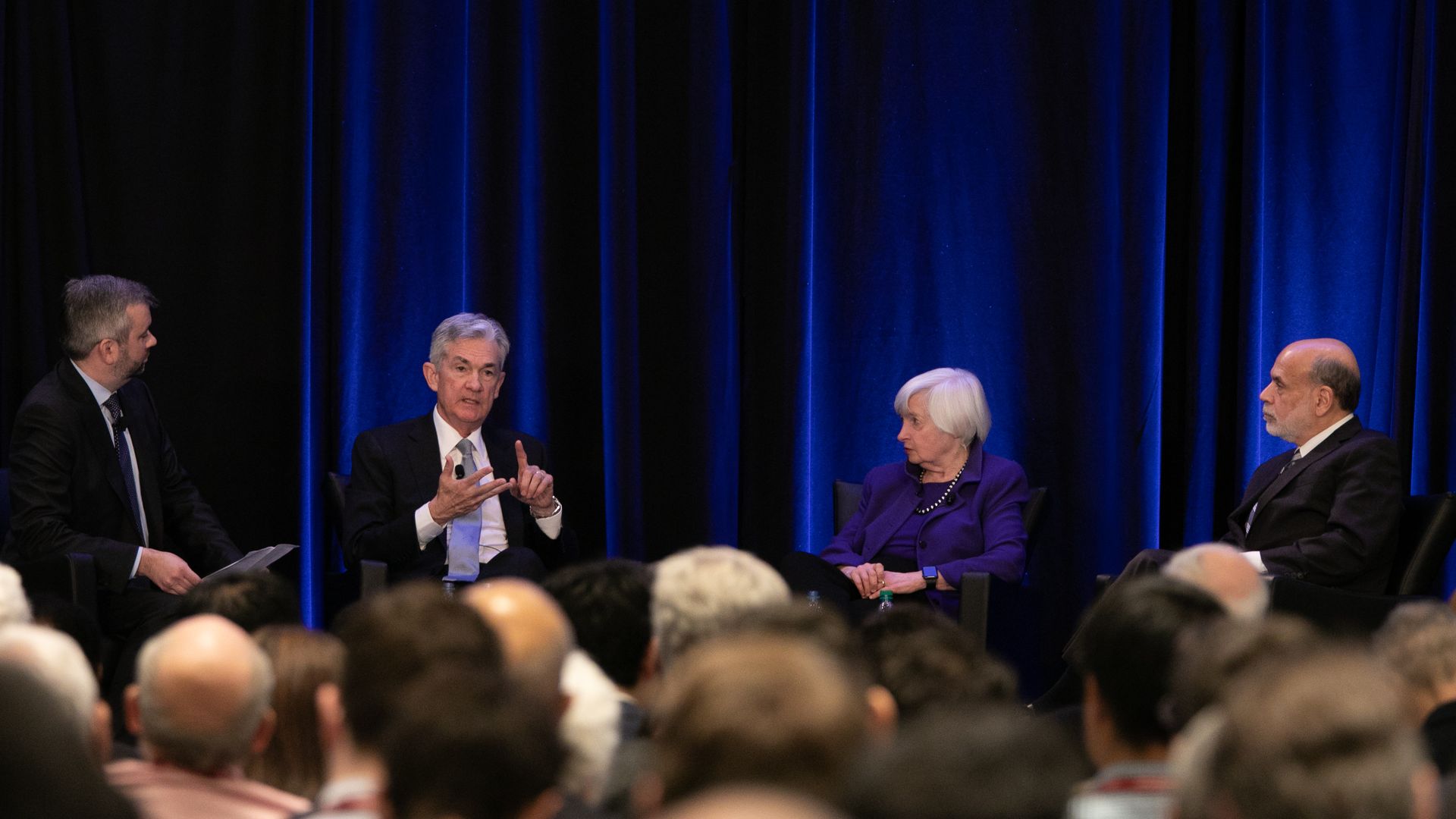
- Chair Jerome Powell, in a panel discussion on Jan. 4, 2019, assured the world that the Fed would be patient with rate hikes, tempering expectations of tighter money.
- Later that summer, the central bank cut interest rates three times, a "mid-cycle adjustment," as Powell called it, aimed at extending what was already the longest expansion on record.
- It seemingly worked, with the economy experiencing solid growth, low unemployment and low inflation until the pandemic hit the next year.
Yes, but: Things aren't always so rosy. In early 2001, with the dot-com bust accelerating and tremors in the economic data suggesting a recession, the Fed cut rates by 0.5 percentage point between regularly scheduled policy meetings.
- Chair Alan Greenspan said in the closed-door meeting, "[W]e're certainly not yet in a free fall. I say 'not yet' because a free fall doesn't look like a free fall until you really start falling."
- The action, the first of what would be 11 rate cuts that year, was not enough to prevent a mild recession in 2001 that was followed by a slow, jobless recovery.
- In effect, the economic downdraft from a stock market crash and pullback in business investment was so powerful that even the Fed's rapid rate cuts couldn't offset it.
Finally, there is an even gloomier example of what can follow a Fed pivot. In August 2007, global credit markets were freezing up due to losses on U.S. home mortgages. Chair Ben Bernanke signaled rate cuts were ahead at the Fed's Jackson Hole conference late that month, followed by a 0.5-point rate cut in September.
- It helped soothe things for a while, but the losses kept spreading, and by the end of 2007, the credit markets were again in crisis mode.
- Lower rates were not enough to offset massive disruption in the global financial system that constrained the flow of credit, making 2008 a year of severe recession.
The bottom line: Whether a Fed rate cut pivot is enough to avert a recession depends on whether the underlying economic situation is basically sound or if there are deep-seated imbalances the economy is working through that monetary policy can help offset but can't fix.
- The big question now — which we'll explore in the days and weeks to come — is which of those situations better describes 2024.
2. Stretched consumers


Consumers continue to look more financially stressed, according to new data from the New York Fed.
By the numbers: Roughly 8% of auto loan balances were newly delinquent in the second quarter, with payments at least 30 days late. That is roughly flat relative to the start of 2024.
- The story looks similar for credit card balances, which edged up by 0.1 percentage point from the second quarter. Both are the highest since the 2007 financial crisis.
Yes, but: The deterioration in household balance sheets is clearer when comparing these rates to the same period a year ago.
- Delinquency rates for credit cards have jumped 1.8 percentage points since the second quarter of last year. For auto loans, it's 0.7 percentage point.
- The share of credit card balances transitioning into "serious" delinquency status — with payments 90 or more days late — was about 7.2% last quarter. This time last year, it was about 5.1%.
The intrigue: Those aged 30-39 have transitioned into delinquency at quicker rates than other cohorts.
- Researchers at the New York Fed offer a few reasons why this might be the case: They overextended themselves during the pandemic and they're more likely to be renters, so they're more exposed to rent price increases.
What to watch: Other loan types show little trouble for consumers: Mortgage delinquencies remain lower than in pre-pandemic times.
- It's a bit foggier for student loans: Late payments still aren't being reported to credit agencies.
Sign up for Axios Macro