Axios Macro

March 27, 2024

A new report explains why worker productivity growth around the world might look very different in the years ahead. More below.
- Plus, how economists see the Baltimore bridge fallout rippling through the national economy.
Today's newsletter, edited by Kate Marino and copy edited by Katie Lewis, is 751 words, a 3-minute read.
1 big thing: A huge moment for global investment

Illustration: Natalie Peeples/Axios
Over the last 15 years, weak capital investment in rich countries has held back productivity growth. But that may be about to change.
Why it matters: The pathway to higher incomes and standards of living rests on economies finding ways to deploy their labor forces more productively.
- The dearth of productivity growth over the last couple of decades has held back incomes in the U.S. and other rich countries, according to a report out today from the McKinsey Global Institute, the research arm of the global consultancy.
The big picture: Productivity growth has been weak in the U.S. and Western Europe since the 2008 global financial crisis, but things looked better among many emerging markets.
- The McKinsey report finds that global labor productivity growth was 2.3% a year from 1997 to 2022, a rapid rate that has increased incomes and quality of life in large parts of the world.
- China and India account for the largest portion of that surge — half of overall global productivity improvement, with other emerging markets accounting for another 25%, led by Central and Eastern Europe and emerging Asian economies.
By the numbers: In the U.S., the report finds that the decline in capital investment following the 2008 financial crisis has resulted in a $4,500 lower per-capita GDP in 2022 than it would have if pre-crisis trends had continued.
- Rapid advances in manufacturing technology, especially for electronics, petered out in the same time period, subtracting another $5,000 from per-capita GDP.
- "Digitization was much discussed as the main candidate to rev up productivity again, but its impact failed to spread beyond" the tech sector, the authors write.
Yes, but: The authors are optimistic that a confluence of factors will make the years ahead different.
- The rise in global interest rates and inflation are evidence of stronger global demand. Many countries are experiencing labor shortages that may incentivize more productivity-enhancing investment. And artificial intelligence and related technologies create big opportunities.
- "Inflationary pressure and rising interest rates could be signs that we are leaving behind secular stagnation and entering an era of higher demand and investment," the report finds.
What they're saying: "In corporate boardrooms around the world right now, there's a tremendous amount of conversation associated with [generative] AI, and I think there's a broad acknowledgment that this could very much transform productivity at the company level," Olivia White, a McKinsey senior partner and co-author of the report, tells Axios.
- "Another thing that's happening right now is the conversation about labor. Labor markets in all advanced economies, and the U.S. is really sort of top of the heap, are very, very tight right now."
- "So there's a lot of conversation around what do we do to make the people that we have as productive as they can be?"
2. Economic fallout from the Baltimore bridge collapse
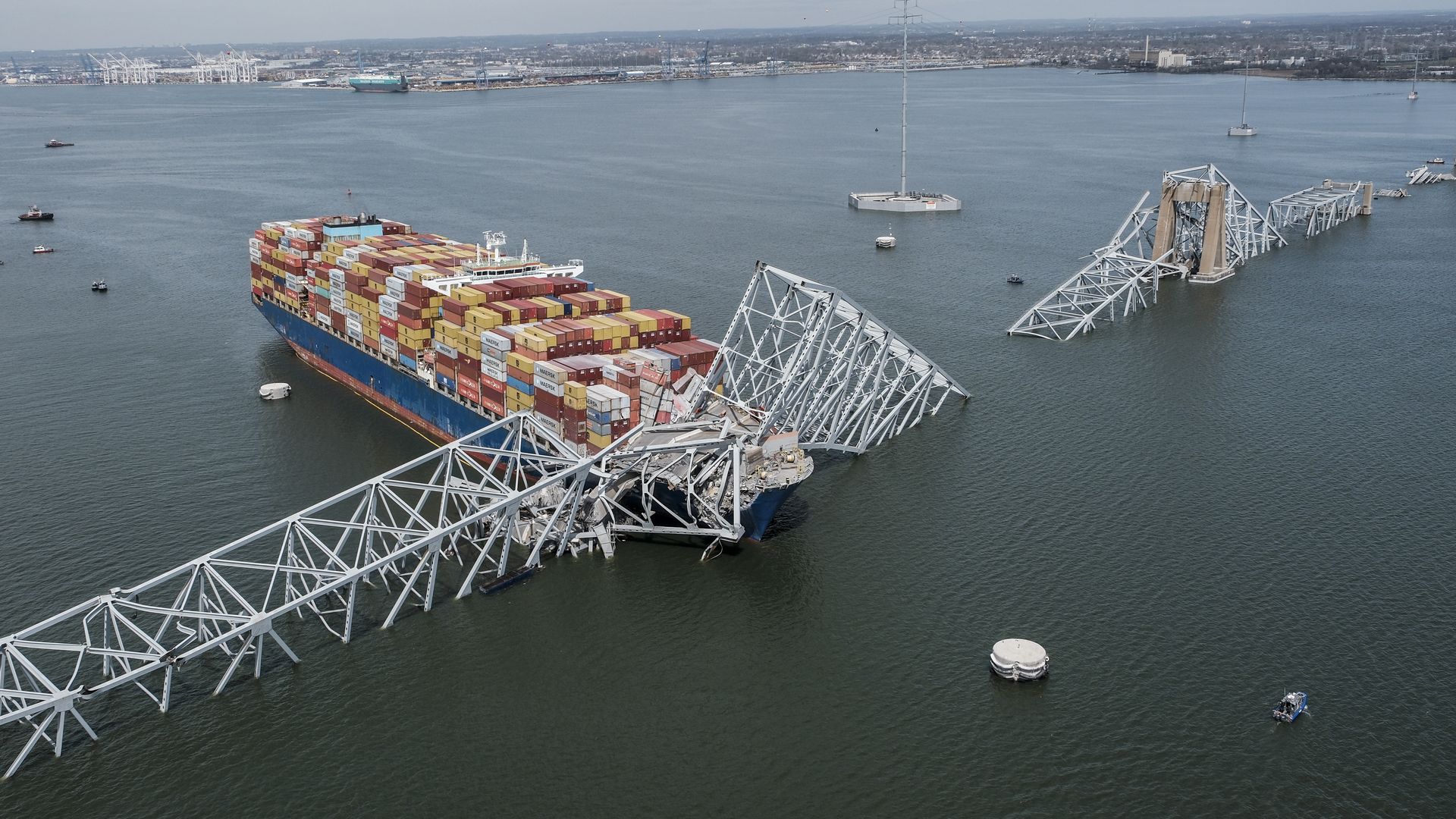
The remains of the Francis Scott Key Bridge in Baltimore. Photo: Michael A. McCoy for The Washington Post via Getty Images
The tragic bridge collapse in Baltimore closed a vital throughway for the nation's commerce.
The big picture: It may complicate shipping logistics along the East Coast as shippers divert to other nearby ports — but the economic disruption doesn't look like the type of threat to broader supply chains that could cause widespread shortages and price spikes.
Why it matters: The unsnarling of supply chains was a notable disinflationary tailwind. While unknown shocks could threaten that progress, this bridge collapse — at least so far — doesn't appear likely to be one of them.
What they're saying: The collapse "is another reminder of the US vulnerability to supply-chain shocks, but this event will have greater economic implications for the Baltimore economy than nationally," Ryan Sweet, chief U.S. economist at Oxford Economics, wrote in a note.
- Sweet says that transportation costs may rise, given the bridge is a key throughway for commercial trucks.
- Still, the firm doesn't anticipate "that the increase in transportation costs and disruptions will be widespread or large enough to lift either headline or core consumer prices."
By the numbers: The port of Baltimore ranks 17th in the nation by tonnage of cargo handled, but it leads all other U.S. ports in imports and exports of cars and light trucks, according to state data.
- Analysts at Cox Automotive say the impact on auto market sales "will be non-material as current new-vehicle inventory levels are healthy and alternative ports are in position to take up the slack."
- In a statement to Axios, a spokesperson for General Motors said the company expects the situation to have "minimal impact" on its operations.
- "We are working to re-route any vehicle shipments to other ports as the recovery work continues," the spokesperson said.
Sign up for Axios Macro

Stay ahead of the curve on the most important economic developments with reporting and analysis on how business, policy, and markets collide.