Axios Macro

September 16, 2026


1 big thing: CEO confidence at a 4-year high
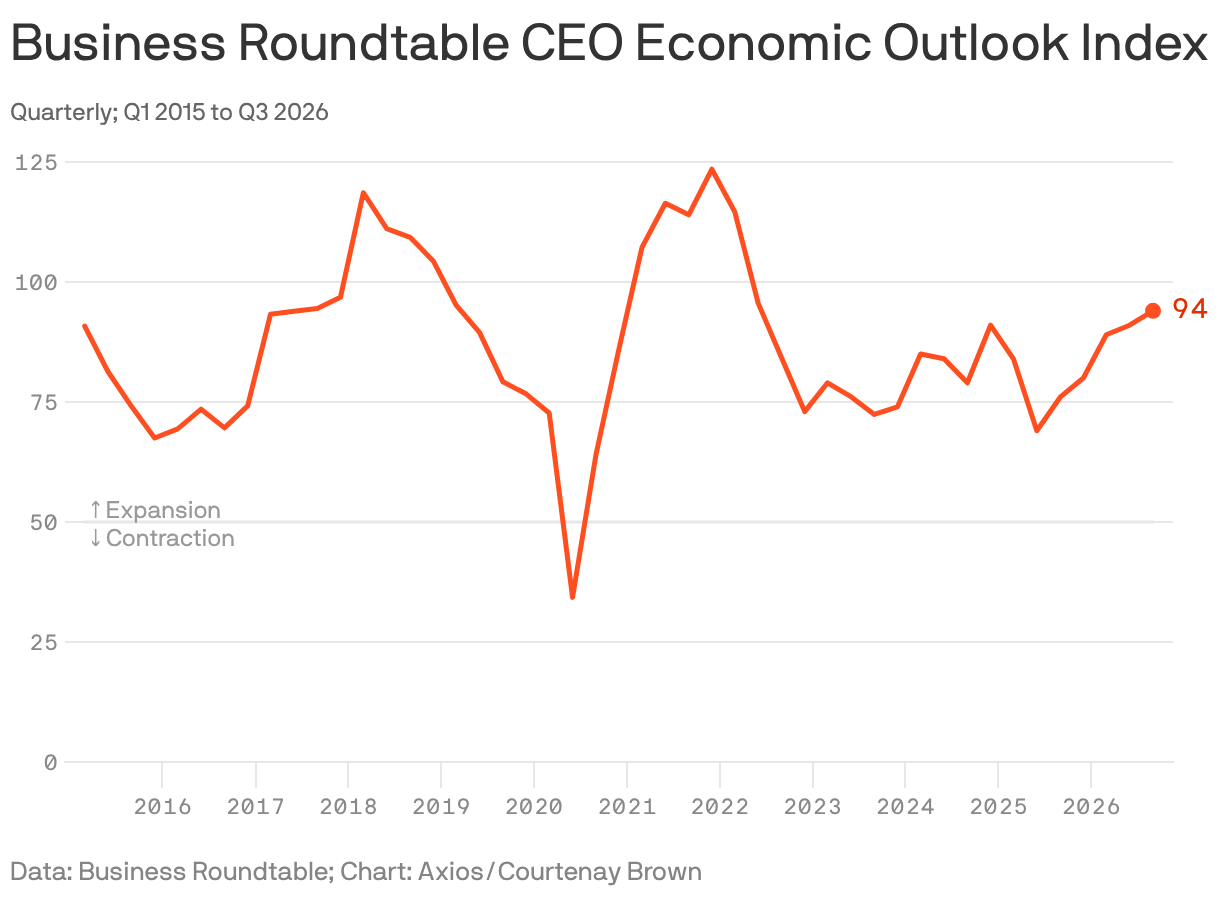
CEO economic confidence is the highest since 2022, with that optimism now spilling over into plans to hire more workers.
Why it matters: The chief executives of America's largest companies are signaling confidence in the economy that could support job growth and investment, a stark contrast with the gloom among consumers.
Driving the news: The Business Roundtable's CEO Economic Outlook Index climbed 3 points in the third quarter, to 94 — the fifth consecutive increase and well above the historical average of 83.
- The index has climbed steadily from a five-year low after President Trump's "liberation day" tariffs early last year.
- The survey was conducted from Aug. 31 through Sept. 11, a period that coincided with new U.S.-Canada tariffs taking effect, tensions in the Iran war intensifying and a renewed surge in global energy prices.
- Yet CEOs still grew more upbeat. Sales and investment plans remained well above historical norms, while the hiring index jumped 7 points, to 58, just shy of its long-run average of 61.
What they're saying: "The increase in hiring plans is encouraging, even as the broader economic picture remains mixed," Business Roundtable CEO Joshua Bolten said in a statement.
- "But further deterioration of the vital U.S.-Canada economic relationship and broader North American trading framework could deliver a major blow to that progress," Bolten added, urging both sides to resume trade talks and roll back tariffs.
The intrigue: For much of the past year, the survey captured a striking feature of the AI economy — strong investment plans alongside unusually weak hiring projections. It reflected a bet that AI and other new technology could fuel growth without requiring companies to add many workers.
- The latest survey's pickup in hiring plans suggests a growing appetite for workers, with a larger share of CEOs planning to add workers and a smaller group expecting cuts.
- About 36% expect employment to rise over the next six months, 37% expect no change, and 28% expect employment to shrink.
- The shift is consistent with a recent firming in labor market data, with job growth picking up sharply in August.
The big picture: The brighter mood in the C-suites stands in sharp contrast with the gloom among consumers, underscoring a widening divide in how businesses and households are experiencing the economy.
- The University of Michigan's consumer sentiment index fell to 47.8 in early September, the second-lowest reading on record (and about 3 points above the all-time low hit in May).
- Consumers are feeling the latest price pressures more acutely, with year-ahead inflation expectations jumping to 4.6% from 4% as energy prices surged.
- "This quarter's survey results are welcome news and reflect the resilience of the U.S. economy, but affordability pressures remain a challenge for businesses and families," Cisco Systems CEO Chuck Robbins, who chairs the Business Roundtable, said in a release.
The bottom line: Corporate America is looking through an economy that has left consumers rattled — and now CEOs appear more willing to put that confidence behind more hiring.
Situational awareness: Bolten is stepping down as head of the BRT on Jan. 31, our colleague Mike Allen reports. His successor will be Kristen Silverberg, a former U.S. ambassador to the European Union and current No. 2 at the group.
2. 🔥 August spending surprise


Consumers may feel lousy about the economy, but they still won't quit spending.
- The final piece of economic data before this afternoon's Fed decision is hot. Retail sales last month surged by the most since March, when a spike in gasoline prices and a boost from tax refunds helped account for higher spending totals.
Why it matters: The spending boom is welcome news for an economy that is carrying plenty of momentum into the fall. But resilient consumer spending could make Fed officials' efforts to tame inflation that much more difficult.
By the numbers: Retail sales jumped 1.2% in August, after a 0.5% drop in spending the prior month.
- The data is not adjusted for inflation, so some of last month's strength reflects the recent run-up in pump prices. Sales at gas stations surged 3.1% last month.
Zoom in: Excluding gas stations, retail sales rose 1.1%, reflecting notably broad spending in August.
- Online sales jumped 2.6%; spending at electronics and appliance stores climbed 1.6%, and sales at restaurants and bars gained 1.2%.
- Of the top-level categories the Census Bureau tracks, just one posted a monthly decline: building materials.
What they're saying: "The report points to continued resilience in consumer spending, which, against a backdrop of persistent inflation pressures, puts further pressure on the FOMC to raise rates today," Richard de Chazal, a macro analyst at William Blair, wrote in a note.
- A closely watched measure of sales that feeds into GDP calculations rose an even stronger 1.4% in August — nearly triple what economists expected.
The bottom line: Any signs that consumers were running out of steam look a lot less convincing after August's surge, even as households faced higher prices.
Axios Macro