Axios Macro

April 25, 2023
Angst about whether lawmakers will strike a deal to raise the debt ceiling is being reflected in the bond market. That angst is also increasingly apparent in commentary from economists. More below.
- 🗓 Our annual dealmaking event is heading to the West Coast: Axios BFD will be in San Francisco on May 10, convening top industry leaders across finance and business. Request an invite to attend the event in person here.
Today's newsletter, edited by Javier E. David, is 600 words, a 2-minute read.
1 big thing: The bond market sounds the alarm
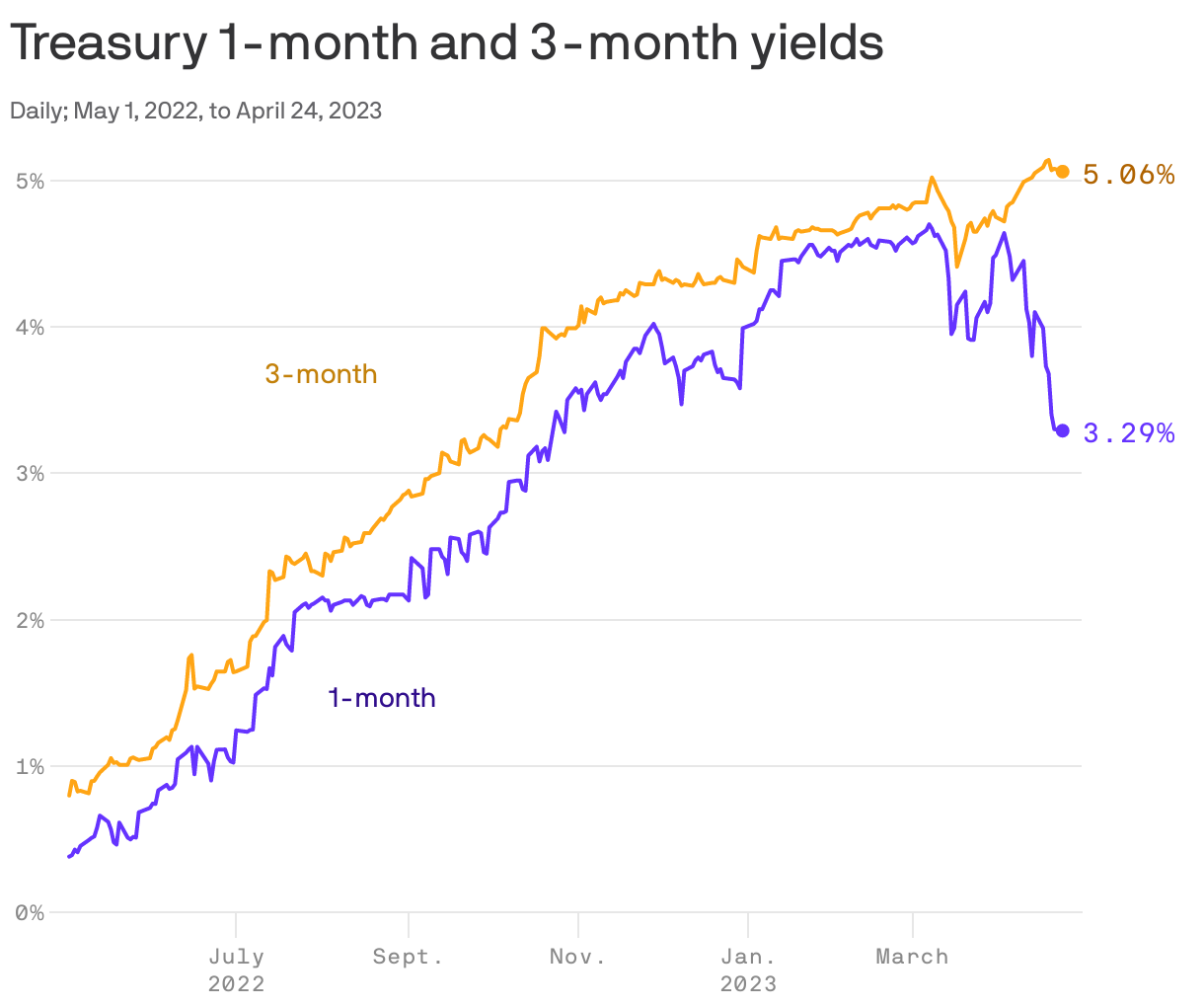
An unprecedented dislocation in the Treasury markets is a sign of extraordinary nervousness about the upcoming U.S. debt ceiling negotiations.
Why it matters: Short-term interest rates are normally the most boring and predictable part of international financial markets. The current chaos is a sign of just how seriously traders are taking the extreme level of uncertainty in Washington.
By the numbers: Three-month Treasury bills are yielding 1.77 percentage points more than their one-month equivalents. That's the largest gap of all time.
The big picture: When markets are nervous, they pile into Treasury securities, which are conventionally considered to be the risk-free benchmark against which everything else is measured.
- The sharp drop in one-month Treasury yields reflects just such a flight-to-quality trade. (Yields fall when prices rise in the face of strong demand.)
Between the lines: Three-month yields haven't fallen — indeed, they've risen over the past couple of weeks — because fast-forwarding three months from now takes us into the heart of any potential debt ceiling default.
Where it stands: The U.S. hit the debt limit earlier this year. Since then, the Treasury Department has used "extraordinary measures" to allow the nation to keep paying its bills. But it can only do that for so long.
- The Treasury is expected to issue new guidance in the coming days on when those measures might be exhausted, based on tax revenue data.
- Private sector economists, including those at Goldman Sachs and Bank of America, warn that revenues have been weaker than anticipated. That means a potential default might be sooner.
The bottom line: Buying a one-month Treasury bill doesn't protect against a government default; nothing can do that. The bill will mature, and the cash will need to be reinvested somewhere.
- But for the time being, a one-month bill is significantly — and alarmingly — less risky than a three-month bill.
2. Economists are worried

Illustration: Sarah Grillo/Axios
Lawmakers are far from reaching a deal to raise the debt limit, with economists warning about the potential macroeconomic consequences of a deadlock and possible default.
Driving the news: The latest warning comes from Moody's Analytics, the economic research arm of the ratings agency.
- Raising the debt ceiling "will surely be messy and painful to watch, generating significant volatility in financial markets," economists Mark Zandi and Bernard Yaros write in a new note.
- "Lawmakers will not be sufficiently motivated to find a political path forward and act until they recognize the severe economic and political costs of not doing so."
Moody's Analytics also assessed House GOP leader Kevin McCarthy's proposal to lift the debt ceiling alongside spending cuts.
- They estimate that package would result in lower employment and slower economic growth than if the debt ceiling was raised without those spending cuts.
- The White House is using these estimates to slam McCarthy's proposal: "Speaker McCarthy's bill would cut the American economy off at the knees," said press secretary Karine Jean-Pierre in a statement.
The backdrop: Meanwhile, International Monetary Fund economist Filippo Gori says the global economy and financial markets will face huge consequences should U.S. lawmakers fail to get a deal at all.
- "It would be a spectacular debacle—weakening the U.S. economy and undermining the United States' international standing—of the country's own creation," Gori writes in a new essay for Foreign Affairs.
Gori says any protracted showdown could be more damaging than the last debt ceiling standoff in 2011. Then, global financing costs were low. Now, many countries are already facing high interest rates as policymakers try to contain inflation.
- "In this context, a shock to U.S. Treasury bonds could escalate into a wave of corporate and sovereign defaults," Gori notes.
Sign up for Axios Macro

Stay ahead of the curve on the most important economic developments with reporting and analysis on how business, policy, and markets collide.