Axios Macro

April 05, 2023

1 big thing: Milestone for Black workers
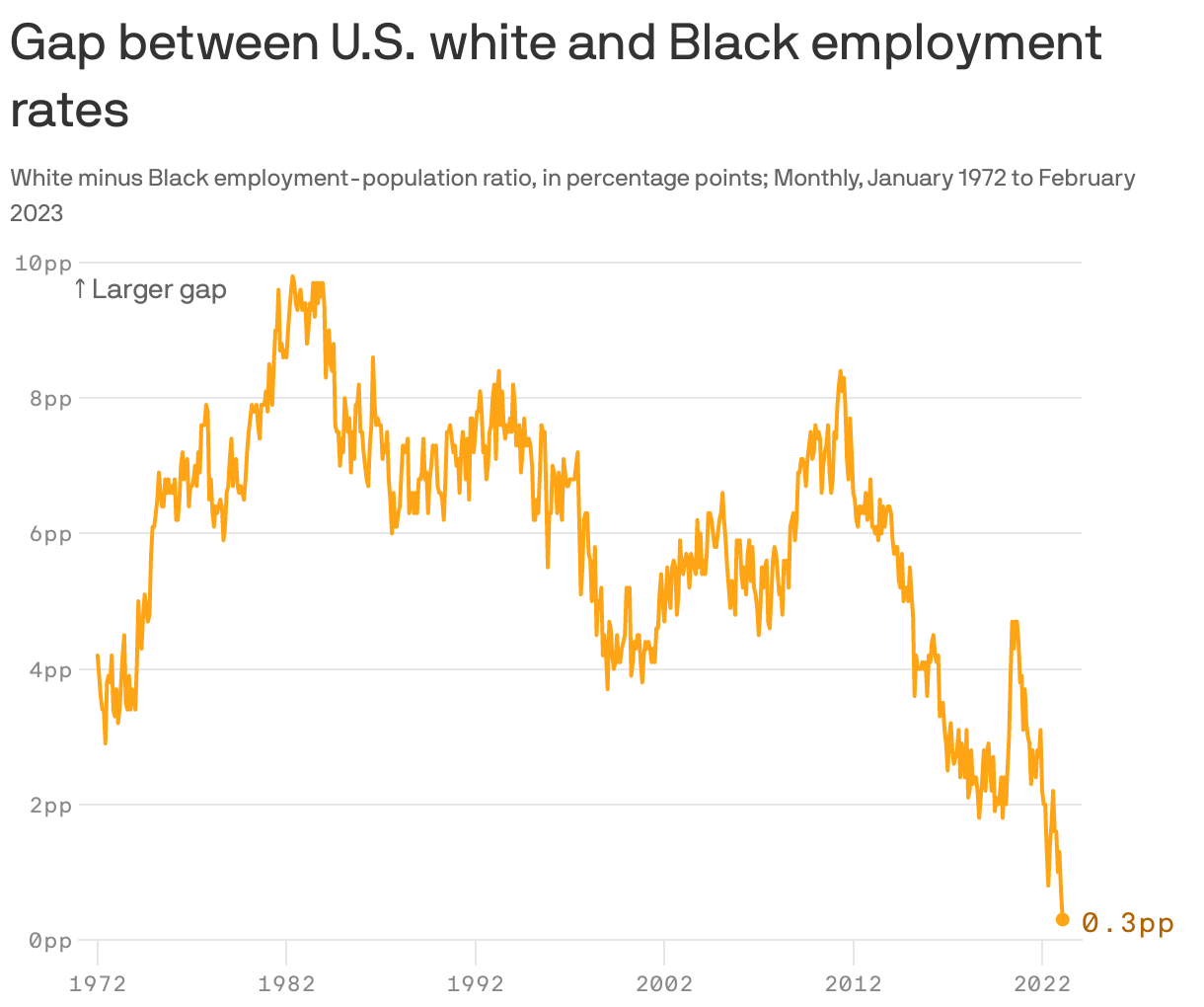
The economy hit a quiet milestone in recent months: The labor market is seeing more equitable employment outcomes across racial groups than it has in years.
Where it stands: For the half-century data has been available, white workers have enjoyed higher rates of employment than Black workers. That gap still exists, but it has been shrinking notably.
Why it matters: Overall, America's labor market has continued to surprise, to the upside. One real-world effect is the lasting favorable job conditions necessary for marginalized workers, including Black Americans, to reap the benefits others get much sooner.
- "The tighter that the labor market gets, the more incentivized employers are to pull [in] workers they have overlooked in the past," says Daniel Zhao, an economist at career site Glassdoor.
By the numbers: In the sluggish recovery that followed the 2008 financial crisis, the white employment-population ratio — or the share of that population with a job — was more than 8 percentage points above the comparable measure for Blacks, according to the Labor Department.
- But as of February, that gap has nearly shut: It's 0.3 percentage points — the smallest differential on record, helped by big employment gains for Black men.
What they're saying: "Not every issue of inequity is resolved here — not every job is equal," says Skanda Amarnath, executive director at research firm Employ America. "But employment is an important part of people's welfare."
Between the lines: Stronger employment gains for Black workers are the notable side effect of the hotter-than-desired labor market. That was also true in 2019, when the Black unemployment rate hit an all-time low after the decade-long expansion.
- The unemployment rate among Black Americans was 2.1 percentage points higher than the overall rate in February, a narrower spread than any time on record — except for a four-month span in 2019, when it reached an all-time low of 1.6 percentage points.
- "On the one hand, Black workers, largely men, are enjoying a fairly robust labor market," says Michelle Holder, an economics professor at John Jay College of Criminal Justice. But on the other hand, wage gains in some cases are being pressured by inflation, Holder adds.
The bottom line: It's not enough to knock them off course, but the Fed has acknowledged moves to cool inflation could ultimately hit a subset of workers particularly hard.
2. ADP says hiring cooled last month
Photo: Mario Tama via Getty Images
Axios Macro

Stay ahead of the curve on the most important economic developments with reporting and analysis on how business, policy, and markets collide.