Axios Macro
January 16, 2024

❄️ Greetings from Davos, Switzerland, where Neil is at the World Economic Forum. Today features his takeaways from an intense first two days — specifically about the macroeconomics of artificial intelligence.
- Plus, we read between the lines of an optimistic new Fed speech.
📉 Situational awareness: Manufacturing activity in New York state plummeted this month, a new Fed survey shows. The headline index fell 29 points to -43.7, the lowest on record outside of the pandemic, as new orders sank.
- The readings can be volatile, so it's worth watching whether the trend continues in other regional manufacturing Fed surveys.
Today's newsletter, edited by Javier E. David and copy edited by Katie Lewis, is 703 words, a 2½-minute read.
1 big thing: The huge open question on AI economics

Clara Shih, CEO of Salesforce AI, at Axios House in Davos, Switzerland. Photo: Dani Ammann for Axios Events
When it comes to the economic impact of artificial intelligence, is 2024 going to be more like 1987 or more like 1995?
Why it matters: In the 1990s and early 2000s, a revolution in information technology helped fuel a productivity boom — and with it, an environment of rapid growth, rising wages and low inflation.
- Many at the World Economic Forum in Davos envision something similar — or more significant — emerging from AI advances. Less clear is when.
- Yet the 1990s IT productivity boom didn't arrive until late in that decade, even though it was based on technologies developed in the 1980s. "You can see the computer age everywhere but in the productivity statistics," economist Robert Solow famously observed in 1987.
State of play: It takes time for companies to learn how to use technological innovations to their maximum effect to get more output from their workers. In Davos, many talks have centered on AI's leap from an interesting novelty to the core driver of business efficiency.
What they're saying: "We're at a phase where in 2024 we think generative AI will move from pilots and experiments to implementation and industrialization," Paul Knopp, the U.S. CEO of KPMG, tells Axios.
- Clara Shih, the CEO of Salesforce AI, said at Axios House yesterday that the companies Salesforce works with "are already seeing productivity gains" from AI tools.
After all, implementing AI-driven work processes doesn't require the same kind of massive investment in equipment that earlier waves of technology have; most knowledge workers already sit at a computer all day.
- "I'm actually very bullish about some of the possibilities for significantly improving productivity much faster than we might have thought," said Stanford AI economics scholar Erik Brynjolfsson at another Axios House event.
Yes, but: Companies usually don't rework their processes overnight. Software must be vetted for security and accuracy. Employees need to be retrained. That may paradoxically slow productivity growth during implementation.
The bottom line: 2024 will be a year of significant change thanks to AI, but there is no certainty it will be visible, as Solow once said, in the productivity statistics.
2. Why a top Fed official is feeling good about inflation
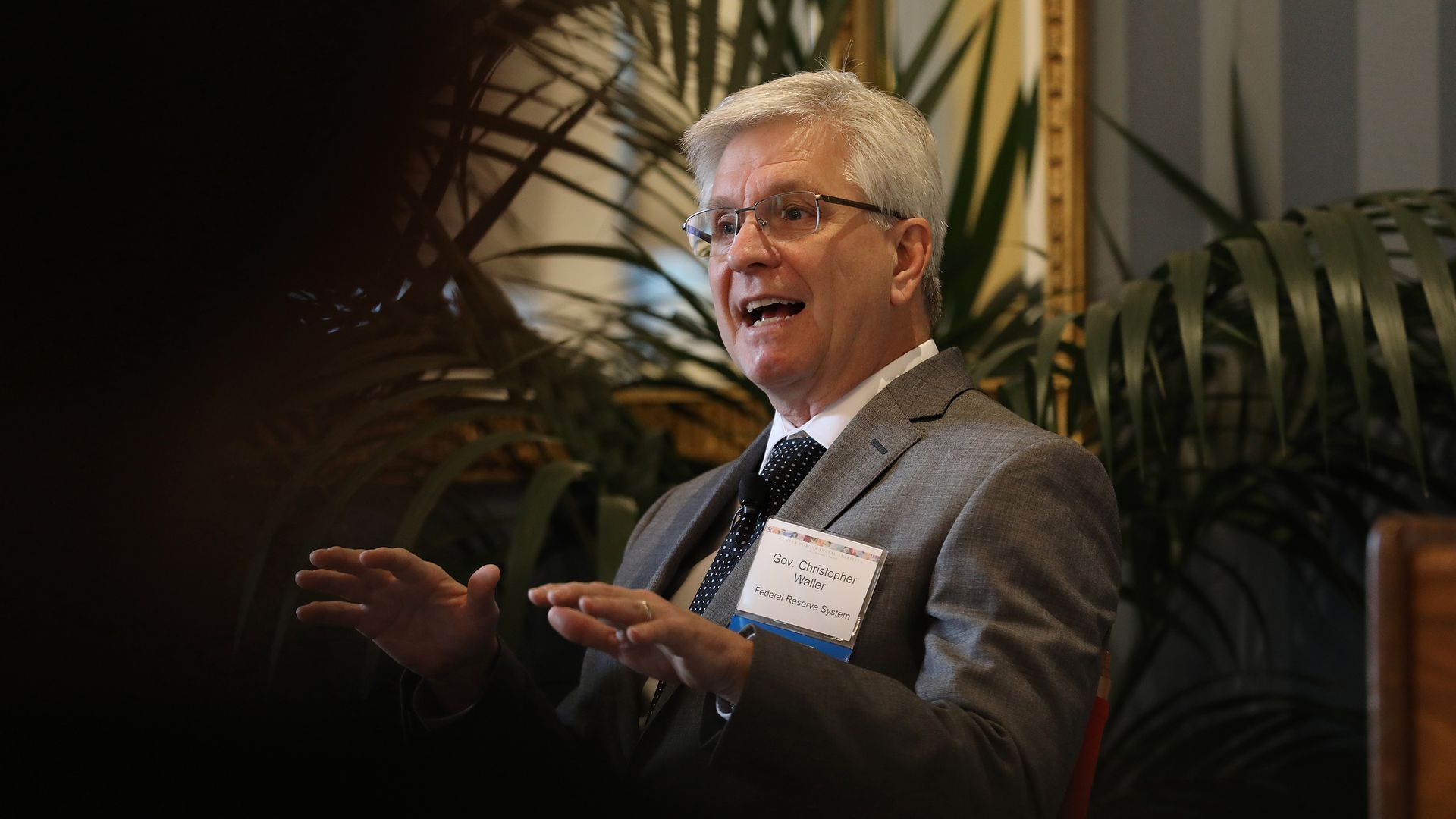
Federal Reserve governor Christopher Waller speaks at an event in 2021. Photo: Bess Adler/Bloomberg via Getty Images
Fed governor Christopher Waller is more confident now than at any point since 2021 that "inflation is on a path" to the Fed's 2% target.
What he's saying: "[B]ased on economic activity and the cooling of the labor market, I am becoming more confident that we are within striking distance of achieving a sustainable level of 2 percent" inflation, Waller said in a virtual speech today at the Brookings Institution.
Why it matters: Waller's comments lay out the case for why the Fed can consider cutting interest rates this year. But he was slightly cautious that optimal economic trends may not last.
- "The data we have received the last few months is allowing the [Fed] to consider cutting the policy rate in 2024," Waller said.
- "However, concerns about the sustainability of these data trends requires changes in the path of policy to be carefully calibrated and not rushed," Waller noted, adding that the timing and extent of such cuts will depend on incoming economic data.
The big picture: The speech, titled "Almost as Good as it Gets...But Will It Last?" is the closest thing to a soft landing victory lap yet by a top Fed policymaker.
- Waller notes that economic activity has moderated but not collapsed and the labor market remains healthy as they come back into balance — all while inflation has returned to more tolerable levels.
- He also notes that financial conditions "remain restrictive and continue to have the desired effect of being a drag on economic activity to put downward pressure on inflation."
Yes, but: Waller notes a number of risks that could make him more pessimistic about inflation's path, including faster-than-expected economic growth in the final quarter of 2023; labor market rebalancing "stops improving or reverses"; and "gains on moderating inflation evaporate."
The intrigue: History shows that the Fed has cut rates "reactively and did so quickly and often by large amounts," Waller said. This economic cycle, however, might prove different.
- "When the time is right to begin lowering rates, I believe it can and should be lowered methodically and carefully," Waller said.
Sign up for Axios Macro
Stay ahead of the curve on the most important economic developments with reporting and analysis on how business, policy, and markets collide.