Axios Macro

October 03, 2022

Welcome to another week of Macro. While Neil enjoys a few days off, Courtenay will guide you through what may be a particularly newsy stretch ahead of Friday's big jobs report.
- In today's edition, a look at how the Fed sees the hot labor market cooling off. And, keeping on the jobs theme, a few notable labor anecdotes from the manufacturing sector. 🏭
Situational awareness: In a new report, a United Nations agency warned a global recession and prolonged stagnation is ahead, unless there's a quick change in the "current policy course of monetary and fiscal tightening" in advanced economies. It called on central banks in developed countries to "revert course and avoid the temptation to try to bring down prices by relying on ever higher interest rates."
Today's newsletter, edited by Javier E. David and copy edited by Katie Lewis, is 656 words, a 2½-minute read.
1 big thing: Bringing balance to the labor market

Illustration: Allie Carl/Axios
For much of the pandemic recovery, the Federal Reserve said more labor supply —i.e., pulling more people into the workforce — could help take steam out of the hot job market.
- But more recently, officials say that strategy is likely all but tapped out. Now the path to cooling the labor market largely rests on demand — or, put frankly, diminishing employers' voracious appetites for workers.
Why it matters: The Fed says the out-of-whack job market needs to normalize to take the pressure off wage growth and, by extension, inflation. But the way it appears that will have to happen (fewer job openings, more layoffs) has wide-ranging implications for workers and the economy.
Catch up quick: Anecdotes point to businesses continuing to bid up wages to compete for workers, though to a lesser extent than earlier this year. Indeed, companies like restaurant chain brand Darden say turnover is slowing, and labor shortages have eased a bit.
- One reason might be a bigger pool of workers. In August, the number of people in the labor force rose by a whopping 786,000.
But in recent days, some Fed officials have warned that more relief on this front may be unlikely.
What they're saying: "We're basically back to trend on the labor force participation rate, given demographics, so I'm not expecting this big influx of workers," Cleveland Fed president Loretta Mester told CNBC last week.
- “A strong labor market may help draw some of those sitting on the sidelines back into the workforce and alleviate some labor market pressure. But as time passes, I've become less optimistic that this labor supply channel will be very large," Chicago Fed president Charles Evans said in London last week.
Between the lines: In a world where there's limited upside for labor supply, the focus is on chilling labor demand.
- As chair Jerome Powell said at last month's press conference, job openings are critical to the Fed's understanding of the demand for workers (for better or for worse).
- In the Fed's ideal scenario, this is the channel through which pressure on the job market eases. In other words, the historically high number of job openings — there are currently two for every available worker — would come down, but without unemployment spiking as it historically has.
- A growing number of economists are skeptical about this possibility, noting far more workers will need to be laid off from work to tame inflation.
The bottom line: Data so far points to labor market momentum that's providing difficult to slow. Layoffs remain low, if jobless claims are any indicator. Companies have added 430,000 jobs on average each month this year, still far more than before the pandemic.
- All of it helps keep pressure on the Fed to raise rates at a torrid pace, even as global developments muddy the backdrop.
- There are crucial updates on the jobs front this week, as our friends at Axios Markets have noted: new job openings due out tomorrow, plus the all-important September jobs report on Friday.
2. Factory checkup
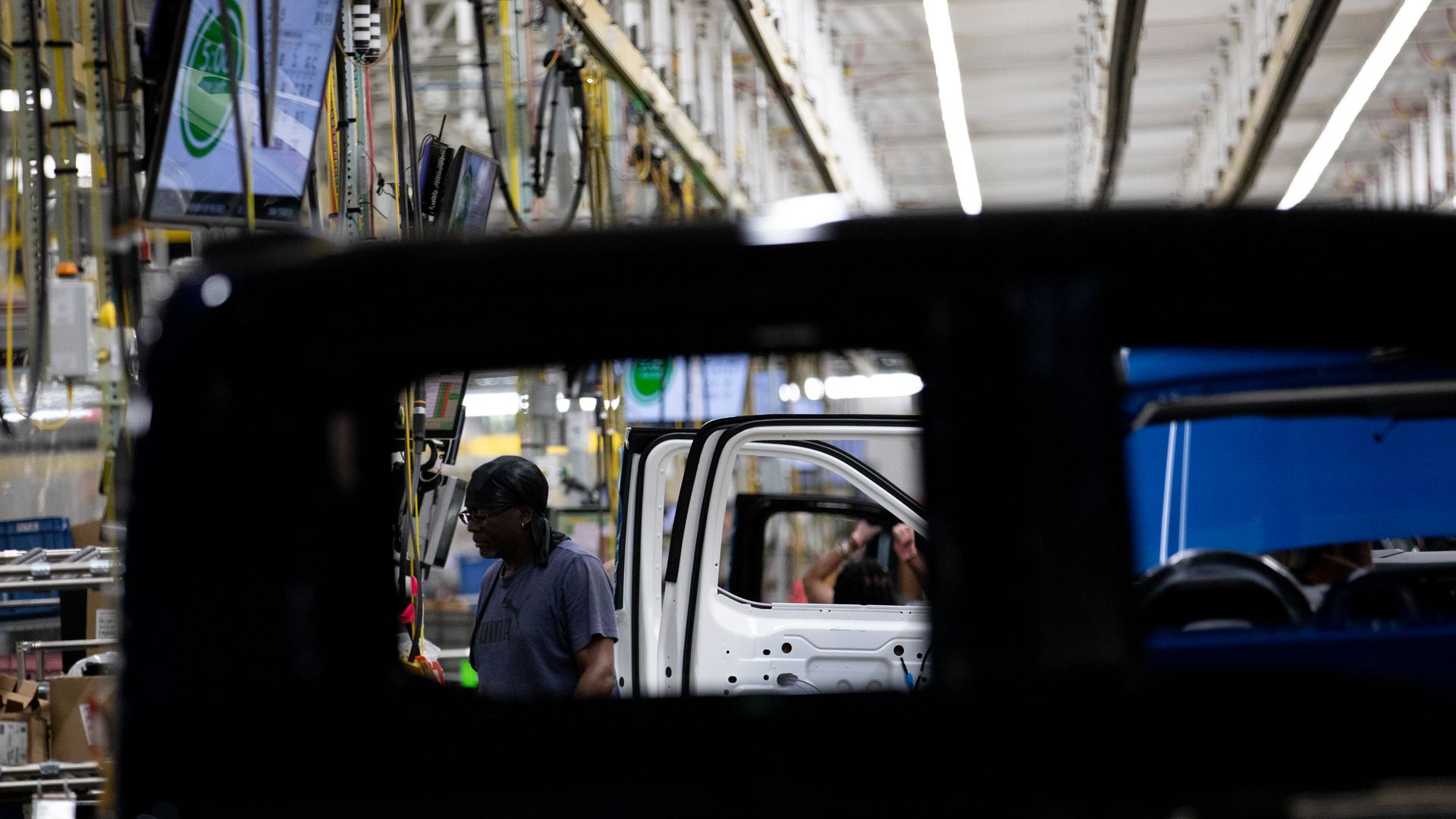
A worker on the production line at the Ford Rouge Electric Vehicle Center. Photo: Emily Elconin/Bloomberg via Getty Images
How are U.S. factories faring? In short: meh.
- A closely followed survey shows the manufacturing sector remains in expansion mode. But activity slowed more than expected, largely because demand for goods has stalled.
Details: The Institute for Supply Management's manufacturing index fell to 50.9% — hovering above the 50-level that indicates whether the industry is growing or shrinking.
- Survey respondents indicate that there is some easing of price pressure for manufacturers as supply chains untangle: The prices index fell again to 51.7%, the lowest level since June 2020. This time last year, it was roughly 81%.
Perhaps most intriguing, however, were the anecdotes illustrating how manufacturers are thinking about the labor market, even as they see demand slow.
What they're saying: "Markedly absent from panelists' comments was any large-scale mentioning of layoffs," ISM's Tim Fiore said in a statement.
- Some companies are instead implementing hiring freezes and not rushing to replace workers who depart.
Sign up for Axios Macro

Stay ahead of the curve on the most important economic developments with reporting and analysis on how business, policy, and markets collide.