Axios Macro
June 04, 2025


New data shows sluggish hiring in May ahead of the government's big jobs report on Friday. President Trump is pointing fingers at the Fed.
- More below, plus a soft reading on the service sector.
🤖 Tune in here at 2:30pm ET for Axios' AI+ Summit happening live from NYC to hear conversations with New York Gov. Kathy Hochul, actor/entrepreneur Joseph Gordon-Levitt, Runway co-founder and CEO Cristóbal Valenzuela, WndrCo founding partner Jeffrey Katzenberg and more.
Today's newsletter, edited by Ben Berkowitz and copy edited by Katie Lewis, is 770 words, a 3-minute read.
1 big thing: The fall guy in Foggy Bottom
/2025/06/04/1749043765930.gif?w=3840)
In case there were any doubt, today's developments put them to rest.
- If the economy starts to seriously buckle due to the trade war, Trump will blame the Federal Reserve and its leader, Jerome Powell.
The big picture: Trump has made no secret that he thinks the Fed should be proactively cutting interest rates to ease the pain of any economic bumps ahead — despite the inflation risk also fueled by tariffs.
- Today brought some new evidence that there are, indeed, bumps ahead.
Driving the news: The private sector added just 37,000 jobs in May, payroll processor ADP said — down from the 60,000 jobs added in April and well below the 110,000 jobs economists anticipated.
- It was the second straight month of soft hiring in the ADP data — but this time, Trump noticed.
- Six minutes after the data release, Trump posted on Truth Social: "ADP NUMBER OUT!!! "Too Late" Powell must now LOWER THE RATE. He is unbelievable!!! Europe has lowered NINE TIMES!"
Separately, (and after Trump's post), the Institute for Supply Management said that its index of activity in service industries fell to 49.9 in May, from 51.6 in April. That puts it narrowly in contraction territory — 50 is the line.
- Its new orders index fell particularly sharply, to 46.4 from 52.3, a sign that even in a month of trade war de-escalation, underlying business activity was softening.
Between the lines: The two reports are evidence — which has been scant so far — that economic activity may be starting to buckle under the pressure of erratic trade policy.
- The president's social media comments make clear that he intends to shift blame for any weakening onto the Fed, which has left interest rates unchanged so far this year, as it awaits clear evidence of whether higher inflation or labor market softening is the more urgent concern.
What they're saying: Comments released with the ISM survey show the origins of companies' economic angst.
- "Tariff variability has thrown residential construction supply chains into chaos," said an unnamed construction firm.
- "Tariffs remain a challenge, as it is not clear what duties apply," said a survey respondent in the information sector. "The best plan is still to delay decisions to purchase where possible."
- "Tariffs have increased the cost of doing business," said a firm in transportation and warehousing. "It's too early to tell what the lasting impact of this will be. ... Overall, we are seeing a leveling off in business activity; time will tell if this is temporary or long lasting."
Yes, but: Speaking to reporters today, ADP chief economist Nela Richardson was less pessimistic about the state of the labor market — despite the soft number.
- The weak data doesn't point to a collapsing labor market, she said, "but there is hiring hesitancy."
- Private employers added the fewest jobs since March 2023, when ADP's data showed the economy shed 52,000 jobs. "We all know the labor market stayed strong despite that 2023 loss," Richardson said.
Of note: The nation's smallest businesses — those with fewer than 50 employees — lost more jobs than larger firms.
- "I always say, 'as goes small businesses, so goes the economy.' This weakness is something that we're paying close attention to," Richardson said, adding that small firms were most vulnerable to trade policy uncertainty.
2. Fed reality check
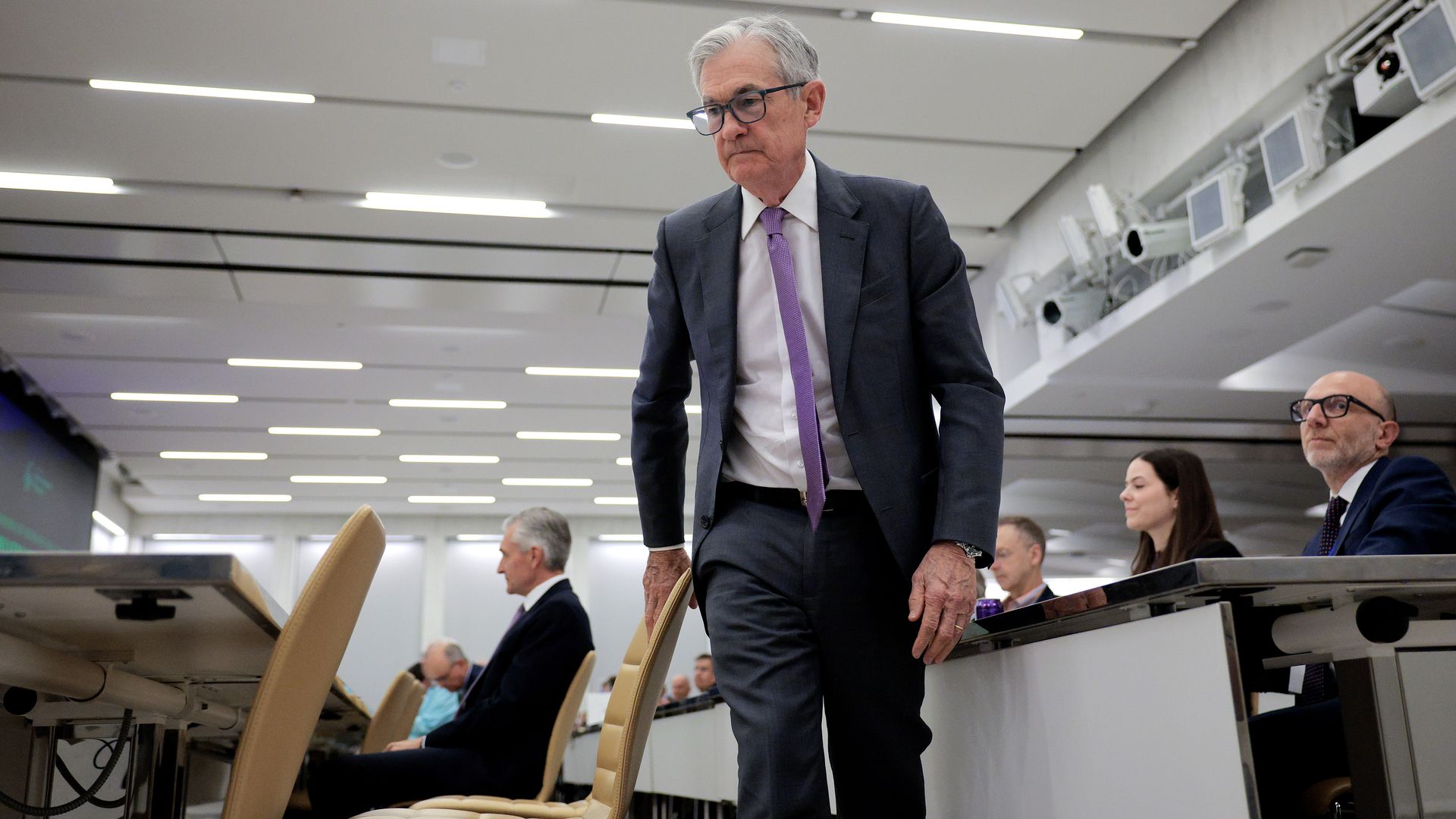
Within the Federal Reserve, officials have said they need to wait until there is more clear-cut evidence of how trade and other policies are rippling through the economy before adjusting interest rates.
- "I think there's a great deal of uncertainty about where tariff policies are going to settle out and also, when they do settle out, what will be the implications for the economy for growth and for employment," Powell told reporters last month.
- "I think it's too early to know that," he added.
Zoom out: Trump wants the Fed to move to preemptively shield the economy. His own policies make that hard.
- "The fact that this number is getting [so] much attention just signals how important economic data is in this moment," Richardson told Axios when asked about Trump's callout of the report.
- "When things are going really bad, it's easy to make a call. When things are really good, it's easy to make a call. When things are murky, it's harder — I think we're in that state."
What's next: This afternoon, the Fed releases its Beige Book, a compilation of anecdotal information from businesses around the country, which can be particularly useful at economic turning points.
- Friday, the Labor Department releases May jobs data. Two weeks from today, the Fed's policy committee concludes its next meeting.
Sign up for Axios Macro