Axios Macro
January 22, 2026


The bond market isn't as responsive to Federal Reserve interest-rate policy as President Trump's rhetoric might suggest. That makes the market a powerful check on the president.
- We explore the tension — and what it means for this volatile week in geopolitics — below. 🏔
- Plus, a dark horse to be the next Fed chair looks to be gaining ground. 🐎
Situational awareness: The Commerce Department released shutdown-delayed data that showed solid growth in incomes and spending for October and November.
- Consumption expenditures were up 0.5% both months (0.3% inflation-adjusted), pointing to steady underlying demand.
- The Fed's preferred inflation measure rose 0.2% both months, and in November was up 2.8% over the previous year.
- Q3 GDP was revised slightly higher, to a 4.4% annual growth rate (from 4.3% previously), reflecting an upward adjustment to exports.
Today's newsletter, edited by Jeffrey Cane and copy edited by Katie Lewis, is 1,023 words, a 4-minute read.
1 big thing: The bond market keeps the score
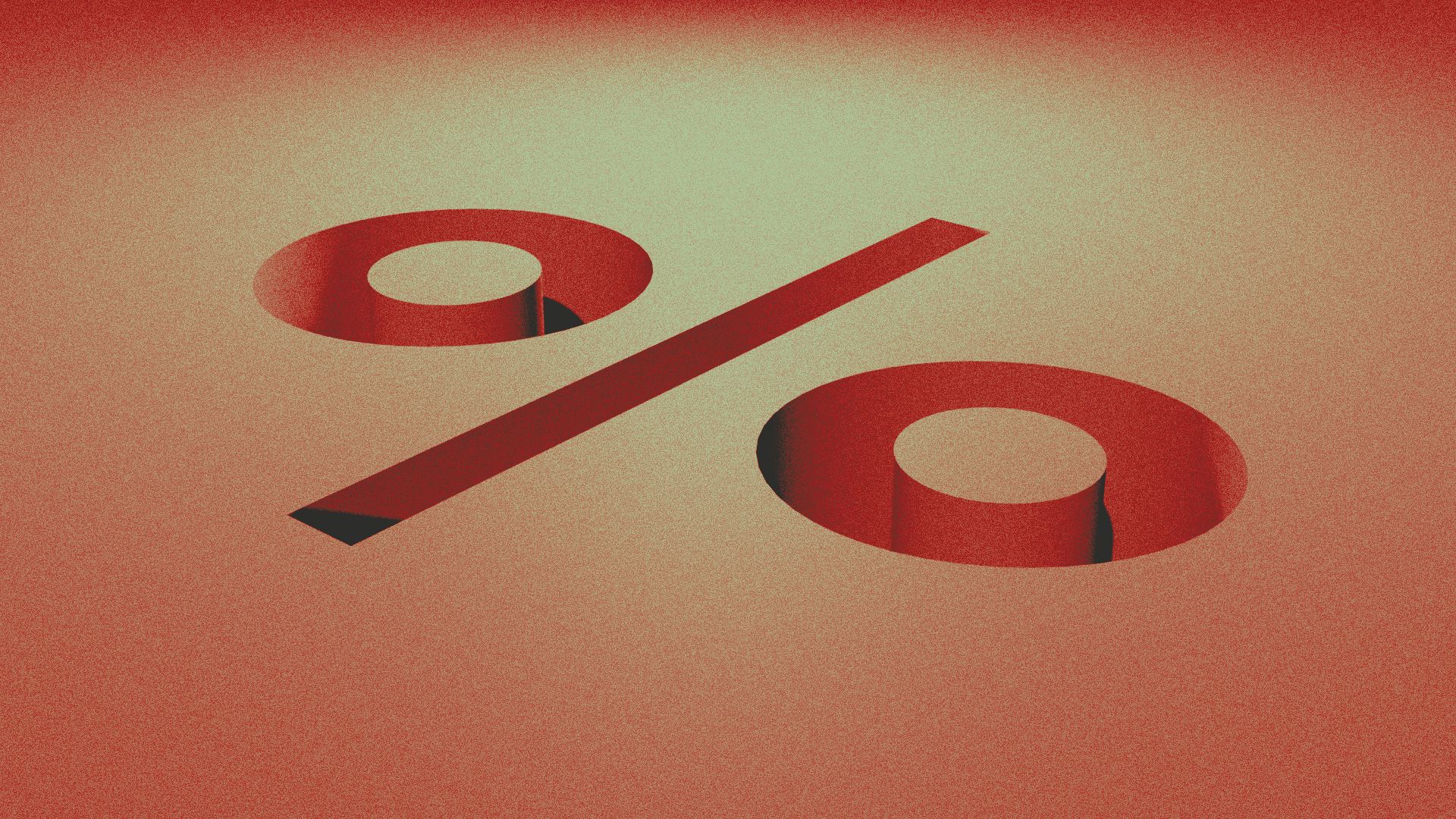
Trump really, really wants lower interest rates, and the Federal Reserve and other tools of state power have tried to deliver them. The bond market isn't cooperating.
Why it matters: Longer-term borrowing rates are set on global markets, as savvy players who together deploy trillions of dollars make bets on the future of growth and inflation.
- In an era of vast power concentrated in the Oval Office, that makes it one of the few forces even Trump can't control. It is a constraint on his actions that will not respond to insults or threats.
- That, in turn, shows why the TACO trade — the bet that Trump Always Chickens Out when his rhetoric or actions start to ripple across global markets — has been in full force this week.
Driving the news: Trump sees the Fed as the main mechanism to bring rates down. That was evident in his latest plea for lower rates, which he brought to the global stage yesterday in Davos, Switzerland.
- "I'll be announcing a new Fed chairman in the not-too-distant future. I think he'll do a very good job," Trump told a room of global CEOs and government leaders at the World Economic Forum.
- "Problem is, they change once they get the job. You know they're saying everything I want to hear and then they get the job ... and all of a sudden, it's 'let's raise rates a little.'"
- Trump said he hopes his pick "does the right thing" with lowering rates. He later added that the U.S. should be paying "the lowest interest rate of any country in the world" on its debt "because without the United States, you don't have a country."
Reality check: The Fed cut interest rates by a full percentage point in 2024 and another three-quarters of a percentage point in 2025. Yet longer-term borrowing costs are up in that time.
- The day that rate-cutting began, Sept. 18, 2024, the 10-year U.S. Treasury yielded 3.7%. When the second wave of cutting began this past September, it was 4.06%.
- This morning, the 10-year yield was 4.27%.
- The rise in longer-term borrowing costs has happened for a mix of good reasons (higher growth prospects) and bad (higher inflation being priced in). But regardless, the swing shows the limit of the Fed's ability to cater to the president's wishes.
What they're saying: "The Fed doesn't really set interest rates," JPMorgan Chase CEO Jamie Dimon said in Davos.
- "What happens if inflation goes up? They raise interest rates. What happens if inflation goes down? They reduce interest rates. They are a follower."
Yes, but: That doesn't mean the president has no power over long-term interest rates. Tax and spending policy determines government deficits and, in turn, bond issuance and supply.
- And this administration in particular has been creative in using the tools of government to try to encourage demand for longer-term securities, including directing Fannie Mae and Freddie Mac to buy hundreds of billions of dollars in mortgage bonds and tweaking regulations to encourage banks to hold more Treasuries.
- Fed appointments also matter — though not necessarily in the way Trump emphasizes. A key to longer-term rates remaining low is investor confidence that the Fed will do what it takes to prevent inflation from taking off — even if that means rate increases in the near term.
Between the lines: Last April, a bond market sell-off was a big factor in Trump backing away from "Liberation Day" tariffs.
- This week's threats of military force against Greenland and new tariffs on Europe — followed by backtracking — seemingly had echoes of that episode.
- Treasury Secretary Scott Bessent, however, said on a podcast that "the bond market didn't change the calculus" and that "President Trump always knew where he was going."
2. Rieder's Fed chair odds rise

Traders in prediction markets are betting that BlackRock executive Rick Rieder now has solid odds of becoming the next leader of the world's most important central bank.
Driving the news: Rieder, the chief investment officer of global fixed income at the world's largest asset manager, interviewed with Trump last week.
- In an interview with CNBC yesterday, Trump said Rieder was "very impressive."
By the numbers: Rieder had 30% odds of being Trump's choice for the job this morning on Polymarket, second only to former Fed governor Kevin Warsh at 45%.
- Rieder's odds on the marketplace 10 days ago were only 3%.
- His gain has largely come at the expense of White House economist Kevin Hassett, who looked to be in pole position last month (his odds peaked at 85% on Dec. 2) but whose odds are now down to 6%.
State of play: Fed chair Jerome Powell's term is up in May, and Trump has signaled an appointment announcement could come much sooner. He has seemingly enjoyed a reality-show-like process for selecting a successor.
- "I'd say we're down to three, but we're down to two, and I can probably tell you, we're down to maybe one, in my mind," Trump told CNBC yesterday. 🤷♂️
Between the lines: Rieder is an accomplished analyst in macroeconomics and monetary policy, but has considerably less political experience than other top candidates.
- He has served on advisory committees to the Treasury and Federal Reserve, but has never worked in a presidential administration, within the Fed system or on Capitol Hill.
Sign up for Axios Macro