Axios Macro
June 29, 2022

1 big thing: A tale of 2 inflation indices


Tomorrow morning, the Commerce Department will release new inflation data that analysts expect will show inflation of 6.5% over the 12 months ended in May.
But wait, you may think: Didn't we already get May inflation data, and didn't it show significantly worse inflation, at 8.6%?
- Why, yes. But that was a different inflation measure, and the wedge between the two is widening, which could be surprisingly important in the months ahead.
Why it matters: In normal times, the gap between the Consumer Price Index and the Personal Consumption Expenditures price index doesn't matter much. But these are not normal times, and a widening gap between them could undermine confidence that inflation will recede.
The details: The CPI, prepared by the Bureau of Labor Statistics, comes out early each month and receives lots of public attention, especially now. PCE inflation, prepared by the Bureau of Economic Analysis, is released two to three weeks later and gets fewer headlines, but is the inflation measure targeted by the Federal Reserve.
- The differences between them are highly technical (CPI is a Laspeyres index, PCE is a Fisher Ideal index, and it's fine if you don't know what either one of those is). But the gap between them is usually small, averaging 0.2 percentage points for any given 12-month period in the 2010s.
- If the forecasts for the May PCE turn out to be right, it will be 10 times as large — exceeding 2 percentage points, the biggest wedge between them since 1980.
As a result of methodology differences, PCE inflation places a lower weight on prices of gasoline and of residential rents, which have sent CPI inflation skyrocketing.
The dilemma: If the wedge persists, public expectations around inflation could stay high — even if the Fed starts to achieve success on its own terms, with PCE inflation declining toward its 2% target.
- After all, it is CPI inflation that gets the most public attention and is commonly incorporated in cost-of-living adjustments, and other contractual provisions indexed to inflation.
- If PCE inflation were to reach 2% but CPI inflation remained above 4%, the Fed might technically be achieving its goals. But the public would still be deeply unhappy about inflation and higher, long-term inflation expectations might take root — just what the Fed is trying to prevent.
The good news: The wedge between the two measures has historically come down when inflation rates come down, so in a world where inflation is dropping, CPI would be expected to fall faster than PCE. The spread between them could even reverse.
The bottom line: The inflation gauge favored by a bunch of Ph.D. economists may be less alarming than the one the public pays the most attention to — but right now, what the public thinks about inflation is what matters most.
2. A new world on inflation
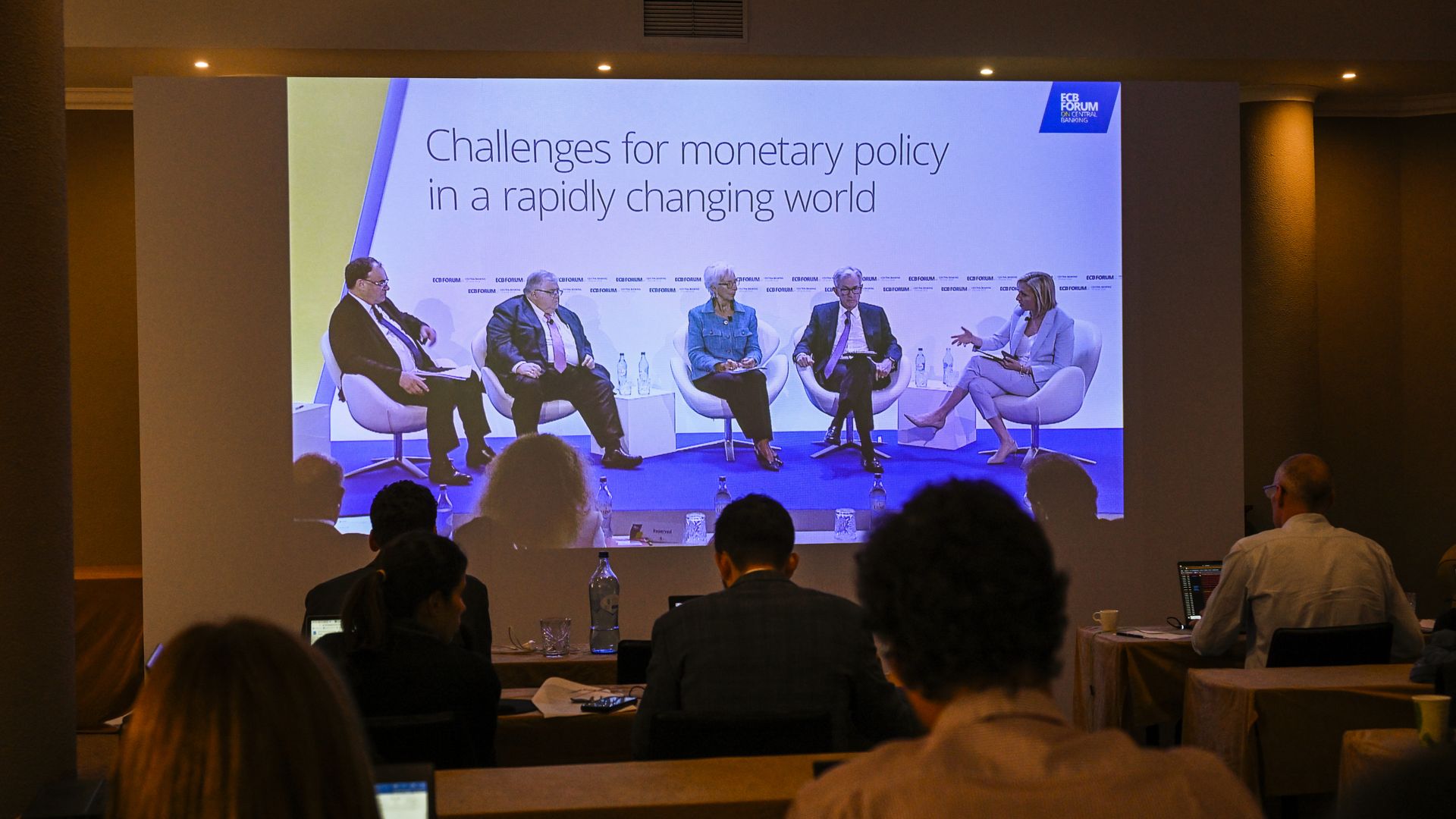
From left to right: Bank of England governor Andrew Bailey, the Bank of International Settlements' Agustín Carstens, European Central Bank president Christine Lagarde and Federal Reserve chair Jerome Powell speak on a panel in Sintra, Portugal, this morning. Photo: Horacio Villalobos Corbis via Getty Images
Axios Macro
Stay ahead of the curve on the most important economic developments with reporting and analysis on how business, policy, and markets collide.