Axios Macro
September 03, 2024


Predicting what's ahead for the economy has been a losing game the last few years. But even the longer-term records of leading prognosticators hold lessons for anybody who has to make decisions based on long-term forecasts.
- More below, plus a mixed outlook for the manufacturing sector.
Today's newsletter, edited by Kate Marino and copy edited by Katie Lewis, is 724 words, a 3-minute read.
1 big thing: When forecasters are most (over-)confident

Economic forecasters are pretty accurate when they project where things are headed in the near term — but are overconfident in their ability to see around the corner to what the world will look like a year or two out.
Why it matters: This finding, from a New York Fed piece out today based on decades of professional forecasters' predictions, has philosophical implications for anyone who finds themselves needing to predict the future.
- Even among the people paid to offer rigorous, methodical economic projections, it is easy to be overconfident by underestimating how much underlying conditions can change over long time periods.
Zoom in: Economist Marco Del Negro analyzed the Philadelphia Fed's Survey of Professional Forecasters from 1982 to 2022. He looked at the forecasters' confidence level in their outlook for growth and inflation — as measured by the odds they placed on economic results significantly different from their forecast.
- In other words, he looked not just at how accurate or inaccurate the forecasters were but at whether they had appropriately large error bands around their forecast.
- It is a test not of whether the forecasters were right or wrong but of whether they were overconfident.
State of play: For time periods of less than a year, the forecasters were actually underconfident. That is, they had wider error bands around their projections than were ultimately justified by events.
- But for periods of one to two years, they were significantly overconfident, putting too-low odds on outcomes significantly diverging from their forecast.
Between the lines: This finding jibes with a concept we've been thinking about in other realms, whether it's forecasting financial markets, geopolitics or anything else.
- Over short time frames, it is possible to have a pretty good handle on the range of possibilities. Over longer time frames, the world can evolve in ways that are more radically different from what our puny brains can imagine.
- In the political realm, for example, it is one thing to place odds on either former President Trump or Kamala Harris winning the November election. But if you think you can reasonably predict what the political landscape will look like in 2028, you're probably wrong (ask anyone who in 2015 was certain the next president would be either Jeb Bush or Hillary Clinton).
Yes, but: This thinking can result in a nobody-knows-nothin' kind of nihilism. The reality is that in many pursuits, you have to forecast something to have some baseline.
- Companies have to project what demand will look like years down the road when deciding to build a factory. Investors must decide how to allocate their retirement portfolios.
The bottom line: The lesson of this finding isn't that we must never write down what we expect to happen far in the future. It's that we must do so from a position of intellectual modesty, and be ready to update assumptions as the facts change.
2. Mixed bag for manufacturing
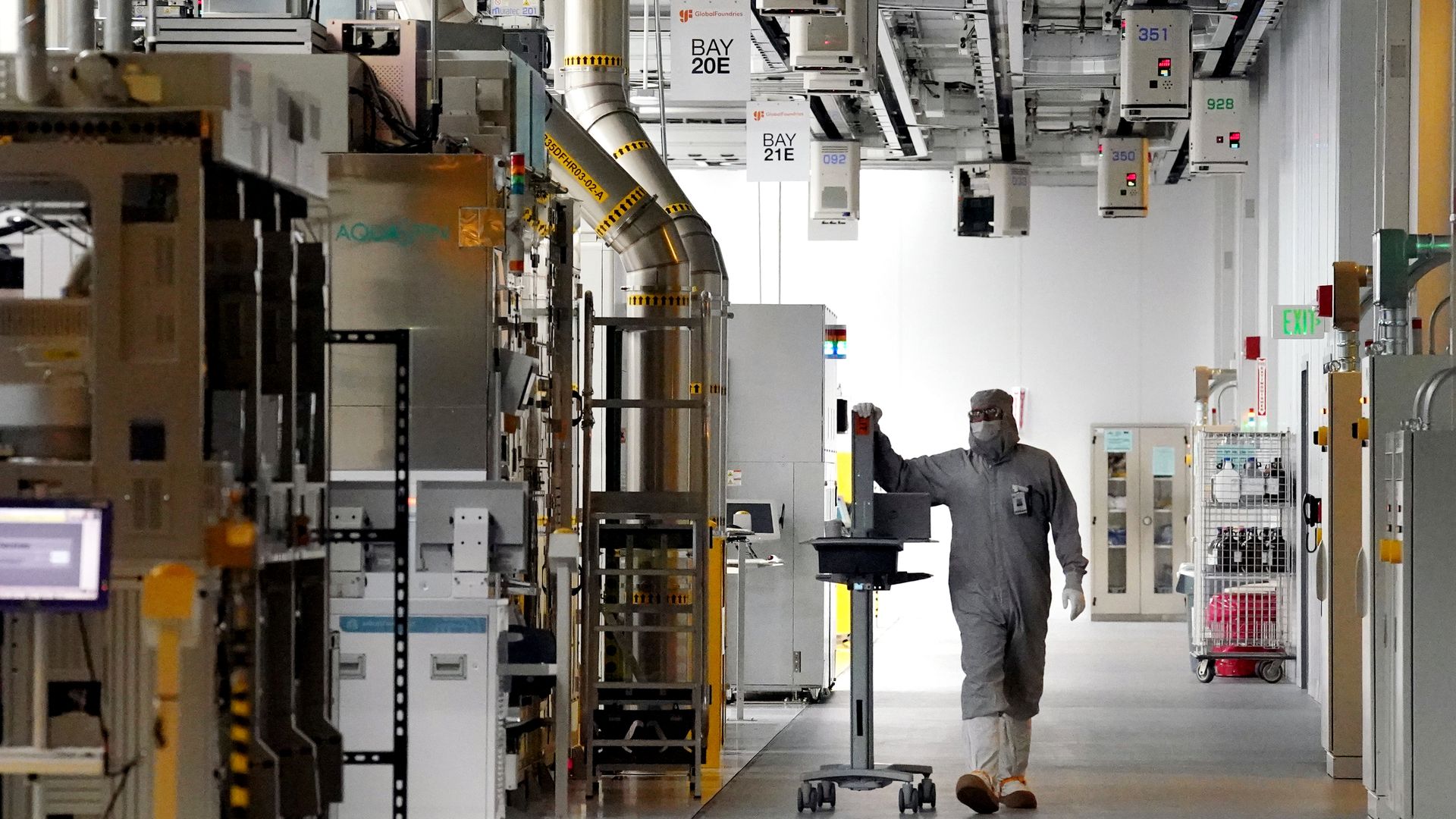
Sluggish demand and slightly better employment conditions: This was the state of American manufacturing last month.
Why it matters: The manufacturing sector continues to display recession-like conditions, even as the rest of the economy looks to be expanding.
By the numbers: The Institute for Supply Management's manufacturing index improved slightly in August, rising 0.4 percentage point to 47.2%. Any reading below 50 suggests the sector is contracting.
- The details of the report show the employment index rose almost 3 percentage points in August, suggesting a better outlook for workers in the sector.
- One survey respondent in the metals industry told ISM that their company has not laid off staff — rather, they have downsized through attrition.
The other side: New orders for manufacturing equipment fell roughly 3 percentage points to the lowest level in more than a year.
- Just one sector reported higher demand: computer and electronics.
What they're saying: "While still in contraction territory, U.S. manufacturing activity contracted slower compared to last month," Tim Fiore, ISM survey chair, said in a statement.
- "Demand remains subdued, as companies show an unwillingness to invest in capital and inventory due to current federal monetary policy and election uncertainty," Fiore added.
The intrigue: A machinery manufacturer told ISM that even though new orders had declined, there were more inquiries about future purchases.
- Its customers "were directed to put projects on hold until the fourth quarter of 2024. This indicates the uncertainty around the election," the respondent said.
Sign up for Axios Macro