Axios Macro
October 09, 2025


1 big thing: The 22 states close to (or in) recession
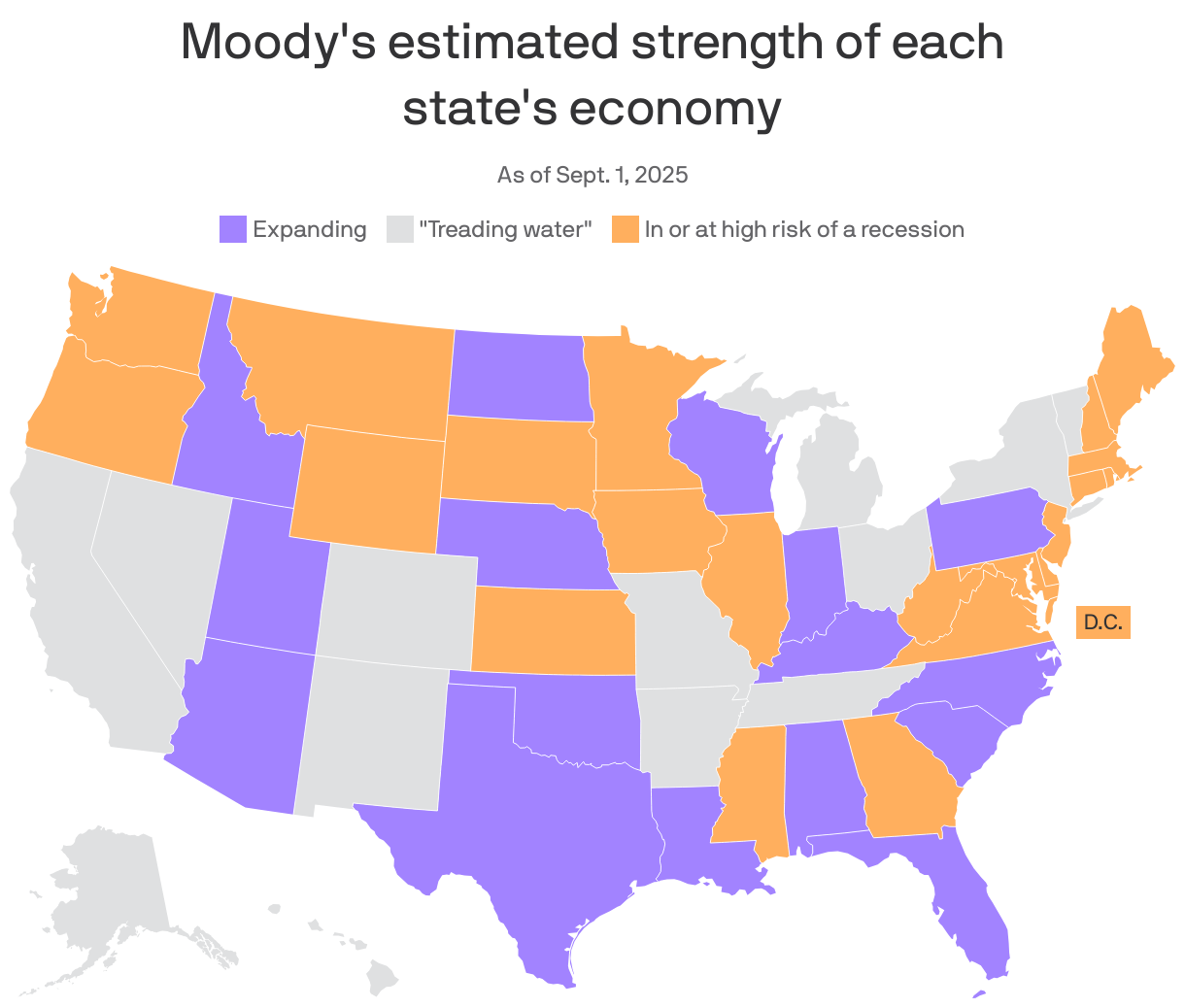
Twenty-two states are either in a recession or on the precipice of a downturn, according to an intriguing analysis from Mark Zandi, chief economist at Moody's Analytics.
Why it matters: The states in contraction are spread across the country — from Washington to Virginia to Maine — and make up about a third of overall GDP.
- Their problems are driven largely by a mix of slowing immigration, increasing tariffs and federal job cuts, Zandi argues.
- The analysis is based on Zandi's calculation of where things stood in the economy at the end of August — perhaps more useful now, as more data measures go dark with the federal government shut down.
How it works: He created an index looking at state-level jobs data as well as other inputs, including modeled industrial production, personal income and housing starts.
- The idea was to mimic what the eight-member National Bureau of Economic Research Business Cycle Dating Committee does when it determines if the economy is in a recession.
- While employment is the most important indicator, it is only one of many, Zandi tells Axios.
Between the lines: The states that received a negative index ranking landed in the recession bucket; the rest are either still expanding or "treading water."
- For those categories, Zandi says he ultimately made some judgment calls after looking at more inputs, including credit card delinquency rates, credit scores, port activity and migration.
Reality check: Like NBER's recession call, this is a subjective assessment. But in this case, it's just one economist doing the ranking.
- Overall, the economy is not in a recession and the national unemployment rate — at least in August — was still relatively low.
The big picture: The states most impacted are the ones more reliant on agriculture and manufacturing. Those sectors are more likely to be affected by tariff increases, Zandi says.
- The immigration crackdown is suppressing growth as well.
- Also in trouble are the states most exposed to federal job cuts, like Virginia and Maryland. Unemployment in Washington, D.C., was 6% in August, the highest in the country.
Also on the recession list:
- Iowa, where farmers are struggling in the fallout from the trade war. Yet its unemployment rate in August was at 3.8%, lower than the national average of 4.3%.
- Kansas and South Dakota also have more exposure to agriculture.
- Georgia, Illinois and Oregon have comparatively large manufacturing industries.
States doing well are ones still seeing robust population growth, particularly Texas and Florida.
What to watch: New York and California, both in the "treading water" category, could decide which way the national economy goes.
- Keeping them afloat for now is a soaring stock market, which is buoying the wealthy households that are more prevalent in those states.
- California has the second-highest jobless rate in the country at 5.5%, which is basically unchanged since August of last year. In New York, unemployment is 4%, just under the national average.
- "If New York and California turn down, the nation's going into recession," Zandi says.
The bottom line: "My takeaway is not that the economy is in recession, but it's pretty darn close," he says.
2. Bessent visits the Fed

Axios Macro