Axios Macro

June 14, 2023

1 big thing: The surprising fall in global inequality
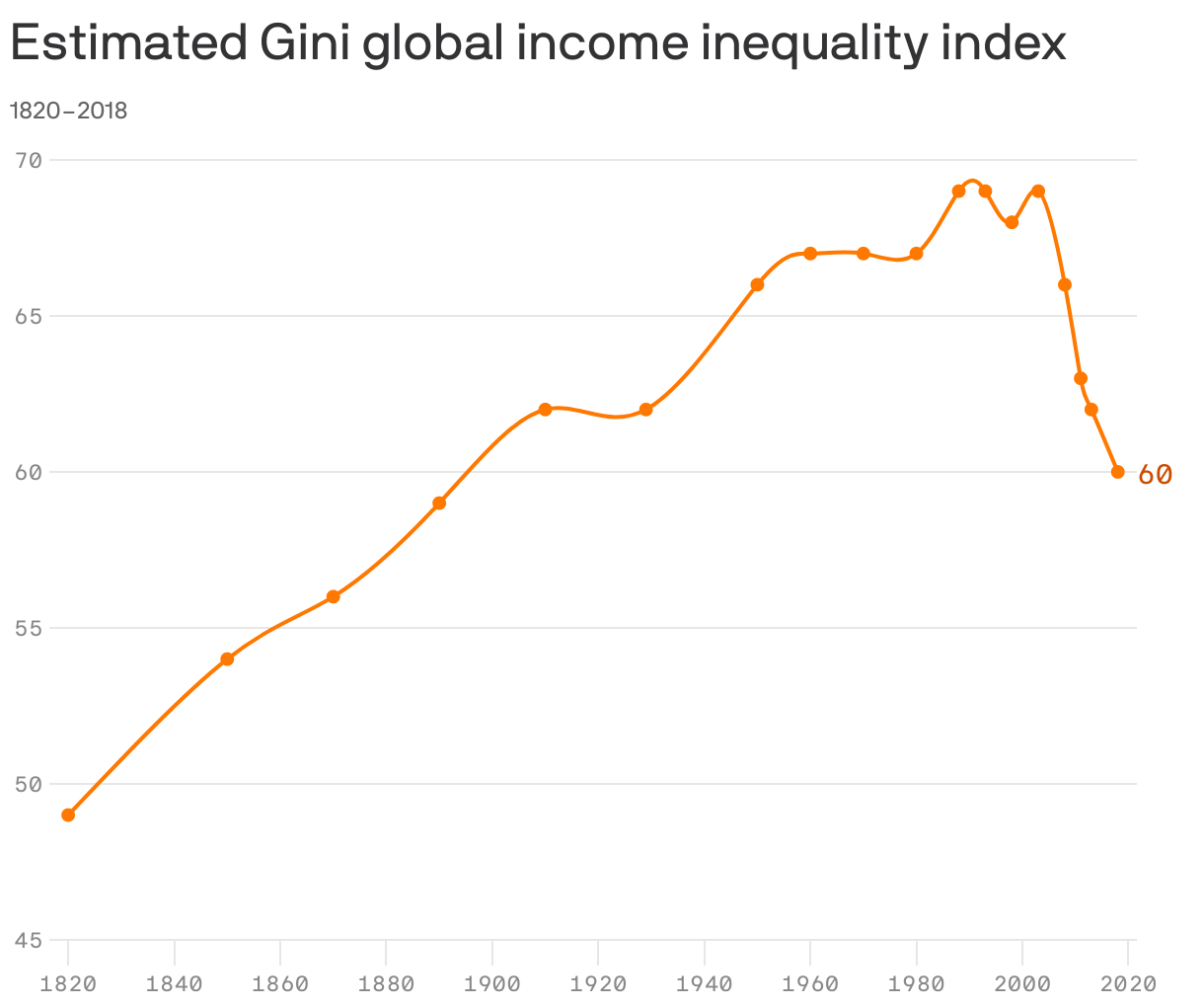
This century has known a startling decrease in global income inequality, bringing it back to levels not seen in well over a century.
- That's the conclusion that Branko Milanovic, one of the world's foremost inequality researchers, comes to in an important essay for Foreign Affairs, out this morning.
Why it matters: The USA has only about 4% of the world's population. Increasing equality is good for the planet as a whole, but it foreshadows an end to U.S. hegemony.
By the numbers: Inequality is measured using the Gini coefficient, which runs on a scale from 0 (perfect equality) to 100 (where one person would have all of the world's income).
- On that scale, inequality fell from 69 in 2000 to 60 in 2018 — and is almost certainly even lower today. That means the world is more equal now than at any point since about 1875.
Between the lines: The part of that number due to inequality within countries has ticked up slightly — it now stands at about 13, up from 7 in the 1990s. Conversely, the component due to inequality between countries plunged from a high of 63 in 1988 to just 47 in 2018.
- That's a complete reversal of what happened during most of the Cold War, when inequality between countries was rising but inequality within countries fell dramatically.
Be smart: What we're seeing is not just China getting richer, although that is a large part of the story.
- "In the 1970s, India's share of global GDP was less than three percent, whereas that of Germany, a major industrial power, was seven percent," notes Milanovic. "By 2021, those proportions had been swapped."
The big picture: People who are poor by U.S. and other rich countries' standards have been rich by global standards for as long as anyone can remember.
- "[T]hey are now being overtaken, in terms of their incomes, by people in Asia," writes Milanovic.
- In 2018, for every 100 Americans earning more than the median U.S. income, there were about 25 Chinese people earning that much. Within the next 20-30 years, the number of Chinese people earning more than the U.S. median will reach and then surpass the number of Americans.
- In turn, that "would reflect a wider shift of economic, technological, and even cultural power in the world," says Milanovic.
Yes, but: While the rise of Asia in general and China in particular is inexorable, the decline of global inequality is not. For the global Gini coefficient to continue to plunge, Africa would need to get substantially richer in coming decades — and "that remains unlikely," says Milanovic.
The bottom line: The countries with the richest citizens are generally the world's most powerful. That power is now more broadly distributed than at any point in over a century.
2. Axios interview: OMB's Shalanda Young

Photo: Eric Lee/Axios
Axios Macro

Stay ahead of the curve on the most important economic developments with reporting and analysis on how business, policy, and markets collide.