Axios Macro

October 13, 2026


A fresh look at U.S. inflation arrives this week, starting with tomorrow's Consumer Price Index. The data will show whether surging energy costs are fueling broader inflation as the Federal Reserve considers another rate hike.
- 🌍 Today, however, we go international, with Europe's bet on containing China's import surge, plus an IMF warning about risks to global growth.
Today's newsletter, edited by Jeffrey Cane and copy edited by Carlin Becker, is 860 words, a 3-minute read.
1 big thing: China Shock 2.0 gambit
Europe is testing a new response to China Shock 2.0, betting that it can confront Beijing's export juggernaut without resorting to President Trump's tariff-heavy approach.
Why it matters: More of the world is beginning to confront the threat that China's industrial overcapacity poses to their industries. But protecting individual sectors will not solve the bigger problem: China's factories are cranking out far more than its own economy can absorb.
Driving the news: The European Union and China struck a preliminary deal on Friday to sharply limit Chinese hybrid vehicle exports to Europe.
- The EU plans to initially cap Chinese hybrid and plug-in hybrid imports at 350,000 annually, potentially starting as early as December.
- The cap would more than halve projected Chinese hybrid shipments, which were on track to reach roughly 800,000 this year, an EU official told reporters.
- Imports totaled 302,000 in 2025. (Chinese officials yesterday noted that the deal still allows its automakers to increase shipments from last year's levels.)
- Vehicles exceeding the quota would be blocked rather than face additional tariffs.
The backdrop: France and Germany last week proposed giving Brussels sweeping new powers to restrict market access over unfair trade practices, a striking shift for Germany, which opposed EU tariffs on Chinese EVs in 2024.
- European Commission president Ursula von der Leyen warned in her annual address last month that the bloc's trade deficit with China had reached a "tipping point."
- "Some say the second China shock is looming. But it's already here," von der Leyen said.
What they're saying: EU leaders are considering tougher powers to confront Chinese trade practices, including one resembling the authority Washington has used to impose sweeping tariffs on Chinese goods.
- The agreement could dampen momentum for harsher measures, making member states "hesitant this week to rock the boat," Daniel Mullaney, an Atlantic Council senior fellow and former U.S. trade official, tells Axios.
- Washington is pushing trading partners to join forces against China's industrial overcapacity.
- "It's really hard for any one country to make progress on that if you don't have allies on your side," Mullaney says.
By the numbers: Chinese automakers ramped up hybrid shipments to Europe after the EU imposed steep tariffs on fully electric vehicles in 2024.
- New data released yesterday shows that China's global passenger vehicle exports surged 64% in September, to 919,000, even as domestic sales fell 27%.
What to watch: Europe's deal could shift pressure to other industries — or perhaps even other nations — without addressing the underlying imbalances driving China's export boom.
- Economist Michael Pettis argued over the weekend that the agreement would do little for European manufacturing overall.
- "EU producers of hybrids will be better off, but at the expense of other EU manufacturers," he wrote on X.
The bottom line: Europe's deal may provide breathing room for its automakers. But China's industrial might — and the pressure it is inflicting on manufacturers around the world — is not going away.
2. IMF: Global economy nearing "limits of resilience"
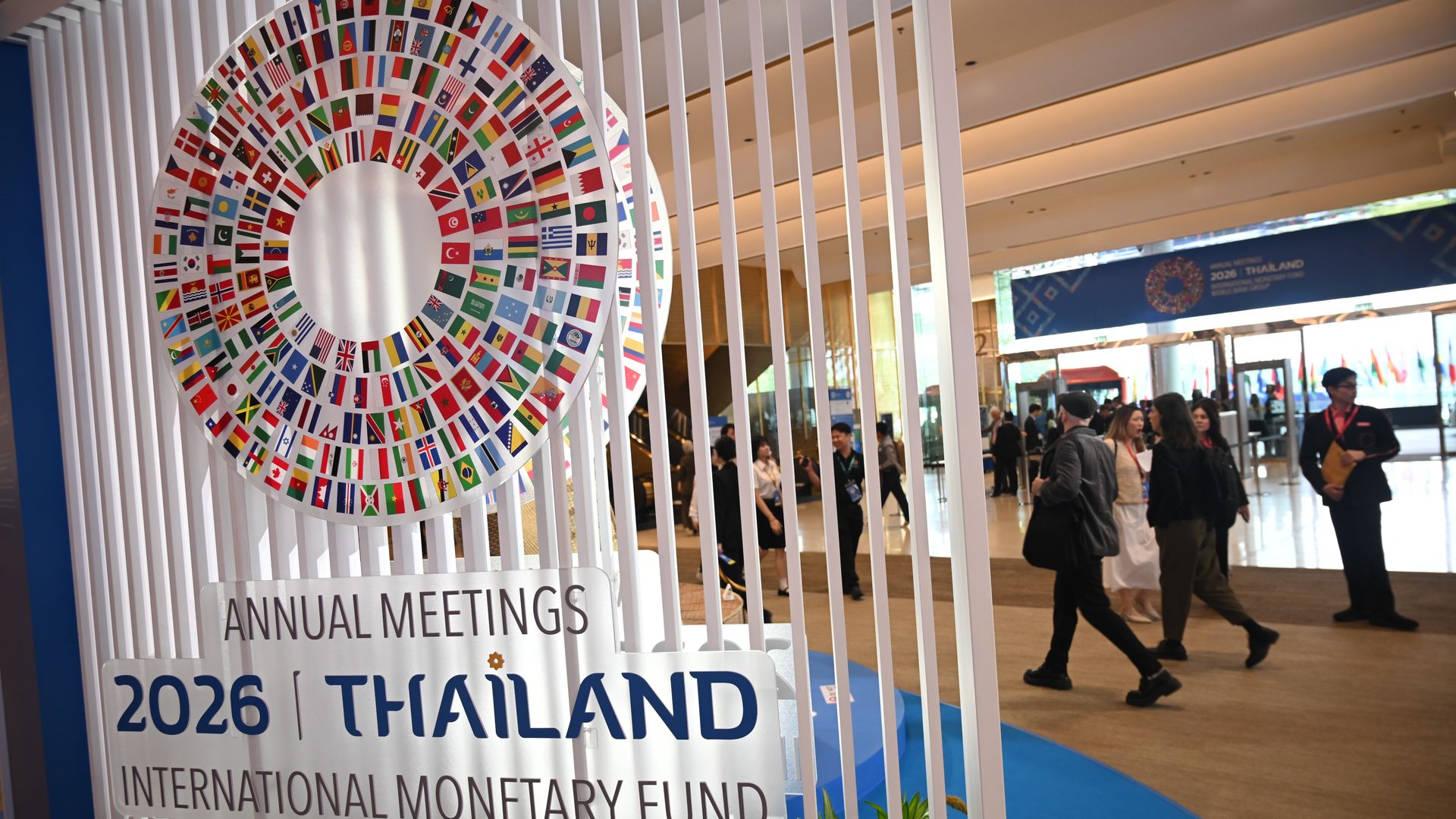
Global policymakers and central bankers are gathering in Bangkok this week for the International Monetary Fund and World Bank's annual meetings.
- New economic forecasts warning of risks to the world economy's resilience will set the backdrop for discussions.
Driving the news: Global growth has defied expectations, holding up despite the Middle East war and soaring oil prices.
- But the IMF warns that dwindling energy reserves, mounting debt and growing reliance on the AI boom leave the world vulnerable to another shock.
What they're saying: "The global economy has been resilient, but that resilience is reaching its limits," IMF economic counselor Silvana Tenreyro said at a press conference.
- "Technology-related investment, while an important boon against the energy shock, is concentrating risks — making the global expansion heavily reliant on a small number of firms, sectors, and economies," Tenreyro wrote in a separate blog post.
The intrigue: The AI boom has helped offset the economic toll of the energy shock, but it is also concentrating risks.
- An AI bust could leave global GDP 1.1% below the IMF's baseline forecast by 2028, with a larger 1.8% hit to the U.S.
- But stronger AI investment and productivity gains could lift global output 0.6% above baseline by 2029.
By the numbers: The IMF largely maintained its global growth outlook in its latest World Economic Outlook released last night. It now expects inflation to stay hotter for longer.
- Global growth is projected at 3.1% in 2026, a slight upgrade from July but unchanged from April. The IMF expects growth to pick up to 3.4% in 2027.
- The U.S. economy is expected to grow 2.3% in both years, the fastest among G7 economies.
- Global inflation is forecast at 4.7% this year and 4.1% next year, both upward revisions from April, though only the 2027 forecast was raised since July.
Sign up for Axios Macro