Axios Macro
August 05, 2025


President Trump weighed in this morning on some big economic questions, including who's in — and out — of the running to be the next chair of the Federal Reserve. More below.
- But first: why the labor market is feeling a wee bit like 2024.
👀 Situational awareness: The U.S. trade deficit narrowed to $60 billion in June — the smallest in two years — as tariffs slowed the pace of imports.
- Separately, the Institute of Supply Management said its index of service sector activity fell 1.6 points to 52.6% in July, while the prices index surged to the highest since late 2022.
Today's newsletter, edited by Ben Berkowitz and copy edited by Katie Lewis, is 927 words, a 3½-minute read.
1 big thing: Labor market flashback
You could be forgiven for having a spell of déjà vu: America's labor market is souring in ways that look similar to conditions seen last summer.
Why it matters: The worse-than-expected July jobs report strengthens the case for rate cuts in September, exactly one year after the central bank started its rate-cutting cycle to shield the labor market.
- The new variable is Trump's trade war, which poses fresh inflationary threats that could restrain the Fed if the job market continues to soften.
What they're saying: "Not only did job growth slow markedly last year, but there were sizeable downward revisions as well," Goldman Sachs economists wrote in a note this week.
Flashback: Revisions last summer shifted our understanding about the pace of jobs growth.
- The largest revision from that period was in June 2024, which showed April and May employment was a combined 111,000 lower than previously estimated.
- But even that revision pales in comparison to the recent reading showing 258,000 fewer jobs added in May and June than initially thought.
The intrigue: Goldman Sachs economists noted one distinction between this year and last: Then, the unemployment rate was rising alongside slowing hiring rates.
- This year, it ticked up in July but has been in a stable range of 4% to 4.2% all year.
- "[L]ast year's slowdown and downward revisions were accompanied by a sharper increase in the unemployment rate than we have seen so far this year, which may have made them more concerning to Fed officials and market participants," wrote the economists at Goldman Sachs.
- The jobless rate appeared to be on a troubling upward trajectory last year, spiking to an originally reported 4.3% in July — up 0.6 percentage point from the start of 2024.
- The unemployment rate has held steady in recent months at 4.2%, still historically low.
Between the lines: Much like last year, there is uncertainty about how much of the perceived weakness stems from the shift in the supply of workers, not just weaker demand for them.
- The economy is grappling with huge population shifts as the Trump administration cracks down on immigration — a change that might help explain the larger-than-usual revisions and this summer's hiring stall-out.
- Last year, economists pointed to an expansion in the labor force as driving up the unemployment rate, not necessarily an increase in firings.
- "The rise in the unemployment rate this year largely reflects weaker hiring, as job searchers entering the labor force are taking longer to find a job, while layoffs remain low," Fed governor Michelle Bowman said in a speech last August.
Of note: The Institute of Supply Management said this morning that its employment index for service businesses fell 0.8 points to 46.4 in July. It has been below 50 — indicating contraction — for four of the last five months.
What to watch: The Fed pivoted to cut rates last year as inflation looked benign, in a bid to shield the labor market from further weakening.
- Conditions look different now: Inflation has not only stopped falling, it has steadily increased over the summer.
2. Bessent out as Fed chair possibility, Trump says
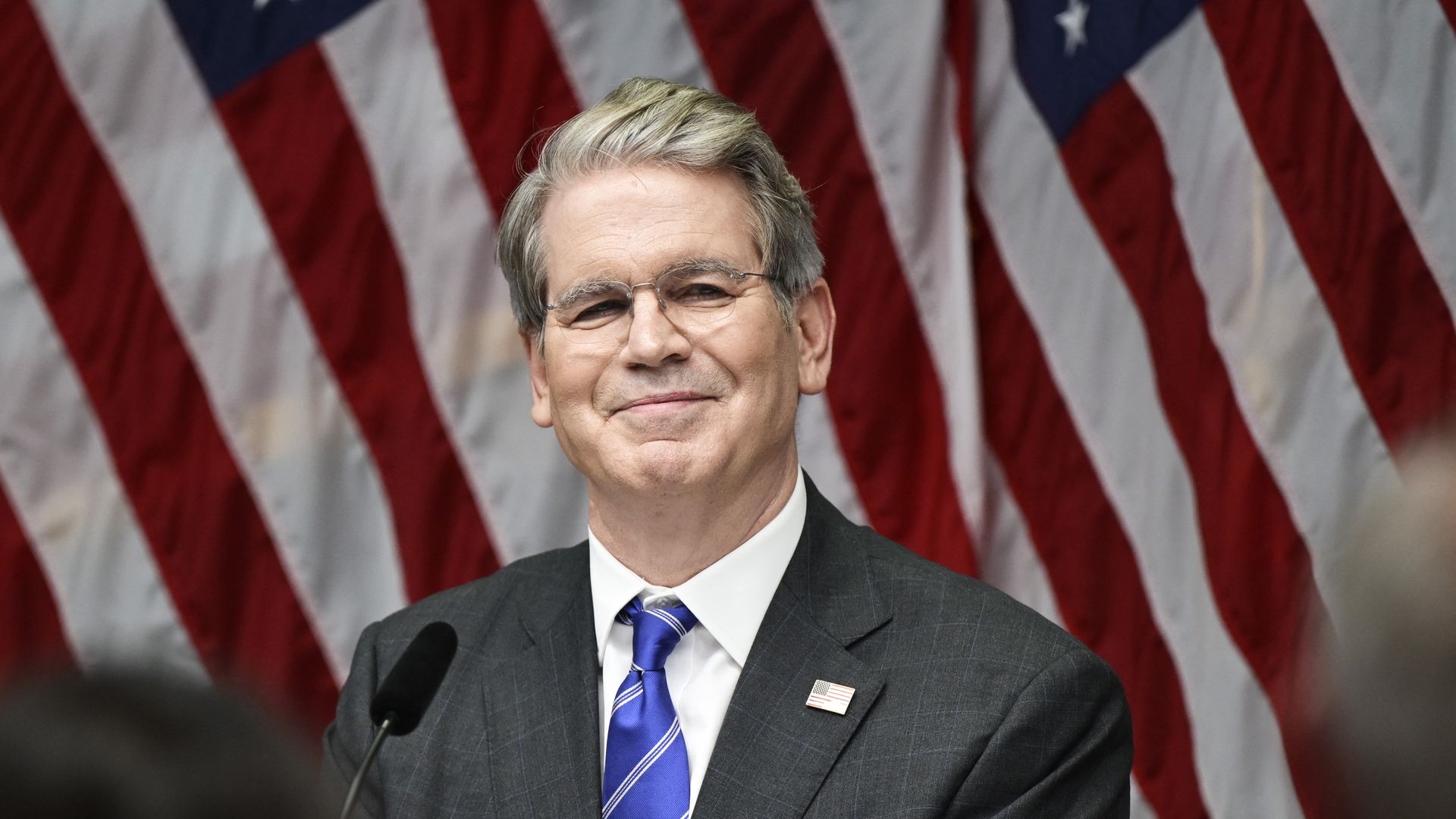
Trump ruled out one much-floated possibility for the Fed chairmanship this morning, saying that Treasury Secretary Scott Bessent told him last night he doesn't want the job.
Driving the news: "I asked him just last night, 'Is this something you want?'" Trump said on CNBC's Squawk Box this morning. "He does not want it — he likes being Treasury secretary."
- That would also seem to rule out a possibility, discussed by some Trump allies in recent weeks, of Bessent serving in both roles simultaneously. (That idea was anathema to devotees of central bank independence.)
The intrigue: Trump did not give definitive guidance on how exactly he will navigate a vacancy on the Fed's Board of Governors. Adriana Kugler said Friday she will step down this week, well before the Jan. 31, 2026, conclusion of her term.
- An open question is whether Trump will immediately appoint someone to that seat for the rump five months of Kugler's term, which could imply all the hassle of a Senate confirmation process, just for the person to serve a few months before needing to be confirmed all over again for a full term.
- Trump could appoint a Fed-chair-in-waiting to Kugler's seat, in part to create internal pressure on chair Jerome Powell to cut interest rates.
- It would create a situation in which the newly appointed governor is essentially auditioning for the chairmanship for several months — suboptimal for believers in Fed independence but potentially appealing to the president.
What they're saying: "A lot of people say ... 'Why don't you just pick the person who's going to head up the Fed?' That's a possibility, too," Trump told CNBC.
- Asked who the next chair might be, Trump said he had four people in mind, including "the two Kevins": National Economic Council director Kevin Hassett and former Fed governor Kevin Warsh.
Sign up for Axios Macro