Axios Macro
May 31, 2024

Today brings inflation updates from both sides of the Atlantic. In the U.S., the data offered some relief; in Europe, a little less so. We unpack both below. 🇺🇸 🇪🇺
Today's newsletter, edited by Kate Marino and copy edited by Katie Lewis, is 584 words, a 2-minute read.
1 big thing: A (small) breath of relief for inflation

Illustration: Sarah Grillo/Axios
Inflation resumed its downward path in April — if ever so slightly — and the white-hot consumer looks to be no more.
Why it matters: Should that continue, it might mean the U.S. economy is back on track for a gradual inflation cooldown — even if the process is bumpier than initially thought.
Driving the news: The Personal Consumption Expenditures Price Index, the Fed's preferred gauge, showed a slight deceleration in core inflation, with prices excluding food and energy rising 0.2% in April versus 0.3% in February and March.
- The report also said consumer spending rose a modest 0.2% in April, versus 0.7% in both February and March.
What they're saying: "Disinflation momentum resumed in April," Gregory Daco, chief economist at EY-Parthenon, wrote in a note.
- "Slower consumer spending growth, reduced markups, declining rent inflation and moderating wage growth" will keep inflation cooling — even if there is a "temporary plateau," Daco added.
Yes, but: The inflation relief looks less promising if you go out a couple more decimal points. Core PCE came in at 0.249% — just barely rounding down to 0.2%.
- Over the last three months, core PCE rose at an annualized rate of 3.5% — pulling back from the 4.4% in March.
- But for all of 2024, core inflation is running at a 4.1% annualized pace — well above the Fed's 2% target, and key evidence for why officials will still be cautious about lowering interest rates.
The intrigue: The data also showed a gloomier snapshot of the American consumer. Shoppers pulled back on spending, particularly on a range of goods, including vehicles.
- "Businesses need to prepare for an environment where consumers are not splurging like they were last year," LPL Financial chief economist Jeffrey Roach wrote in a note.
State of play: Personal consumption expenditures fell 0.1% when adjusted for inflation, compared to the 0.4% increase in March.
- Meanwhile, wages did not rise as quickly as inflation did: Real disposable incomes fell 0.1%, the second such decline in three months.
- The personal saving rate — that is, how much income is left after spending — held at 3.6%, a level lower than in pre-pandemic times.
2. Higher European inflation vs. ECB's plans
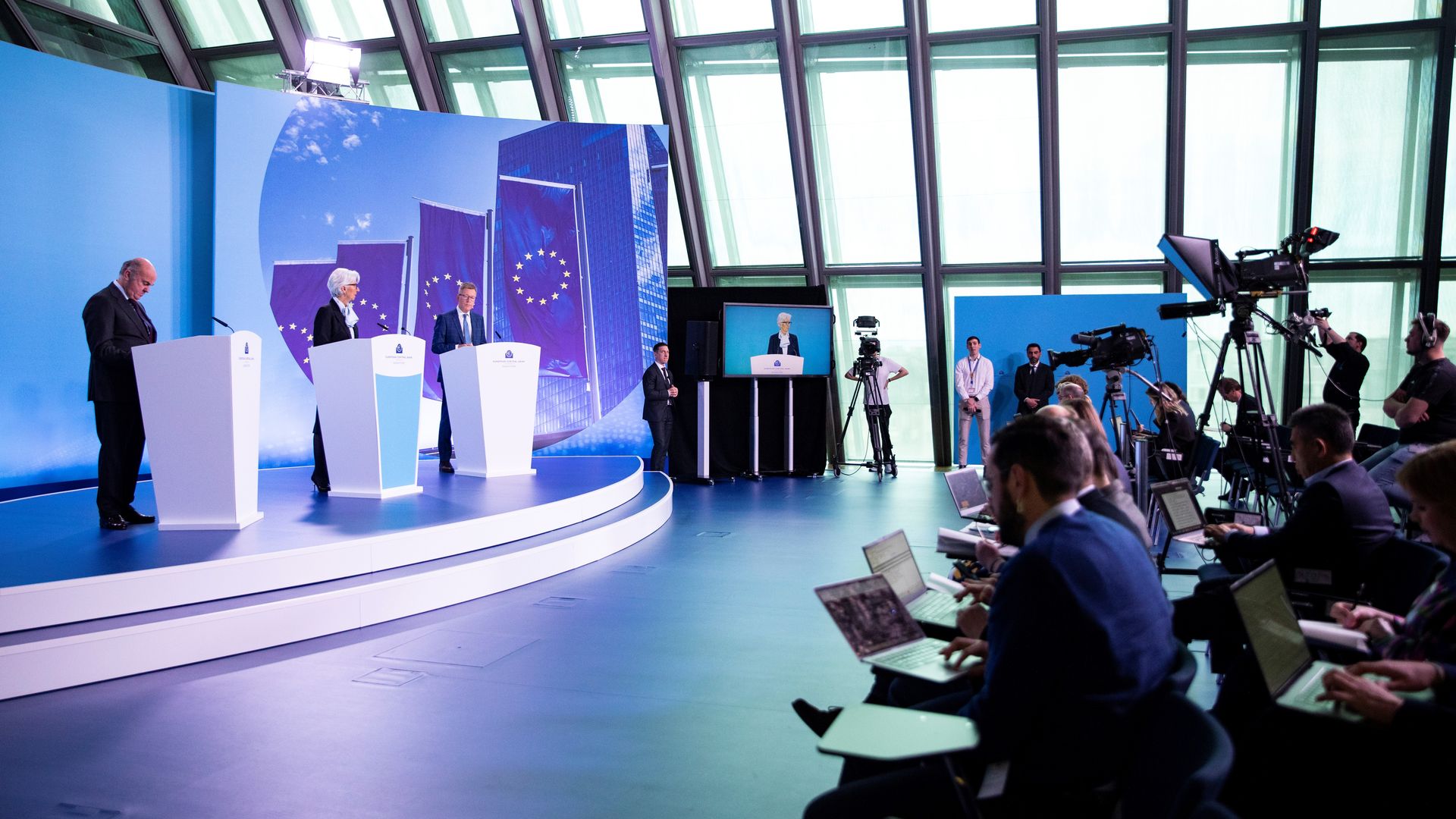
A press conference at the European Central Bank. Photo by Zhang Fan/Xinhua via Getty Images
Inflation in the countries that use the euro had a surprising uptick in May, according to new data out this morning — and that could create a dilemma for the European Central Bank as it meets next week.
Driving the news: Year-over-year inflation in the eurozone rose to 2.6% in May, from 2.4% in April. It was the first uptick this year. Core inflation, excluding food and energy, also rose to 2.9% from 2.7%.
The intrigue: The ECB has telegraphed that it will cut interest rates at a meeting next Thursday, and so the resurgence of inflation, though modest, is an unwelcome development.
- The open question is whether it will be enough to cause the central bank to reevaluate plans that have been discussed publicly for months and thoroughly priced into markets.
What they're saying: "For some reason, the ECB Governing Council ... seems already to have decided many weeks ago to deliver a June cut," wrote JPMorgan economist Greg Fuzesi in a note.
- "In our view, this goes against the data-dependent and meeting-by-meeting approach," he wrote.
- Fuzesi noted that the inflation uptick could limit ECB president Christine Lagarde's ability to signal back-to-back rate cuts are on the way.
The bottom line: The Fed may be taking its time with rate cuts, but the ECB appears set to move forward, the latest inflation numbers aside.
Sign up for Axios Macro

Stay ahead of the curve on the most important economic developments with reporting and analysis on how business, policy, and markets collide.