Axios Macro
April 21, 2025


Another day, another presidential attack on Federal Reserve chair Jerome Powell. This morning, President Trump said on Truth Social that there is "virtually No Inflation," and that the economy could slow "unless Mr. Too Late, a major loser, lowers interest rates."
- Relatedly, today we do some arithmetic on the challenges facing the Fed on both sides of its mandate from Trump's trade war.
- Plus, a look at the economic thought — and influence — of the late Pope Francis.
Today's newsletter, edited by Ben Berkowitz and copy edited by Katie Lewis, is 854 words, a 3-minute read.
1 big thing: Dual mandate dilemma
/2025/04/21/1745246269437.gif?w=3840)
With the U.S. economy shifting toward stagflation, the central question for the Federal Reserve will be which half gets worse: the stag- or the -flation.
Why it matters: The central bank faces challenges on both sides of its dual mandate — the responsibility to seek both stable prices and maximum employment.
- Fed officials say they will assess on which side of the mandate they are most coming up short.
The big picture: Most forecasters think a recessionary impulse in the economy will be powerful enough (and trade war-driven, inflation-temporary enough) that the Fed's next move will be rate cuts to support the job market — even if those cuts won't come quickly enough for Trump's taste.
- But Fed officials have avoided committing themselves to that approach, leaving open the possibility that the next move could be a rate hike to combat inflation.
- Indeed, modeling of the trade war's effects points to 2025 inflation being considerably further from the Fed's goals than the unemployment rate.
What they're saying: "We may find ourselves in the challenging scenario in which our dual-mandate goals are in tension," Powell said last week.
- "If that were to occur, we would consider how far the economy is from each goal, and the potentially different time horizons over which those respective gaps would be anticipated to close," he said.
Zoom in: Some simple math shows how those numbers may look by the end of the year.
- The unemployment rate was 4.2% last month, which is also the level that the median Fed official sees as its long-term rate. So the maximum employment mandate is, for the moment, being achieved.
- The Yale Budget Lab estimates that the tariff policies currently in place, if sustained, would raise the unemployment rate by 0.6 percentage point by year-end, which implies a 4.8% jobless rate.
- The impact on inflation would be considerably higher in the Yale group's models, fueling a 1.6 percentage point rise in the price level. That's even after adjusting for "substitution effects," in which activity shifts toward lower-tariff and domestically made goods.
The intrigue: Inflation is already running above the Fed's goals, with the Personal Consumption Expenditures Price Index up 2.5% for the 12 months ended in February.
- Even if you use a more generous baseline, assuming that in a non-trade-war world inflation would be 2% this year, tariffs are on track to push the economy further from the Fed's price stability mandate than its maximum employment mandate, at least temporarily.
Reality check: There's a lot going on aside from trade — particularly a volatile financial market environment, as well as slumping business and consumer confidence — that could change the landscape over the years ahead.
- Moreover, as Powell's quote above indicates, the Fed won't be exclusively using some mechanical analysis of how far it is from each goal, but rather will factor in how persistent those divergences are likely to be.
The bottom line: "Our modeling suggests the Fed should look through" a one-time shift in prices due to tariffs, Martha Gimbel with the Yale Budget Lab tells Axios.
- "But that doesn't account for changes in expectations or contagion from financial markets," she adds. "Expectations are the ballgame right now, and that makes it particularly important that the Fed is able to signal that it's going to keep inflation under control."
2. The economic message of Pope Francis
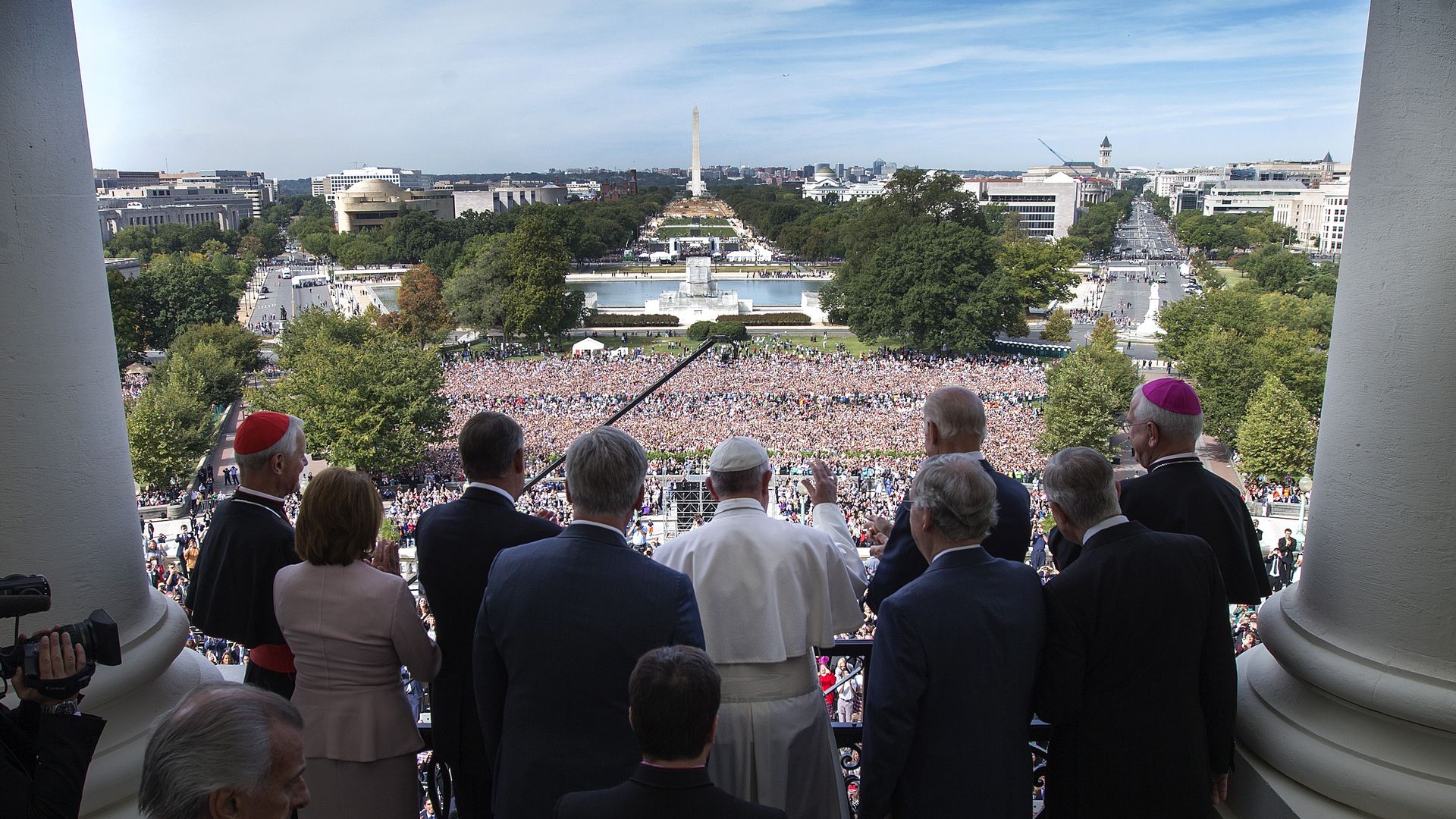
Pope Francis warned global leaders and CEOs of quick shifts in the world's economic order that could have far-reaching consequences, especially for the poorest nations.
- This message is from last year, though it has only become more relevant over time as global trade wars risk worldwide economic upheaval.
What they're saying: "For its part, the world of business and finance now operates in ever broader economic contexts, where national states have a limited capacity to govern rapid changes in international economic and financial relations," Francis said in a message for attendees of the 2024 World Economic Forum.
- "This situation requires that businesses themselves be increasingly guided not simply by the pursuit of fair profit, but also by high ethical standards, especially with regard to the less developed countries, which should not be at the mercy of abusive or usurious financial systems," he said, per posted remarks.
- The pontiff gave a full-throated endorsement of globalization, arguing it has a "fundamentally moral dimension."
The big picture: Francis' leadership was marked by a focus on global equality and inclusion, acknowledging the role that capitalism and private firms could play in worsening or supporting these aims.
- Francis granted audiences to the leaders of the world's most powerful companies, including Apple, Facebook and Big Oil firms — meetings that set him apart from predecessors.
Zoom in: Francis called out transformative technologies "conditioned by private interests and an ambition for profit at all costs" that promote fragmentations, rather than to "facilitate approaches that are more inclusive."
- "To our dismay we see technical and economic questions dominating political debate, to the detriment of genuine concern for human beings," Francis said in 2018.
Earlier this year, Francis said that while AI offers an opportunity for great progress and productivity, "human dignity must never be violated for the sake of efficiency."
Sign up for Axios Macro