Axios Macro

April 21, 2026

🏛️ Kevin Warsh's Federal Reserve chair confirmation hearing is underway, with the early innings featuring testy exchanges with Sen. Elizabeth Warren (D-Mass.) over potential conflicts of interest from Warsh's assets.
- We have some early observations below. Look for deeper coverage and analysis on Axios.com and in tomorrow's newsletter.
- But first today, we look at new research that reveals a surprising angle in America's trade deficit story.
Situational awareness: Retail sales rose a surprisingly robust 1.7% in March, driven by higher gasoline prices. But the "core" measure — excluding sales of autos, gas, building materials and food services — increased 0.7%, suggesting resilient consumer spending. 🛍️
Today's newsletter, edited by Jeffrey Cane and copy edited by Katie Lewis, is 1,042 words, a 4-minute read.
1 big thing: Trump's AI deficit


The AI buildout is the new, powerful force widening America's trade gap.
Why it matters: Shrinking the trade deficit and winning the AI race rank high on President Trump's economic agenda — but those aims are pulling in opposite directions, as AI-related products get lighter tariff treatment.
The intrigue: "[T]rade in AI-related products is a very important force behind U.S. trade over the past year," Minneapolis Fed economist Michael Waugh writes in a new paper.
- "In fact, it might be even more important than dramatic changes in U.S. trade policy in 2025."
By the numbers: The paper finds that the U.S. goods trade deficit — which hit a record high in 2025 — would have been about $200 billion smaller last year absent the AI boom.
- AI-related imports accounted for 23% of all U.S. imports last year, up from 15% in 2023. The category has grown more than 70% over that period, compared with just 3% growth for other imported goods.
Zoom in: Compute hardware — GPUs, processors, memory — accounts for roughly half of AI-related imports in Waugh's analysis.
- The other half is a broader basket of products (electrical infrastructure, networking equipment and cooling systems) that are essential to the physical data center buildout.
What they're saying: "You can see there's this tension here — we want the AI buildout, but we also want smaller trade deficits," Waugh tells Axios.
- "Maybe in the long run, this doesn't become a conflict," he adds, if domestic manufacturing of AI inputs revs up.
Waugh says the paper grew out of a question that Minneapolis Fed president Neel Kashkari kept raising internally: Why hadn't trade with Mexico fallen despite the tariffs?
- Mexico is the single largest source of AI-related imports — accounting for roughly 25% — because its role extends into electrical, cooling and networking equipment. Taiwan is the leading source of compute hardware.
- U.S.-bound goods from Mexico rose more than 6% last year, while imports from Canada fell, despite facing the same tariff treatment — a divergence largely attributed to Mexico's surging AI-related exports, Waugh finds.
Between the lines: The administration has largely shielded AI-related products from its tariff regime.
- Waugh finds that 69% of AI-related imports, by value, fall on at least one exemption list. By the end of last year, AI-related goods faced an effective tariff rate of 4.5%, compared with 12.1% for non-AI-relevant goods.
- The gap widened after the April 2025 "Liberation Day" tariff actions carved out exemptions for consumer electronics and other core AI inputs.
What to watch: The paper doesn't separate price effects from volume, meaning that the AI-related import surge may reflect, in part, higher prices.
- The AI buildout is competing with the rest of the economy for the same inputs: Cooling systems needed for data centers are the same ones going into apartment buildings and office towers.
- That demand pressure spills over into prices for everyone — a short-term inflationary force that cuts against the disinflationary wave many are betting AI will eventually deliver.
The bottom line: Whether the exemptions shielding AI-related products from tariffs persist "has important implications for the cost and pace of the AI buildout," Waugh writes.
2. Trump declines off-ramp as Warsh pledges independence
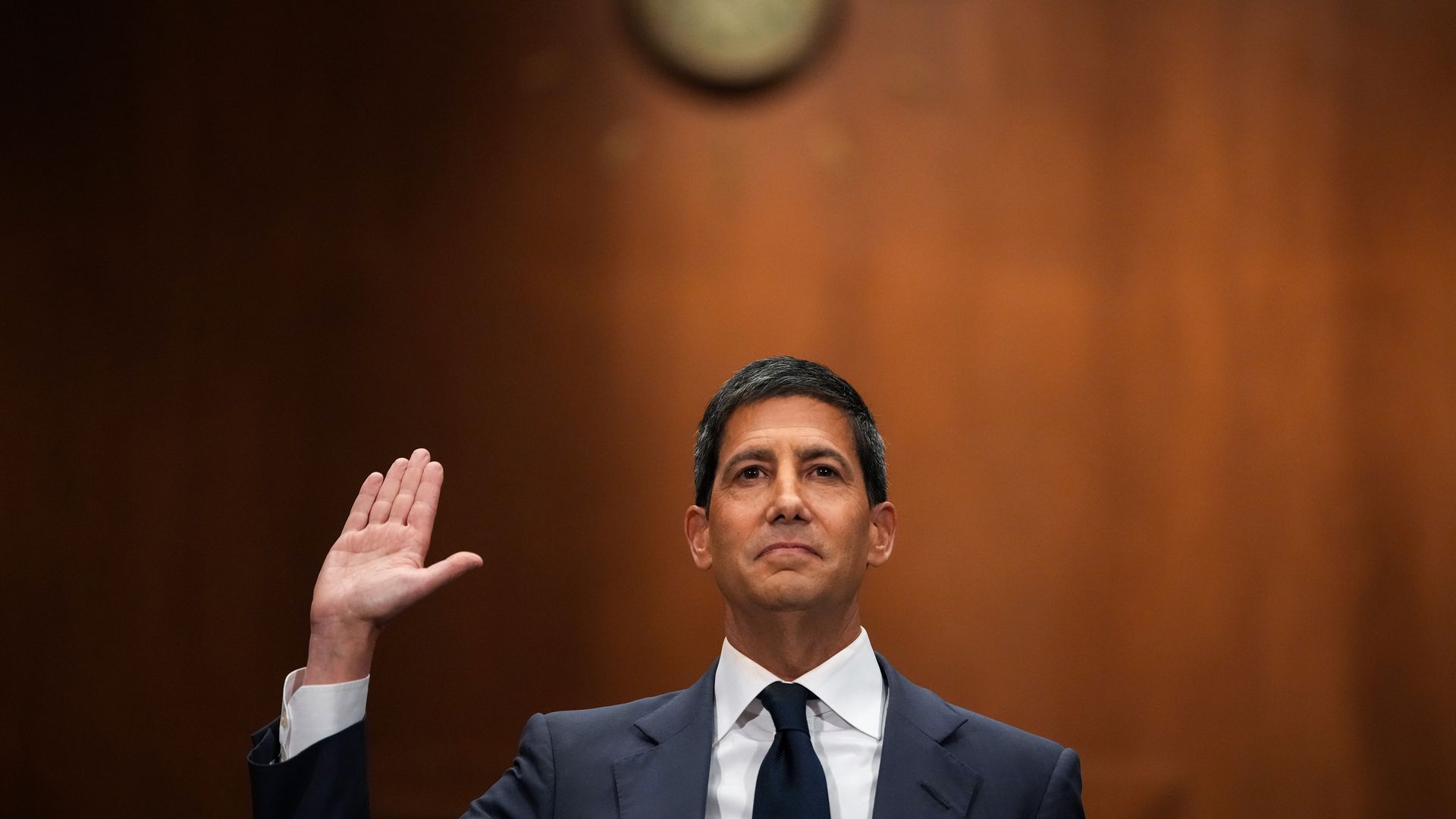
Warsh committed to keeping monetary policy independent from politics at his confirmation hearing today — as Trump showed no signs of de-escalating a stalemate that is holding up Warsh's nomination to lead the central bank.
The big picture: Warsh, testifying before the Senate Banking Committee, presented a vision of the Fed "staying in its lane" and focusing on price stability, implicitly attacking the central bank's leadership over the last decade for mission creep.
- It came just two hours after Trump, appearing on CNBC's "Squawk Box" program, indicated that he has no intention of seeking to wind down a Justice Department investigation of chair Jerome Powell over expensive building renovations.
- Sen. Thom Tillis (R-N.C.) is blocking Warsh's nomination from moving through the banking committee until that investigation, which he and Powell see as a blatant pretext to punish Powell over interest rate policy, is resolved.
- Powell's term as chair is up on May 15. He has said he will continue serving as chairman pro tempore if his successor is not yet confirmed.
Driving the news: Asked whether he would take an off-ramp to get Warsh's nomination on track, Trump said that "we have to find out why a small building cost close to $4 billion," before discussing the Fed building's sheetrock walls and insulation.
- "I'm afraid Kevin will have to have an office next to me in the White House, because that building's not going to be done."
State of play: Warsh said in his opening statement that he does "not believe the operational independence of monetary policy is particularly threatened when elected officials" state their views on rates policy.
- He also emphasized that it is monetary policy where independence is "at its peak."
- By contrast, that degree of independence "does not extend to the full range of its congressionally mandated functions," like bank regulation, he added.
- "I believe that monetary policy independence is earned — and better policy decisions crafted — by steering clear of distractions."
Of note: Warsh appears set to face united disapproval from the panel's Democrats, who objected to proceeding with this hearing amid the president's attacks on Powell and what they describe as Warsh's incomplete financial disclosures.
- Warren, the Massachusetts Democrat, called Warsh "uniquely ill-suited" for the Fed chairmanship, citing his long ties to Wall Street.
- Warsh has said he will sell his stakes in dozens of private companies listed in his financial disclosure before taking office, but would not specify to whom they will be sold.
Sign up for Axios Macro