Axios Macro
December 04, 2025


Smaller businesses are finding it most difficult to cope with a volatile economic backdrop — and data shows they're shedding jobs as a result. More below.
- Plus, the latest on potential next Federal Reserve chair Kevin Hassett.
Situational awareness: There were only 191,000 new claims for jobless benefits last week, the lowest since September 2022.
🌉 Tune in here today at 2pm PT/5pm ET to Axios' AI+ Summit happening live from San Francisco, featuring Google DeepMind co-founder and CEO Demis Hassabis and more.
Today's newsletter, edited by Ben Berkowitz and copy edited by Katie Lewis, is 963 words, a 3.5-minute read.
1 big thing: Why Main Street's pain matters

The economic fortunes of mom-and-pop businesses are diverging from those of their larger counterparts — a pre-existing gap that now appears to be getting bigger, faster.
Why it matters: The evidence is in the private-sector labor market, that in recent months, has been propped up by large companies as smaller firms — typically responsible for 40% of U.S. employment — shed workers.
The big picture: Larger businesses have been able to adapt to a tough economic backdrop — historic tariffs, high interest rates and a more cautious consumer — in ways far more challenging for small companies with fewer resources.
- "It's evident that medium and large firms are better positioned to weather what's going on," said ADP chief economist Nela Richardson.
- "They can set prices, they can change suppliers. They can hire contractors instead of permanent employees in a more sophisticated way. They can hire globally, not just in their local region. They have more tools in the toolbox," Richardson said.
By the numbers: The hiring gap between small and big businesses is getting worse, a fresh sign that small business firings are holding down jobs growth across the economy.
- As we mentioned yesterday, the private sector shed 32,000 jobs in November, according to payroll processor ADP. Small firms — those with fewer than 50 employees — accounted for all of the losses.
- Those businesses reported a net loss of 120,000 jobs, the most small businesses have cut since the pandemic's onset. Larger businesses grew, but not enough to offset the cuts elsewhere.
"Small business hiring really started to slow in April and I attribute some of this to tariffs and the higher cost of doing business that small companies are much less able to absorb," Peter Boockvar, chief investment officer at One Point BFG Wealth Partners, wrote in a note.
- "The natural reaction is to cut costs elsewhere and we know that labor is their biggest cost," Boockvar added.
The intrigue: Bloomberg recently reported that there are more small businesses filing for bankruptcy under a special federal program this year than at any point in the program's six-year history.
- Subchapter V filings, which allow firms to shed debt faster and cheaper, are up 8% from last year, according to data from Epiq Bankruptcy Analytics.
- Chapter 11 filings — a process used by larger businesses — are up roughly 1% over the same time frame.
Threat level: Main Street is bearing the brunt of an economic slowdown in ways that might make it even harder for small shops to compete with larger companies.
- One bright spot: Despite that pain, applications to start new businesses — ones likely to employ other people — remain notably higher than in pre-pandemic times, according to the latest data available from the Census Bureau.
What to watch: The Trump administration shrugged off the ADP data that indicated a hiring bust. Commerce Secretary Howard Lutnick told CNBC that the cuts were due to factors unrelated to tariffs, like immigration crackdowns.
- That hints at a debate among monetary policymakers, who are trying to gauge how much weak jobs growth is a byproduct of fewer available workers.
- But ADP had earlier told reporters that small businesses generally had less demand for workers — not that staff weren't available for hire.
2. Fed sweepstakes intrigue
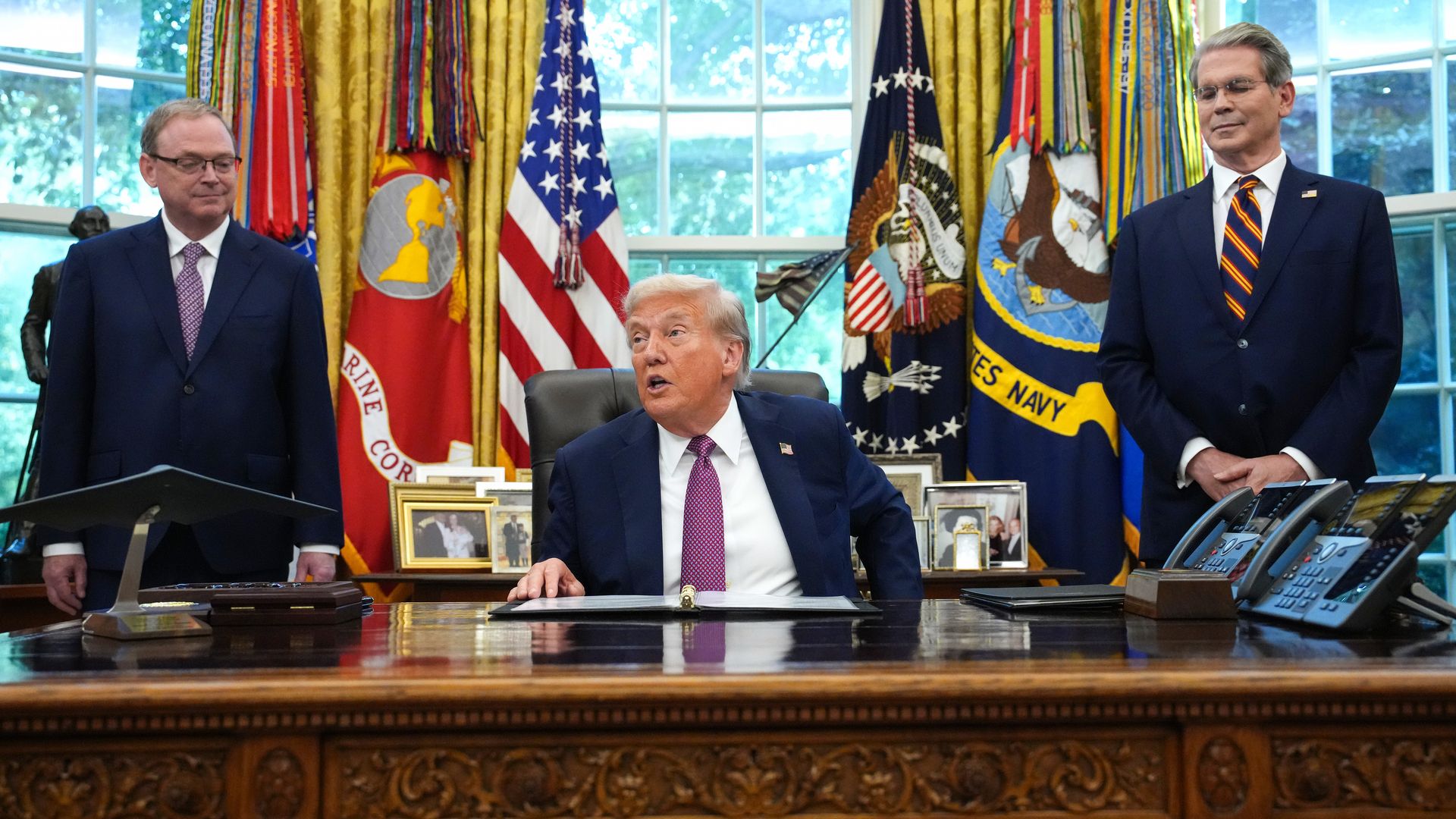
President Trump's remarks this week have done nothing to tamp down expectations that Hassett, currently his top White House economic adviser, will be named to lead the Fed when Jerome Powell's term as chair is up in May.
- But there is intrigue around the personnel dominoes that may fall as a result.
Driving the news: Bloomberg reported last night that Treasury Secretary Scott Bessent may take over as director of the White House National Economic Council if Hassett moves to the Fed, holding both jobs simultaneously.
Between the lines: We've heard speculation from administration allies about this possibility for months, and it certainly is consistent with Trump's past affinity for giving officials he trusts multiple important jobs at once.
- Bessent would essentially be pulling a Rubio in this scenario — emulating Secretary of State Marco Rubio, who is also serving as national security adviser (as well as acting archivist of the United States).
- The NEC job historically drives the economic policymaking process across the administration, while the Treasury secretary has an important but more defined remit.
- It would likely make Bessent the most powerful Treasury secretary of modern times (other contenders: Hank Paulson in 2008 and Bob Rubin in 1998).
Of note: There is some pushback to Hassett as Fed chief, including a report from the Financial Times yesterday that the Treasury has received feedback from leading investors in U.S. Treasury securities "worrying he will cut interest rates aggressively to please" Trump.
Reality check: There has been no surge in bond yields or market-priced inflation measures in the days since a Hassett nomination has looked more likely that would cause major alarm at the White House.
- Since Hassett's odds of getting the job spiked on prediction markets on Nov. 25, the 10-year Treasury yield has risen by 0.09 percentage points, remaining well within its recent trading range.
- Traders on the betting site Kalshi put 72% odds on Hassett being nominated as Fed chair this morning, a bit below yesterday's 81% but far above November levels.
Sign up for Axios Macro