
Axios Macro

December 03, 2025

Black Friday is on the books, and early evidence about how the American consumer is holding up is ... murky. Our editor, Ben Berkowitz, analyzes the numbers and anecdata below. 🎁
- Plus, some worrying new data about private-sector hiring.
Situational awareness: Treasury Secretary Scott Bessent said at the DealBook Summit that he will "start advocating, going forward, not retroactively, that regional Federal Reserve presidents must have lived in their district for at least three years."
- He criticized the banks for conducting national searches for their top leaders, which have resulted in hires like former Goldman Sachs executive Beth Hammack to the Cleveland Fed and former New York Fed official Lorie Logan to Dallas.
Today's newsletter, edited by Jeffrey Cane and copy edited by Katie Lewis, is 913 words, a 3.5-minute read.
1 big thing: The holiday shopping squeeze
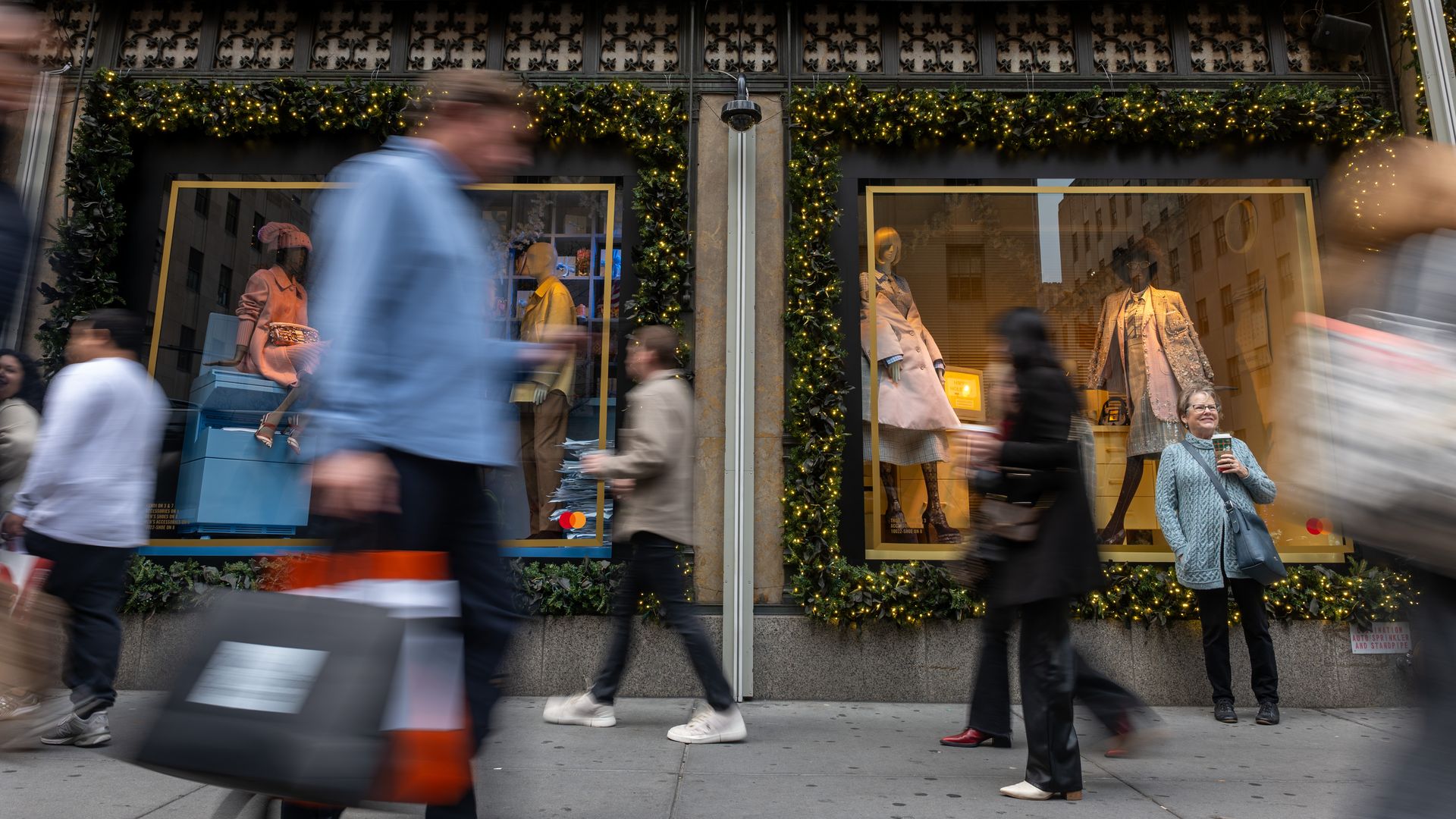
Early holiday retail data looks a lot like the rest of the economy: fine on the surface, with potentially dangerous cracks underneath.
Why it matters: The consumer is the engine of the U.S. economy — an engine many fear will start to sputter amid tariff pressure, a weak labor market and tariff-driven price increases.
The big picture: Early numbers on Black Friday and Cyber Monday look basically fine.
- All-in Black Friday sales excluding autos rose 4.1% this year, per Mastercard SpendingPulse, which measures sales in stores and online, across payment methods (but does not adjust for inflation).
- Bank of America clocked credit card spending for the week ending Nov. 29 as up 0.2% from a year earlier, with spending growth for holiday items better at 2.6%.
- Cyber Monday sales rose about 7% to a new record, Adobe Analytics said.
- The National Retail Federation continues to expect that this will be the first $1 trillion holiday shopping season.
Yes, but: The question is what shoppers are buying, and how.
- Walmart CFO John David Rainey, speaking yesterday at a Morgan Stanley conference, said the disparity in wage growth among low-, middle- and high-income consumers was as big as the retailer has seen in the last decade, and widening.
- "We see that wallets have been stretched and more money is being spent on necessities versus ... discretionary items," he said.
Comments from vendors back up Walmart's assessment of a stretched consumer, especially at the low end.
- Procter & Gamble CFO Andre Schulten, speaking at the same Morgan Stanley event, said the diapers-to-detergent conglomerate saw broad U.S. market weakness in October and November, albeit within the range of the company's estimates.
Zoom in: Placer.ai, which measures foot traffic at physical stores, noted strong visits this season for retailers pushing smaller items under $100.
- "Black Friday 2025 continued the bifurcation trend we've observed over the past several months. Affluent consumers drove visits to luxury categories, while lower- and middle-income consumers sought out deals to stretch their household budgets," Placer.ai's head of analytical research, R.J. Hottovy, said in a note Tuesday.
- Macy's raised its full-year outlook today, but even so, CEO Tony Spring told CNBC that the retailer still doesn't know if "aspirational customers" are going to turn out this season or not, due to stretched finances.
The other side: For all the nerves about whether consumers are spending, some say they're just fine and the course is steady.
- "Interestingly, there's sort of a divergence, I think, between the soft and the hard data," Mastercard chief services officer Craig Vosburg said at a UBS conference Tuesday.
- "We all read the headlines and some of the survey results around consumer sentiment seem increasingly gloomy. But what we see in the hard data continues to be very supportive of consistent spend metrics."
What to watch: With the key Black Friday-to-Cyber Monday period over, the question now becomes whether the consumer is done shopping for the season, or if there's a little more cash left in the wallet.
- "[W]ith so much uncertainty about how the consumer is going to respond to the pressures facing them, it's worth squinting hard at the incremental data this holiday season," Unlimited Funds CEO Bob Elliott wrote Monday.
2. Labor market doldrums


The October hiring rebound now looks like a blip: The private sector resumed shedding jobs in November, according to payroll processor ADP.
Why it matters: In the absence of an official government jobs report this week, the ADP data is the best snapshot of how the labor market performed in November.
Zoom in: ADP says the private sector shed 32,000 jobs last month, with a broad-based slowdown across a slew of industries.
- The data shows that small businesses continue to be the center of job cuts, a dynamic our colleague Emily Peck told you about last month.
- Small firms — those with fewer than 50 employees — accounted for the entirety of job losses.
- They reported a net loss of 120,000 jobs, the most small businesses have cut since May 2020, according to analysis of the data by LPL Financial.
What they're saying: "Save small establishments ... there would have been a net increase in hiring," ADP chief economist Nela Richardson told reporters this morning.
- "It is those Mom and Pop, Main Street firms that are really weathering what is an uncertain macro environment and a cautious consumer," Richardson said.
- Midsize firms, with fewer than 500 employees, reported a net increase of 51,000 workers, while the largest companies added 39,000 jobs.
The bottom line: This is among the few major labor market data points the Fed will have in hand before deciding whether to cut interest rates again next week.
- The November jobs report will be released Dec. 16, following a government shutdown-related delay.
Sign up for Axios Macro