Axios Macro

April 01, 2024

Today, we take a look at what's at stake for the economy and the Federal Reserve in the months ahead — and how much has changed from the end of 2023.
- Plus, it's still early—but the manufacturing downturn might just be over.
Today's newsletter, edited by Kate Marino and copy edited by Katie Lewis, is 658 words, a 2½-minute read.
1 big thing: How the economic narrative has shifted

Illustration: Aïda Amer/Axios
At the end of 2023, much of the economic data suggested optimal conditions for the Fed to slash rates. Now, just three months later, that narrative has been muddied.
Why it matters: As the new quarter begins, the huge question is whether progress on inflation will continue as it did in the back half of last year — or whether still-rapid price gains will be harder to stamp out.
- While top policymakers say they want to head back toward normalized interest rates, it now appears they are in no rush to start that process, thanks to a resilient economy.
What they're saying: "Now the economy is strong, we see very strong growth," Fed chair Jerome Powell said in San Francisco last week.
- "That means that we don't need to be in a hurry to cut. It means we can wait and become more confident that in fact, inflation is coming down to 2% on a sustainable basis," Powell added.
- That echoed what governor Christopher Waller said days prior, in a speech appropriately titled "There's Still No Rush."
Where it stands: Key indicators show how the ground shifted in the first three months of 2024.
- In December, core PCE inflation — as measured by the Fed's preferred gauge — was running at a 1.6% annualized rate over the previous three months, stunningly below the central bank's 2% target.
- We don't have data for March yet, but as of February, core inflation was running at a three-month annualized 3.5%.
At the end of the year, financial markets expected the Fed to announce its first rate cut in early 2024 — until Powell said bluntly in January that that was unlikely.
- In its latest collection of projections, the Fed said it still expects three cuts this year. But fewer officials backed that projection in March than after the meeting in December.
- The timeline for the first rate cut has shifted to the current quarter, with a 56% chance that the Fed will slash rates at its June meeting, according to the CME FedWatch tool.
- The possibility of rate cuts — at least at some point — has helped fuel an aggressive rally in equity prices. The stock market is up more than 10% so far this year, topping the record levels last seen in 2022.
The intrigue: One indicator that has not budged much: the unemployment rate. In February, that rate was 3.9% — just 0.2 percentage points above its December level, an uptick that came as more workers joined the labor market.
- Job gains under the surface, however, have steadied. What appeared to be a hot hiring boom with strong wage gains at the start of the year was revised away, leaving a still healthy — but cooler — job environment.
- March figures due Friday are expected to show a gain of 200,000 jobs, while the unemployment rate is projected to tick down to 3.8%.
2. Manufacturing rebound
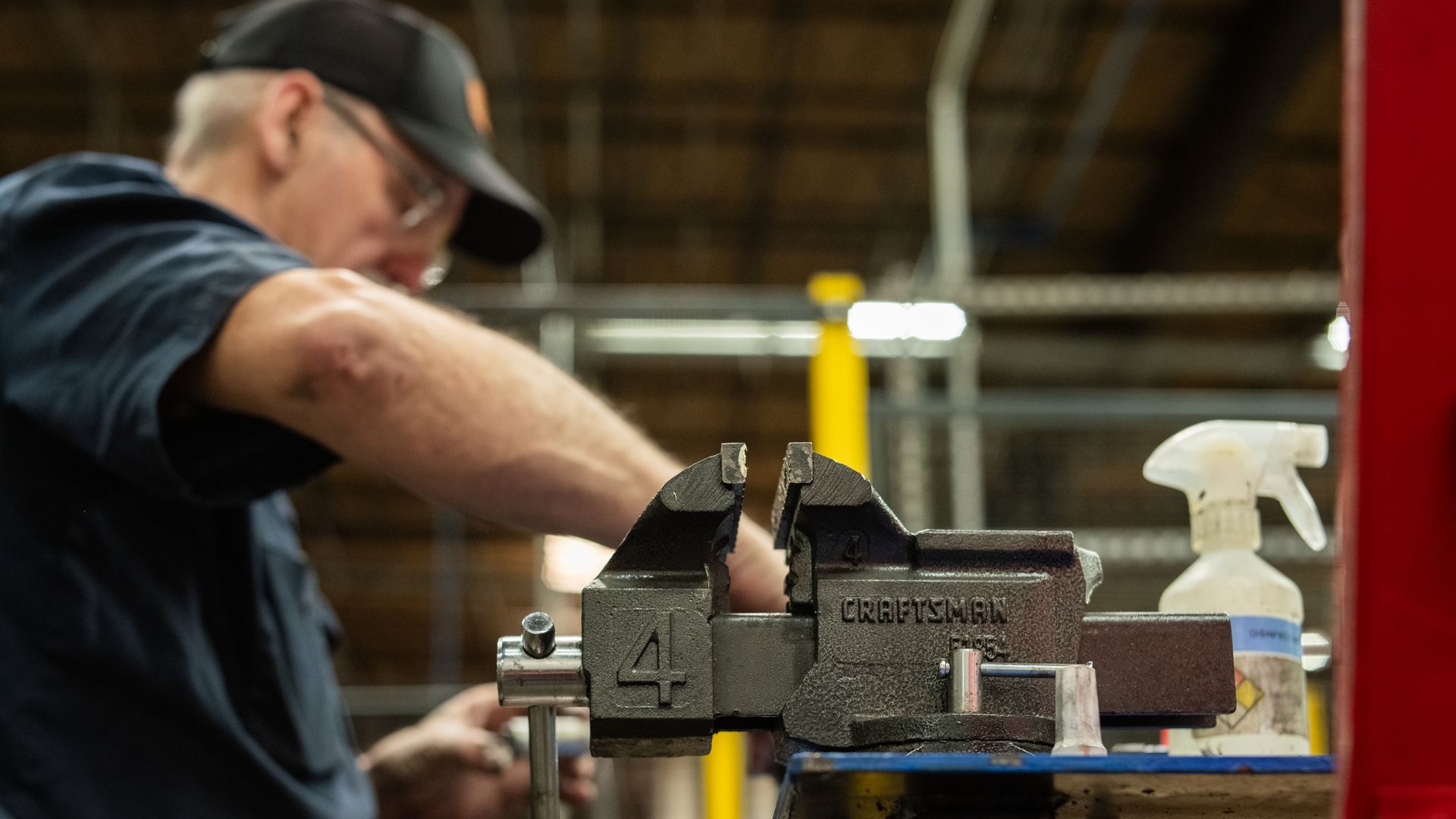
An employee at a factory in Baltimore last month. Photo: Andrew Magnum/Bloomberg via Getty Images
For the first time in more than a year, the U.S. manufacturing sector is back in expansionary mode, according to a closely watched survey conducted by the Institute for Supply Management.
Why it matters: While the overall economy has stayed healthy, manufacturers have been signaling a slump since September 2022. The new data shows demand might be bouncing back. If it continues, the manufacturing recession might be over.
- "Demand remains at the early stages of recovery, with clear signs of improving conditions," Tim Fiore, ISM survey chair, said in a release this morning.
By the numbers: The ISM manufacturing index rose to 50.3% in March, slightly above the 50% level indicating expansion. That's up 2.5 percentage points from February.
- The boost in March was helped by stronger new order figures and stronger output.
The bottom line: "If the manufacturing sector is pulling out of its modest contraction, this would have important repercussions for the outlook for the economy in 2024 and the likelihood of a broader recession," economists at Brean Capital wrote in a note.
Sign up for Axios Macro

Stay ahead of the curve on the most important economic developments with reporting and analysis on how business, policy, and markets collide.