Axios Macro

July 22, 2026

With the Federal Reserve's policy meeting on tap next week, we look today at how the central bank's evolving approach to communications has made markets more reliant on officials who don't occupy the big chair.
- More below, plus what the yen's plunge says about the global economy. 🇯🇵
Today's newsletter, edited by Jeffrey Cane and copy edited by Katie Lewis, is 944 words, a 3.5-minute read.
1 big thing: The trade-offs of a quieter Fed chief
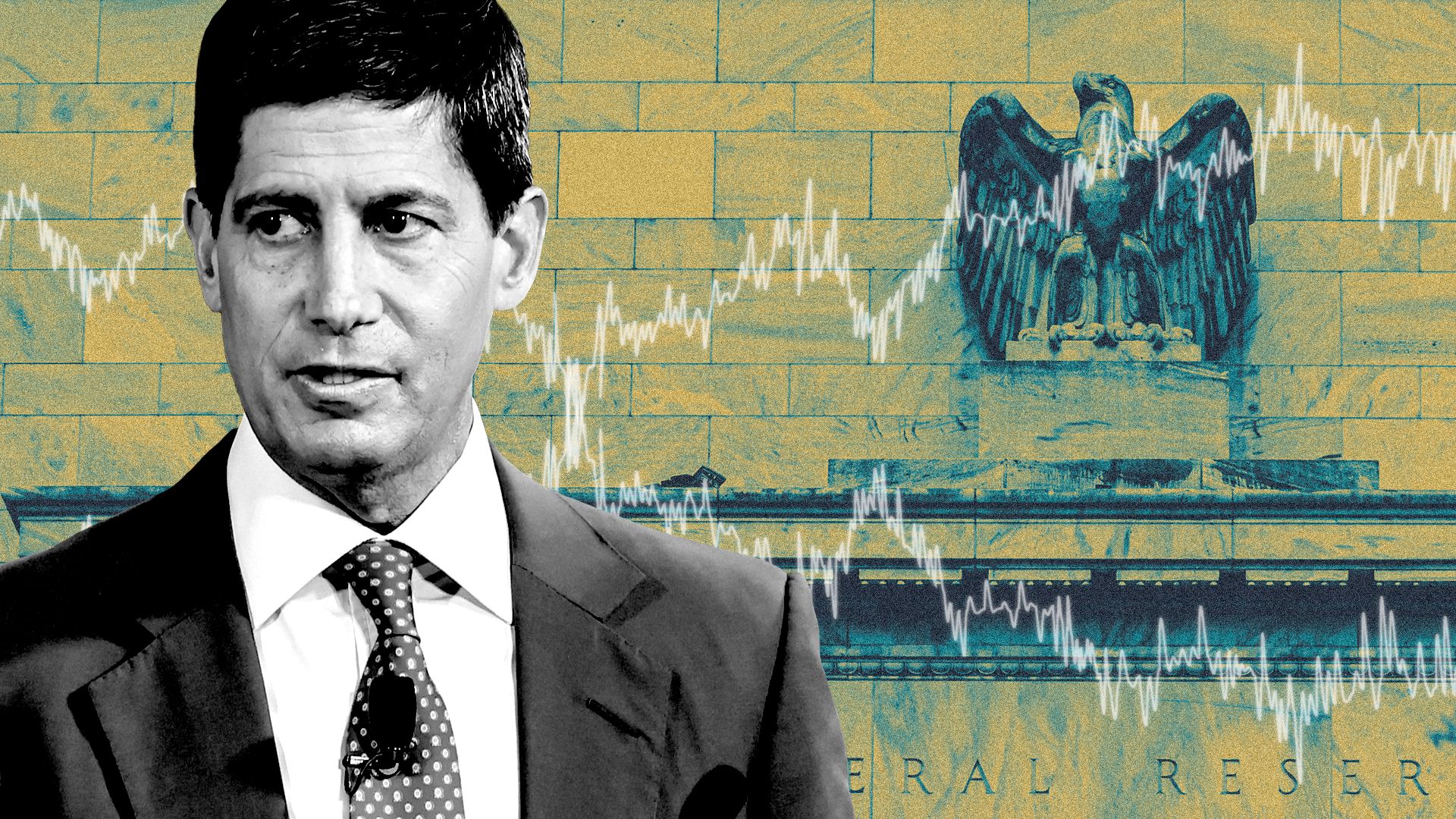
Fed chairman Kevin Warsh testified before Congress over two days last week, totaling more than five hours. Yet it was comments from several of his colleagues that gave the clearest picture of what the central bank is likely to do next week.
Why it matters: It is a central paradox of Warsh's communications strategy. He is determined to get out of the business of giving markets and the public much guidance on future policy, which means the markets fill in the gaps based on comments from other officials.
- That isn't necessarily a bad thing — it preserves flexibility on interest rate policy that was diminished when former Fed chiefs all but preannounced upcoming rate moves.
- But it also means that Warsh has ceded some of the power to set expectations, which raises the risk of more surprise and volatility around future actions.
State of play: The central bank's policy committee meets next week, and Warsh declined to offer much in the way of guidance on what it will do, instead promising a "family fight" that seeks to arrive at the best decision.
- Other officials were a little more specific. Fed governor Christopher Waller, speaking on July 13, said that incoming June inflation data could tilt him toward favoring a near-term rate hike. That inflation data was soft, implying that he will be patient.
- Governor Lisa Cook, speaking two days later, said, "If we do not see signs of disinflation soon, I am prepared to act," suggesting that she is happy to leave rates steady for now, but is on a short fuse for favoring rate hikes.
Zoom in: Most notably, vice chair Philip Jefferson said on Thursday that "in a scenario where actual inflation does not start to cool down soon, I believe that it could be appropriate to reconsider our current policy stance to ensure we fulfill our commitment to deliver price stability."
- With no major inflation data due between Jefferson's speech and the July policy meeting, that implies no rate adjustment on July 29 but a high alert to change course if inflation numbers for July and August come in hot.
- The message carries particular weight coming from the Fed's No. 2 official, although the contours of his role in the Warsh Fed are still coming into focus.
Of note: We also got some visibility into potential dissents from a no-rate-change decision.
- Dallas Fed president Lorie Logan said she favored "modestly higher" rates.
- And coming in with a LinkedIn post on the final day before the Fed entered its customary blackout period before a meeting, Cleveland Fed president Beth Hammack said that her business contacts are pointing to "broad-based" inflation. (She also said she'll go into the meeting with an open mind.)
Between the lines: It takes no great cleverness to map all those comments onto a probable outcome next week — no interest rate change, a couple of dissents and communications that inflation needs to come down to prevent a rate hike later in the year.
- But Warsh's restraint in sharing his own views means one should hold that expectation with a good bit less conviction than if he had sounded more like Jefferson.
The bottom line: That's the inherent trade-off that Warsh's communication strategy entails. He retains more policy flexibility, but at the cost of ceding some of the Fed narrative to others.
Editor's note: This story has been corrected to reflect that Fed governor Christopher Waller said on July 13 that inflation data could tilt him toward favoring a near-term rate hike (not a rate cut).
2. Yen trouble
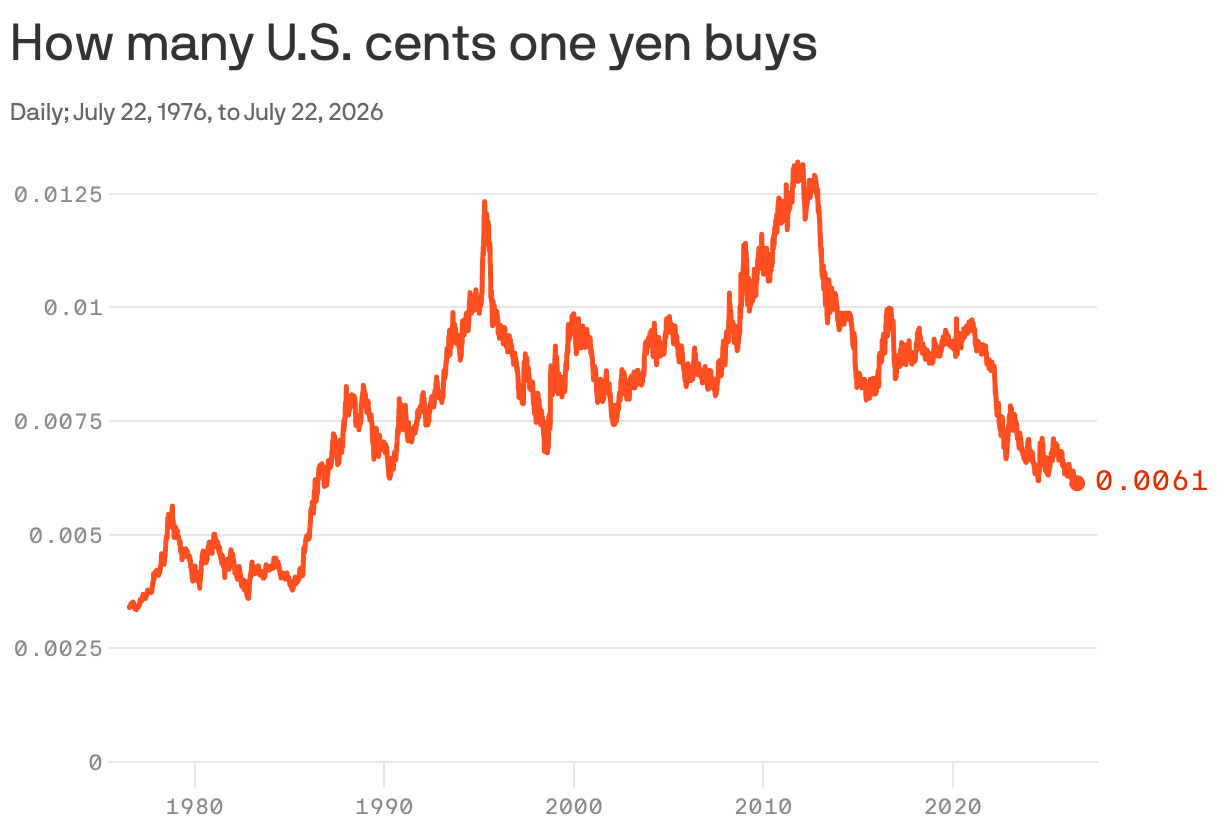
Look out below: The yen is hovering near its weakest level in almost 40 years, reflecting an increasingly lopsided global economy, where capital keeps flowing to the U.S.
Why it matters: The yen is being squeezed by both long-term and short-term forces.
- Higher interest rates in the U.S. (which might go higher, as we write above) continue to draw investors to dollar-denominated assets, while Japan remains stuck with relatively low borrowing costs.
- The Iran war has pushed up oil prices, a blow to an energy-importing economy like Japan that adds to the downward pressure on the currency.
What they're saying: "Rising oil prices, the prospect of U.S. rate hikes and stimulatory fiscal and monetary policy conditions in Japan [are] fueling the trend — one that's unlikely to end without a material course correction from Japanese authorities," Kyle Rodda, a market analyst at Capital.com, wrote in a note this morning.
The intrigue: Japanese officials have said they are prepared to support the currency, as they did earlier this year.
- But intervention has provided only temporary relief because it doesn't address the underlying driver: the wide gap in interest rates between Japan and the U.S.
What to watch: The Bank of Japan, which will announce a policy decision next week, can't easily solve the problem.
- The central bank is reportedly willing to raise rates more quickly than economists expect, with the decline in the yen adding to inflationary pressures, Bloomberg reported this morning.
- The risk is that higher rates could choke off a still-fragile economy and increase borrowing costs for one of the world's most indebted governments.
The bottom line: It has been more than 40 years since dollar-yen tensions became so politically fraught that they culminated in the Plaza Accord.
- Today's pressures are different, though the yen's slide is a reminder that widening global imbalances have a way of forcing policymakers' hands.
- There is a bonus, however: Your dollars currently go a lot further in Tokyo.
Sign up for Axios Macro