Axios Macro

June 13, 2024
Another day, another good reading on May inflation. We dissect the Producer Price Index below.
- But first, we look at why you shouldn't read too much into yesterday's shift in Federal Reserve officials' projections for interest rates. 🧐
Situational awareness: New unemployment filings rose by 13,000 to 242,000 last week, the Labor Department said — the highest level since last summer. The increase, led by a big pickup in California filings, might be a sign the labor market is losing steam.
Today's newsletter, edited by Kate Marino and copy edited by Katie Lewis, is 721 words, a 3-minute read.
1 big thing: The less-than-meets the eye change in Fed forecasts
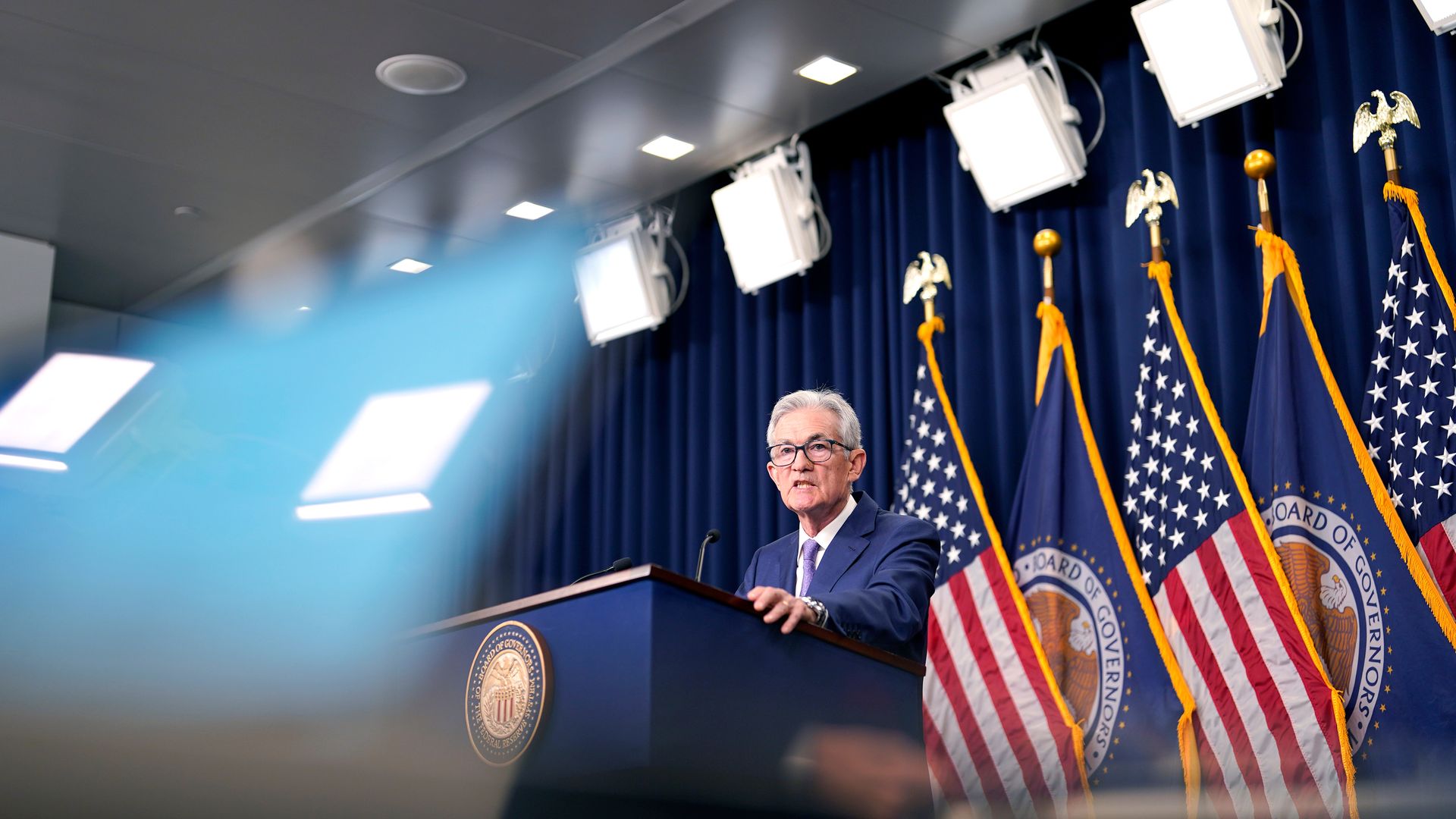
Fed chair Jerome Powell at Wednesday's news conference. Photo: Al Drago/Bloomberg via Getty Images
The big headline out of yesterday's Fed meeting was that the median top official of the central bank now anticipates only one interest rate cut this year, down from three in March. But it's not the hawkish turn it might seem at first glance.
Why it matters: The forecasts released yesterday are not so much a rejection of cutting rates twice this year as an indication that a potential second rate cut is a razor's edge possibility, and policymakers will be tilted one way or the other by how inflation and other data evolve in the coming months.
- As Evercore ISI's Krishna Guha and Marco Casiraghi put it in a note, it may be better to think of the Fed's communications yesterday as a signal that policymakers envision 1.5 rate cuts this year — which is to say one quite likely and the other more of a coin flip.
State of play: The Fed is a consensus-driven organization and unlikely to make a major policy pivot amid substantial dissent within the committee. In the absence of wide consensus making a move toward cheaper rates, there will probably be no change.
- But these forecasts are fluid and subject to change as quickly as incoming data does — as revealed by the fact that the median expectation for where interest rates end the year shifted by half a percent from March to June.
Zoom in: Of 19 top officials who submitted projections for how they expect rates to evolve, four saw no rate cut at all being justified. Seven see one rate cut, and eight anticipate two.
- In his news conference, chair Jerome Powell emphasized the narrow difference between those groups.
- He said that as he canvassed the officials to understand their views, "in many cases, they're thinking ... you know, I can't really distinguish between two of these. They're so close for me, these are very close calls."
- "But what everyone agrees on is it's going to be data-dependent. No one, no one brings to this or takes away from it, those on the committee, a really strong commitment to a particular rate path."
Between the lines: In assessing whether there will be a rate cut in September and another before year-end, pay extra attention to speeches from governor Chris Waller in the coming months.
- He has been an influential voice on monetary policy for years now, and has been a notch more skeptical of cutting interest rates than Powell.
- Powell may be able to live with dissent from community banking-focused governor Michelle Bowman or one of the hawkish presidents of regional reserve banks. But he'd be highly reluctant to power through a policy pivot over the objections of the most seasoned monetary economist on the Board of Governors.
2. More good news on inflation


Last month is shaping up to be an encouraging one for inflation trends. After yesterday's better-than-expected Consumer Price Index report, wholesale prices unexpectedly dropped in May.
Why it matters: Wholesalers' lower costs might get passed along to shoppers. The data adds to evidence that inflation might truly be downshifting.
What they're saying: "Inflation data this week, though only one month of data, could be more indicative of a steady march to the Fed's target," NerdWallet senior economist Elizabeth Renter wrote in a note today.
By the numbers: The Producer Price Index fell 0.2% in May, slowing from the 0.5% increase the prior month.
- Over the last 12 months ending in May, PPI rose 2.2% — a slight dip from April. That's well below the 11% peak hit two years ago, though this measure was as low as 0.3% last summer.
The monthly decline was largely due to plummeting goods prices that fell 0.8% — the largest drop since October 2023. Gasoline prices dropped more than 7% last month, while food prices also edged lower.
- Prices for services were unchanged after surging 0.6% in April. Margins for fuel and lubricant retailers jumped 12%. Among the indexes that declined: airline passenger services and portfolio management.
The bottom line: Some of the underlying details in the PPI report are used to calculate the Fed's go-to measure of inflation, the Personal Consumption Expenditures Price Index, which will be released later this month.
- Based on today's report — and CPI yesterday — core PCE might increase just 0.2% in May, according to calculations by Bank of America economists.
Sign up for Axios Macro

Stay ahead of the curve on the most important economic developments with reporting and analysis on how business, policy, and markets collide.